
 Pipeline & Proposals
 Project Management
 Resource Planning
 Time & Costs
 WIP & Invoicing
 Commercial Reporting
 Consulting Engineers
 Architects
 Town Planners
 Building Designers
Total Synergy Alternative for Engineers & Architects (2026)

Ben Walker
Written for Drum

In This Article
If you’re looking for a Total Synergy alternative, chances are the product hasn’t quite delivered on its promise. Total Synergy markets itself as an all-in-one platform for architecture, engineering, and construction firms. And on paper, the feature list is impressive. But there’s a recurring theme across user reviews on Capterra and G2: the system is powerful, but painfully complex. As one reviewer put it, it has a “huge learning curve and incredibly complex system which took a long time to get the hang of, even for a smaller business.”
That complexity has real costs. And for many Australian engineering and architecture firms, it’s enough to start exploring what else is out there. So if you’re a 10 to 50 person consultancy weighing up the switch, here’s what to look for in a replacement, and how the leading Total Synergy alternative stacks up.
The Total Synergy Problem Nobody Talks About
Total Synergy has been around for years and recently secured growth investment from M33 Growth and PSG to scale further. The product covers a wide range of ground: project management, time tracking, invoicing, resource planning, and document management. It doesn’t publish its pricing, though (our Total Synergy pricing guide pulls together what is known). The plans page lists two tiers, Business and Enterprise, and points you to a quote rather than a number, with critical features like CRM, HR, and advanced reporting sold as separate add-ons.
That add-on model is where frustration builds. The base product handles basic project tracking and timesheets. But the moment you need CRM capabilities (Synergy CRM add-on), staff leave management (Synergy HR add-on), better reporting (Analytics Plus add-on), or document control (Synergy PIM add-on), the per-seat cost climbs well beyond the base subscription. A 20-person engineering firm that needs three of those add-ons is paying a meaningful premium for what competitors include as standard, and because the pricing isn’t public, it’s hard to know what you’ll actually pay until you’re deep in a sales conversation.
Then there’s the complexity tax. Users consistently report that reports are “fiddly” and “not user friendly.” MYOB integration can be unreliable. And version upgrades have been known to break existing customisations and workflows. For a 15-person engineering practice without a dedicated IT person, that’s not a minor inconvenience. It means calling support, rebuilding configurations, and losing productive hours that should be spent on billable work.
The underlying issue is that Total Synergy was built to be configurable enough for large enterprise practices, and that flexibility comes at the expense of simplicity for the mid-market firms that make up most of the Australian consulting engineering and architecture landscape.
What a Total Synergy Alternative Should Actually Deliver
Before jumping to another platform, it’s worth clarifying what matters. The firms we talk to who are leaving Total Synergy tend to share three priorities.
First, they want fewer systems, not more features stuffed behind paywalls. A proper PSA platform should cover the full lifecycle without nickel-and-diming you for essentials like CRM or reporting. Your sales pipeline, proposals, projects, timesheets, and invoices should live in one place and talk to each other natively. When a fee proposal gets accepted, the project budget should carry across automatically. When time gets logged, your financial dashboards should update in real time.
Second, they want software their team will actually use. This might sound obvious, but it’s the issue that sinks most platform migrations. If your new system takes months to learn, your team will resist it. Timesheets will be late or incomplete. Project data will be unreliable. The system becomes another administrative burden rather than the thing that removes administrative burdens. The right time tracking tool gets filled in without reminders because it takes 30 seconds, not 5 minutes.
Third, they want visibility without effort. The best operational insights shouldn’t require someone to spend half a day pulling custom reports. Budget burn, staff utilisation, project profitability, and revenue forecasting should be visible in real time, updating automatically as your team logs time and records expenses. A 2023 SPI Research benchmark found that high-performing professional service firms track project margins in real time, not monthly. That kind of cadence is only possible when your software surfaces insights passively.
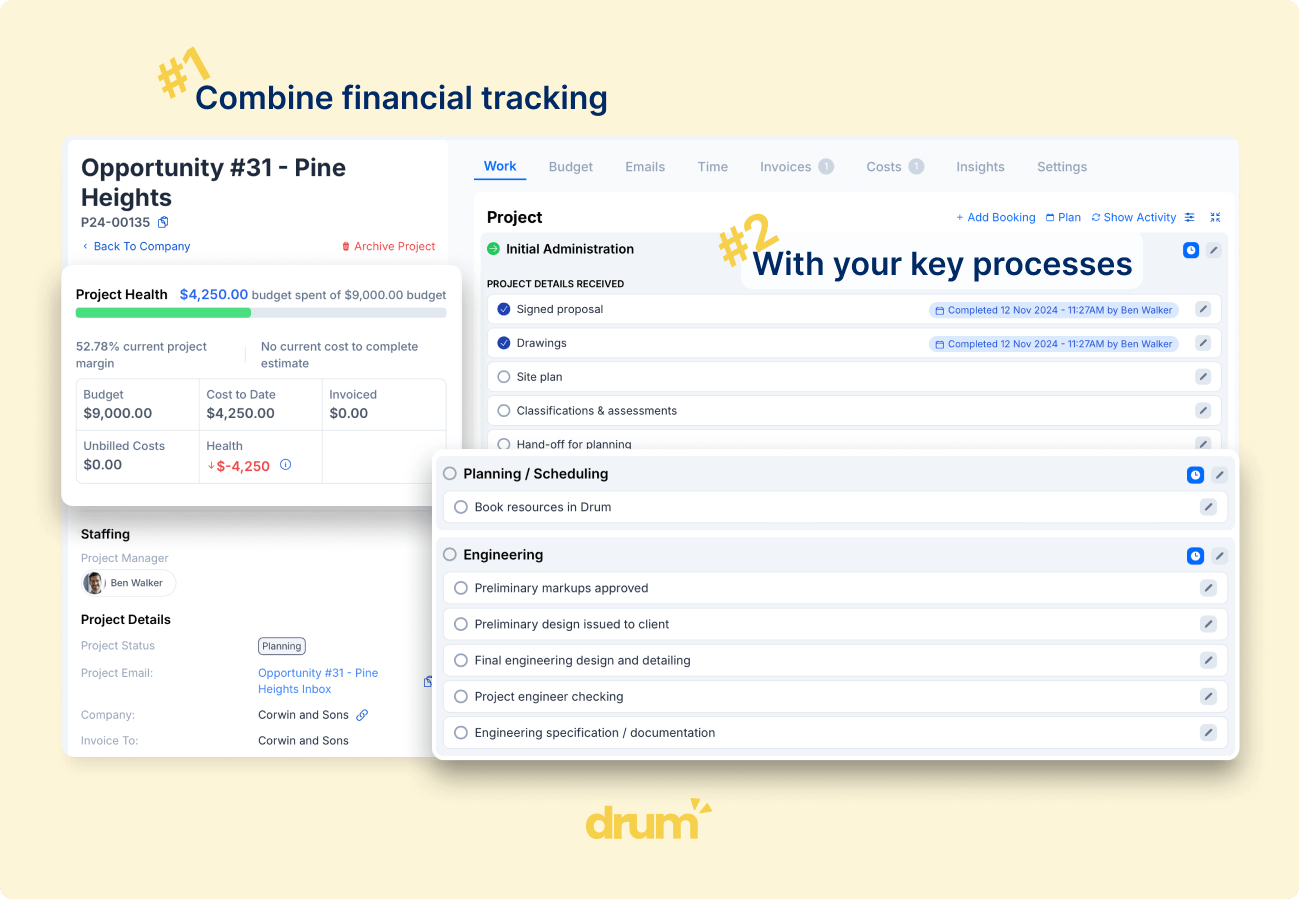
How Drum Compares to Total Synergy
Drum is an Australian-built PSA platform designed specifically for professional service firms between 10 and 200 people. Rather than trying to be everything for every industry, it focuses on the workflow that engineering, architecture, and consulting firms actually follow: win work, scope it, deliver it, invoice it, and understand what was profitable.
Here’s a practical comparison of the areas where Total Synergy users most commonly feel the strain.
| Capability | Total Synergy | Drum |
|---|---|---|
| CRM & sales pipeline | Paid add-on (Synergy CRM) | Included, with AI-powered inbox |
| Proposal generation | Limited | One-click fee proposals with Word export and budget sync |
| Project management | Strong but complex configuration | Intuitive staged projects with templates |
| Time tracking | Available across tiers | Mobile-friendly with one-click manager approval |
| Reporting & dashboards | “Analytics Plus” add-on for advanced | Real-time dashboards included in base product |
| HR & leave management | Paid add-on (Synergy HR) | Staff availability and leave built in |
| Accounting integration | MYOB and Xero (MYOB sync can be unreliable) | Deep two-way Xero sync for invoices, contacts, payments, tax rates and tracking categories |
| Built and hosted | Australian | Australian-built, hosted and supported |
| Onboarding | Self-serve with documentation | Hands-on onboarding and data migration |
| Learning curve | Steep, especially for smaller teams | Designed to be productive within days |
The pricing model is different too. Drum Complete includes CRM, reporting, invoicing and time tracking in one platform fee of $225 AUD per month, which covers your first 5 seats, with additional seats at $45 each per month. Enterprise controls such as SSO and tailored services are custom-priced. Total Synergy pricing is available on request only. Our Total Synergy pricing guide explains what to ask for in your quote and shows Drum’s published subscription costs for 10, 25 and 50 staff.
If you’re weighing up several platforms rather than just one, our comparison of Australian WorkflowMax alternatives covers the wider field of PSA tools serving built environment firms, and the Abtrac alternative breakdown is worth a look if a long-standing, industry-specific option is on your shortlist.
One thing that stands out in practice is speed. Firms switching from Total Synergy regularly comment on how much faster Drum feels in day-to-day use. Loading project dashboards, submitting timesheets, generating invoices: the interactions that happen hundreds of times a week across your team are noticeably quicker. That’s not a flashy feature, but it compounds into hours of saved time each month.
That experience shows up in how firms talk about the switch:
“Drum has become our single source of information for project scheduling, tracking, QA and correspondence. We used to use multiple platforms across our engineering, drafting and administration teams but now all staff use Drum.”
Peter McElroy, Engineering Consultancy Director
Today more than 250 Australian built environment firms run on Drum, with most live within 14 days of starting onboarding.
Switching from Total Synergy: What It Takes
Switching from Total Synergy to another platform is a meaningful decision, and it deserves honest consideration. You have years of project data, established workflows, and a team that has (eventually) learned the current system. Nobody should take that lightly.
Here’s what the move to Drum typically involves.
The Drum team starts with a discovery session to understand how your firm actually operates, not just what features you use, but how your projects flow from enquiry to final invoice. That conversation shapes how your Drum account gets configured. Rather than handing you a blank system and a knowledge base, Drum’s onboarding team sets up your project templates, invoice structures, permission tiers, and integrations before your team ever logs in.
Data migration covers your client records, active projects, and staff details. If you’ve been using Total Synergy’s document management or CRM add-ons, the Drum team maps that data across so nothing falls through the gaps. The goal is to have the system feel familiar from day one, with your real data in place rather than a demo environment. Training is structured around your firm’s actual use cases, not a generic feature tour.
Most firms are fully operational on Drum within 14 days. The time tracking and project management workflows tend to click immediately because they’re designed around how engineering and AEC professionals actually work.
And because Drum is built and supported in Australia, the ongoing relationship matters. Our in-app support averages a response time under 10 minutes, from people in your timezone who understand BAS, GST, and what it takes to run an Australian professional service firm. When you need to adjust a workflow, add a project template, or troubleshoot a Xero integration question, you’re not waiting days for an answer.
So, should you actually make the move? Total Synergy is a capable product for firms that have the internal resources to manage its complexity. If you have a dedicated operations manager who enjoys configuring software, and the add-on costs fit comfortably within your budget, it may continue to serve you well. Plenty of larger AEC firms run on it successfully.
But most 10 to 50 person engineering and architecture firms don’t have that luxury. If your team is spending more time wrestling with the system than benefiting from it, if reports take too long to pull, if people avoid logging time because the interface is clunky, or if you’re paying for add-ons that should be standard, then it’s worth seeing what a purpose-built Total Synergy alternative can do. Drum was designed for exactly this situation: mid-market Australian firms that need serious operational software without the enterprise complexity. One platform, fair pricing, and a team that picks up the phone when you call.
Curious what a simpler, faster Total Synergy alternative looks like?
We'll show you how Drum handles your firm's actual workflows, with no generic demos.
Total Synergy Alternative FAQs
Is there an Australian alternative to Total Synergy?
Yes. Drum is an Australian-built PSA platform made for engineering, architecture, and consulting firms between 10 and 200 people. It covers the full workflow from sales pipeline and fee proposals through to projects, timesheets, WIP, and invoicing, with a deep two-way Xero integration and Australian-based support. More than 250 Australian built environment firms run on it.
How much does Total Synergy cost compared to Drum?
Total Synergy doesn’t publish its pricing, so you’ll need to request a quote. It offers two tiers, Business and Enterprise, with CRM, HR, advanced reporting, and document control charged as separate add-ons, which means your real per-seat cost depends heavily on how many extras you need. Drum includes CRM, reporting, time tracking, and invoicing in the base product, so you don’t pay extra for the essentials or get surprised by add-on upgrades later.
How hard is it to migrate from Total Synergy to Drum?
Most firms are fully operational within 14 days. Drum’s onboarding team configures your project templates, invoice structures, and permissions before your team logs in, then migrates your client records, active projects, and staff details, including data from Total Synergy’s CRM or document add-ons. Training is built around your firm’s real workflows rather than a generic feature tour.
Does Drum integrate with Xero?
Yes. Drum has a deep two-way Xero integration that syncs invoices, contacts, payments, credit notes, tax rates, tracking categories, and account codes. For firms frustrated by unreliable MYOB syncing in Total Synergy, the Xero connection is one of the most common reasons they make the switch.