
 Project management
 Sales & Proposals
 Time tracking
 Invoicing
 Financial Performance
 Consulting Engineers
 Architects
 Town Planners
 Building Designers
Project Management for Architects: How to Deliver on Budget When Every Project Is Different

Ben Walker
Written for Drum
In This Article
Great design is only half the battle. The real magic happens when that creative vision is flawlessly executed, and that requires a solid framework for success: project management for architects. Think of it as the invisible structure that turns a brilliant concept into a built reality, making sure everything lands on time and on budget.
Why Management Is Your Firm’s Blueprint for Success
Let’s be honest, you probably got into this field to design incredible spaces, not to chase down contractor schedules or triple-check permit approvals. But the chaos of juggling client demands, coordinating consultants, and managing timelines can quickly swallow up your creative energy. This is where good project management becomes your most valuable tool, providing the structure needed for creativity to truly thrive.
Think of it this way: an amazing architectural design without a management plan is like a detailed blueprint with no foundation. It’s a beautiful idea, but it’s destined to crumble under the pressure of real-world complexities. Structured management isn’t about stifling your vision; it’s about building a stable, predictable path to bring it to life.
The Real-World Impact of Strong PM. Effective project management cuts through the daily friction that causes stress and eats into your profits. It proactively answers the tough questions before they mushroom into full-blown problems.
- Who is responsible for the next deliverable? A clear plan defines ownership, so nothing falls through the cracks. For example, is Sarah on your team handling the window schedule, or is that with the structural engineer? A good PM system makes that clear from day one.
- Is the project actually on budget? Real-time tracking means no nasty financial surprises down the line. You can see you’ve spent 60% of the design fee but are only 40% through the drawings, giving you a chance to course-correct.
- How do we handle a client’s last-minute change request? A defined process protects both your timeline and your bottom line, turning a potential conflict into a simple, documented decision.
As you can see, success isn’t an accident. It’s the direct result of a deliberate, well-managed flow from the first sketch to the final handover. The AIA’s own research shows that 56% of firm leaders rate increasing profitability as a major concern heading into 2026, underscoring just how critical disciplined project management has become.
Turning Chaos into Profitability. Ultimately, mastering project management is one of the smartest business decisions an architecture firm can make. According to Fortune Business Insights, the global market for architectural services was valued at USD 398.33 billion in 2025 and is projected to reach USD 622 billion by 2034, and project management is a massive driver of that revenue. As the market keeps growing, firms that can predictably deliver incredible results will have a serious competitive edge.
By putting these principles into practice, you’re not just organizing tasks; you’re building a system that delivers tangible results:
- Happier, more informed clients who feel totally confident in your process.
- Less stress for your team, freeing them up to focus on high-value design work.
- A more profitable practice built on a reputation for efficiency and reliability.
For firms ready to simplify these functions, specialized platforms now offer an end-to-end solution for project and billing control for architects. Good project management builds a stronger, more resilient business from the ground up.
Working Through the Five Phases of an Architectural Project
Every project tells a story, unfolding in five distinct chapters. From the first spark of an idea to the final walkthrough, this journey follows a well-worn path. For architects, sharp project management means treating each phase like a mission with its own clear objectives, deliverables, and communication plan.
Think of yourself as the story’s editor, making sure each chapter flows logically into the next. This structure gives you a repeatable framework that turns sprawling, complex projects into something you can manage predictably. Let’s walk through these five essential phases.
Phase 1: Schematic Design. This is the “big ideas” chapter. It’s all about translating the client’s needs, dreams, and practical requirements into a tangible design concept. At this stage, you’re not sweating the small stuff; you’re exploring possibilities and defining the project’s overall scope, scale, and character.
Communication is everything here. You’re working shoulder-to-shoulder with the client to land on a shared vision. This means lots of rough sketches, diagrams, and preliminary floor plans to hash out the basic layout and feel of the spaces. It’s a highly creative and collaborative back-and-forth.
For example, you might create two or three initial massing models for a new office building. You’d sit down with the client, talking through the pros and cons of each: how they handle natural light, circulation, and fit into the neighborhood. The deliverable isn’t a final blueprint, but a conceptual direction everyone is excited about.
Key Takeaway: The whole point of Schematic Design is getting aligned. A successful phase ends with the client saying, “Yes, that’s it. That’s what we want to build.” That approval is your green light to move forward.
Phase 2: Design Development. With the vision approved, it’s time to add the detail and refinement. Think of it as fleshing out the story’s characters and plot. You take the approved schematic concepts and start defining them with much greater precision, making real decisions about materials, systems, and how things will actually come together.
Your team will be refining floor plans, developing building sections and elevations, and starting to coordinate with consultants like structural and MEP (mechanical, electrical, plumbing) engineers. Material selection is a huge activity here, covering the specific types of glass, cladding, and interior finishes that will bring the design to life.
A practical example? If you’re designing a custom home, this is where you finalize the kitchen layout, pick out specific appliance models, decide on the window manufacturer, and detail the exterior brickwork. The deliverables from this phase are much more detailed drawings and an updated cost estimate, giving the client a clearer picture of the final product and its budget.
Phase 3: Construction Documents. This is the most intense, technical chapter of the whole story. Your team creates the massive set of drawings and specifications that a contractor will use to actually build the project. The mission is absolute clarity. These documents need to be so precise that they leave zero room for guesswork on the job site.
Every single detail gets meticulously documented. These deliverables form a legal contract and include everything from architectural and engineering drawings to technical specs for every material and product used. A solid set of construction documents is one of your best risk management tools, minimizing the chance of errors, disputes, and costly changes during construction.
Imagine a commercial renovation. The construction documents would include dimensioned plans for demolition and new walls, electrical plans showing every single outlet and light fixture, and a “finish schedule” that calls out the exact paint color, flooring type, and ceiling tile for every room.
Phase 4: Bidding and Negotiation. The blueprint is done. Now, you need to find the builder who will bring it to life. This phase involves sending the construction documents out to qualified contractors and getting their bids for the work. Your role shifts from pure designer to a facilitator and trusted advisor, helping the client pick the right construction partner.
The process usually breaks down like this:
- Issuing Bid Packages: Sending the complete set of documents to a pre-selected list of contractors.
- Answering RFIs: Responding to contractors’ questions (Requests for Information) to clear up any gray areas in the documents.
- Evaluating Bids: Analyzing the proposals based not just on price, but also on the contractor’s qualifications, experience, and proposed schedule.
Once the bids are in, you’ll guide the client through negotiations to lock in the construction contract. A successful bidding phase means a fair price and a strong partnership with a builder who gets the vision and can execute it properly.
Phase 5: Construction Administration. In the final chapter, you become the on-site guardian of the design. Your team’s focus moves from the drawing board to the construction site. The main goal is to make sure the project gets built according to your documents, on time, and within budget.
During this phase, you’ll be making regular site visits, reviewing the contractor’s work, and answering any questions that pop up. For instance, if the contractor can’t source the specified exterior stone, you’ll need to quickly review their proposed alternative to ensure it meets the design intent and quality standards. You’ll also handle processing payment applications, reviewing material submittals, and managing any design changes through a formal change order process. This is a critical part of project management for architects—it’s all about quality control and protecting your client’s interests right up to the finish line.
To help visualize this journey, we’ve summarized the key stages and their outputs. Think of this as your roadmap from initial concept to a finished building, with each deliverable acting as a critical milestone that unlocks the next phase of work.
Architectural Project Phases and Key Deliverables
| Project Phase | Primary Goal | Key Deliverables |
|---|---|---|
| Schematic Design | Align on a conceptual design direction with the client. | Preliminary site plans, rough floor plans, massing studies, initial cost estimate. |
| Design Development | Refine the design and make key decisions on materials and systems. | Detailed floor plans, building sections, elevations, outline specifications, updated cost estimate. |
| Construction Docs | Create a complete and precise set of instructions for construction. | Fully detailed architectural and engineering drawings, technical specifications, finish schedules. |
| Bidding/Negotiation | Select a qualified contractor at a competitive price. | Bid package, responses to RFIs, bid evaluation summary, signed construction contract. |
| Construction Admin | Ensure the project is built according to the design intent. | Site observation reports, reviewed submittals, approved payment applications, change orders, punch list. |
Understanding these phases and their deliverables is the foundation of successful architectural project management. It provides the structure needed to guide clients, coordinate with consultants, and ultimately deliver a project that brings the initial vision to life.
Choosing Your Project Management Style
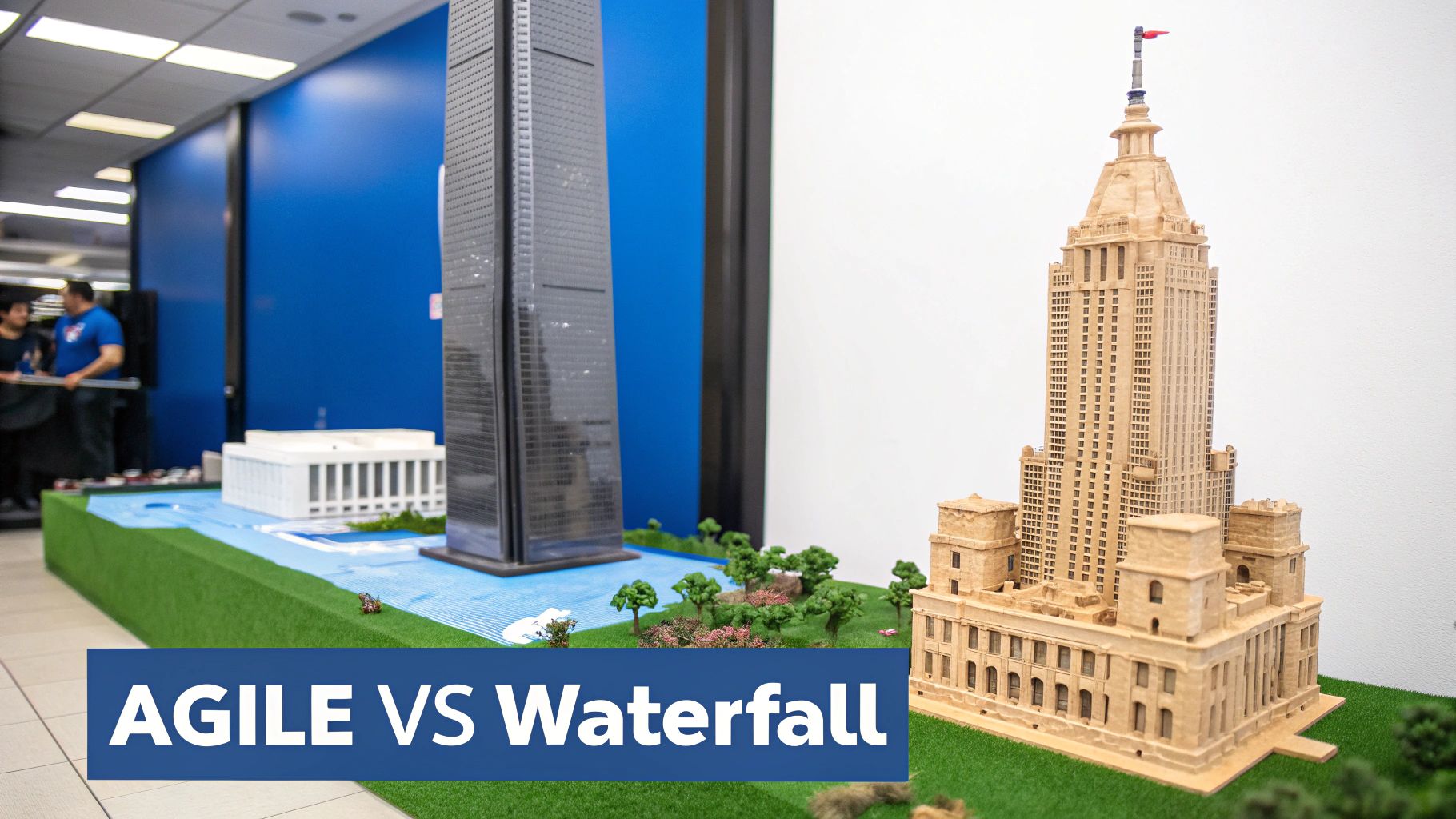
You wouldn’t use the same materials for a glass skyscraper as you would for a rustic timber-frame cabin, right? So why manage every project with the exact same process? The world of project management is full of different methodologies, and knowing which one to use (and when) is the secret to keeping your projects on track and your clients happy.
A project management methodology is just a set of rules for getting things done. For architects, the two big players you’ll hear about most are Waterfall and Agile. They represent two totally different ways of thinking: one is all about linear, step-by-step progress, and the other is built for flexibility.
Think about the lifecycle of your own projects. The early design phase feels completely different from the construction phase, doesn’t it? Understanding the difference between Waterfall and Agile gives you a powerful tool to manage each part appropriately.
The Waterfall Method: The Skyscraper Approach. The Waterfall method is the classic, old-school approach. It’s linear and sequential. You have to finish one phase completely before the next one can even begin. Everything flows downwards in a strict order, like a waterfall, from initial concept right through to construction and handover.
Imagine you’re building a skyscraper. There’s no way you can start framing the tenth floor until the ninth is finished and structurally sound. The foundation has to be perfect before the steel frame goes up. The sequence is rigid and predictable because it has to be. That’s Waterfall in a nutshell.
This style is perfect when you know exactly what you’re building from day one. It works best when the scope is clearly defined upfront, making it an ideal fit for the later, more structured phases of an architecture project.
- Best for: The Construction Documents and Construction Administration phases, where the scope is locked in and the sequence of events is non-negotiable.
- Strengths: It gives you fantastic control over timelines and budgets because every single step is planned out in advance. It’s highly structured and easy for everyone involved to understand.
- Weaknesses: The biggest drawback is its rigidity. If the client wants to make a change halfway through, it’s a massive headache. Changes are difficult and expensive because you have to go back and redo work that was already signed off.
The Waterfall model is your go-to when certainty is high and the “what” has already been decided. It’s all about disciplined execution of a well-defined plan, exactly what you need once construction kicks off.
The Agile Method: The Sculpting Approach. On the other end of the spectrum, you have Agile. This methodology is all about flexibility, collaboration, and iteration. It originally came from the software world, designed for projects where the final outcome isn’t totally clear at the beginning. Instead of one massive plan, Agile breaks the project into small, manageable cycles called “sprints.”
Think of the early design process like sculpting with clay. You start with a rough form, step back, show it to the client, get feedback, and then refine it. You might add a bit here, shave some off there, constantly adjusting until the final design emerges. You’re adapting as you go.
This iterative approach is perfectly suited for the creative, messy, and often unpredictable early stages of a project, like Schematic Design and Design Development. It thrives on continuous client feedback and lets the design evolve organically into something everyone loves.
So, When Do You Use Which Style? The best approach for architects isn’t picking one over the other. It’s using both. The most effective firms use a hybrid model, applying different management styles to different phases of the same project.
- Use Agile for early design phases: When you’re in Schematic Design and Design Development, embrace Agile. Work in short sprints, present ideas, get feedback, and iterate. This lets creativity flourish and ensures the design truly hits the mark for your client.
- Switch to Waterfall for later phases: Once the design is locked in and you move into Construction Documents and Construction Administration, it’s time for Waterfall. The scope is now fixed, and the goal is to execute that plan with military precision.
This blended approach gives you the best of both worlds. You get the creative freedom you need at the beginning and the rigid control you need at the end. By matching your management style to the project phase, you create a workflow that’s not just more effective, but also a lot more intuitive.
Finding the Right Digital Toolkit for Your Firm
The right software can feel like adding a hyper-organized, tireless partner to your team, one who never forgets a deadline or misplaces an RFI. But let’s be honest, stepping into the software market is overwhelming. With countless platforms all claiming to be the best, how do you find the one that actually fits your firm’s unique workflow?
This is your practical guide to cutting through the noise. Instead of just listing features, we’re going to focus on a decision-making framework. The goal is to help you choose a tool that adapts to you, not the other way around. After all, technology should support your process, not force you into a new, clunky one.
First, Ask What Your Firm Truly Needs. Before you even glance at a product page, the most crucial step is to look inward and define your own requirements. Every architecture firm is different. A solo practitioner juggling a few residential projects has vastly different needs than a 50-person firm coordinating massive commercial builds.
Start by getting to the root of the problem with a few foundational questions:
- What’s our biggest headache right now? Is it disorganized client communication? Is time tracking a mess? Is there a total disconnect between project progress and financial health? Pinpoint the single biggest fire you need to put out.
- How complex are our projects? Do you just need simple to-do lists, or are you managing multi-phase projects with intricate dependencies that demand proper Gantt charts?
- Who is this for? Will it be just for the internal team, or do you need a client-facing portal where stakeholders can see progress and approve documents without endless email chains?
- What do we already use? Your new tool must play well with others. If you’re committed to your accounting software, like Xero or QuickBooks, you’ll want a project management tool that integrates smoothly.
Answering these questions first gives you a clear checklist. It transforms a vague shopping trip into a targeted search for a solution that solves your specific problems.
Core Features Architects Cannot Ignore. While every firm’s needs are unique, certain features provide outsized value specifically for the architectural workflow. Think of these as the non-negotiables that separate a generic task manager from a true project management for architects platform.
Your toolkit absolutely has to excel in these key areas:
- A Centralized Project Hub: Can you see everything related to a project (drawings, contracts, RFIs, meeting notes, and site photos) in one organized place? This is about eliminating that frantic search through emails and scattered shared drives for good.
- BIM and Design Software Integration: A tool that can connect with your design software (like Revit or AutoCAD) is a genuine advantage. It helps bridge the massive gap that often exists between the design and management sides of a project.
- Time and Expense Tracking: You simply have to know where your team’s hours are going to understand project profitability. A good system makes it dead simple for staff to log time against specific project phases without it feeling like a chore.
- Client-Friendly Portals: Giving clients a clean, simple window into project progress builds immense trust and dramatically cuts down on the back-and-forth emails just asking for updates.
The market for these tools is growing fast. By 2025, the project management software market is estimated to hit USD 7.24 billion. But here’s the real story: high-performing projects are far more likely to use these tools – 77% of them, in fact. That shows a clear link between the right software and better outcomes. You can discover more project management statistics from Monday.com to see how technology is shaping the industry, while Grand View Research notes that the construction and project management segment now holds the largest share (34%) of the architectural services market.
A great tool doesn’t just manage tasks; it becomes the single source of truth for the entire project lifecycle, from the initial proposal straight through to the final invoice. This is where you can truly connect your operations.
Making the Final Decision. Once you have your list of needs and have identified a few contenders, it’s time for a test drive. Almost every platform offers a free trial, and you should use it to its full potential. Don’t just click around. Run a small, real-world project through it.
Assign tasks to a couple of team members, upload some documents, and try to generate a report. How intuitive does it feel? Does it simplify your work, or does it feel like you’re constantly fighting the software?
The best tool will feel like a natural extension of your team. By taking a thoughtful, needs-first approach, you can confidently select a digital partner that empowers your firm to deliver exceptional work more efficiently. For those looking to unify their entire workflow, exploring a dedicated architectural project management solution can provide the end-to-end control needed to scale your practice.
How to Sidestep Common Project Derailers
Every seasoned architect has a horror story about a project that went completely off the rails. Funny enough, these tales usually feature the same villains: creeping scope, vanishing budgets, and communication black holes that turn simple mix-ups into five-figure mistakes.
Learning from these war stories is how you protect your own projects from the same fate. Think of your project management process not just as a planning tool, but as your first line of defense. It’s about building in the right checks and balances to catch problems before they can snowball. With a few smart strategies, you can dodge the derailers that plague even the most talented firms.
Taming the Beast of Scope Creep. Scope creep is the quiet, insidious addition of features and requests that weren’t part of the original deal. It never happens all at once. It’s the “just one more thing” here and the “while you’re at it” there that slowly chews through your timeline and profit until the project is barely recognizable.
Your most powerful weapon against this is a rock-solid Scope of Work in your contract, backed by a formal Change Order Process. This isn’t about being difficult. It’s about being crystal clear and protecting everyone involved.
When a client asks for something new, don’t just say yes. Document it. A simple change order turns a vague request into a managed, transparent decision. It saves the relationship and the project.
For example, imagine a client on a residential job casually asks to add a custom built-in bookshelf to the study. Instead of a quick “okay,” you pull out a script like this:
“That’s a fantastic idea, it would look incredible in there. Let me draw up a quick change order for you. It’ll outline the design time, materials cost, and the two extra days it’ll add to the schedule. As soon as you approve it, we can get rolling.”
This simple reply does three crucial things:
- It formally acknowledges their request.
- It clearly lays out the impact on the budget and timeline.
- It gives the client the power to make an informed choice.
Avoiding Communication Black Holes. You know the old saying: miscommunication is the mother of all screw-ups. When clients, consultants, and contractors aren’t perfectly aligned, assumptions fill the gaps. And assumptions are incredibly expensive. A central hub for all project communication isn’t a nice-to-have; it’s non-negotiable.
This means getting out of the chaos of scattered emails and text messages. You need a single source of truth, whether that’s a dedicated channel in your project management software or a structured weekly update. Consistency is everything.
Here’s a practical tip that works wonders: end every key meeting with a “decisions and actions” summary. Before anyone packs up, quickly recap:
- What did we decide today? (e.g., “We’re moving forward with the oak flooring.”)
- Who is responsible for what comes next? (e.g., “I will get the final spec sheet to the contractor.”)
- And what are the deadlines? (e.g., “I’ll have that to them by Friday.”)
This five-minute habit wipes out ambiguity and makes sure everyone leaves the room on the exact same page.
Protecting Your Project Budget. Nothing erodes a client’s trust faster than a busted budget. The secret to financial control isn’t just tracking what you’ve already spent; it’s about actively forecasting where the money is going. To do that, you have to connect your team’s effort directly to the project’s bottom line.
This is where accurate time tracking becomes your superpower. When your team logs their hours against specific project phases, you get an incredible level of insight. You can instantly see if Schematic Design took twice as long as you budgeted, which helps you adjust fees for future projects or fix a broken process.
Modern tools have made this so much easier. You can explore how dedicated platforms offer powerful time tracking and reporting features for architects, giving you a real-time pulse on project profitability. This data isn’t just for sending invoices. It’s vital business intelligence that helps you quote smarter and manage resources better, keeping every project firmly in the black.
The world of project management for architects is also standing on the edge of a massive shift, powered by tech that does a whole lot more than just organize your to-do list. These tools are evolving into intelligent partners, designed to take the administrative load off your shoulders so you can get back to what you actually love doing: designing.
Think of artificial intelligence less as a sci-fi concept and more like a sharp co-pilot on your team. AI is already starting to crunch data from past projects to flag potential timeline risks and budget blowouts before they even surface. For example, it might notice that projects with a certain type of foundation consistently run 15% over budget and flag that risk for you on day one. This kind of foresight lets you make smart, proactive moves instead of just reacting when things go wrong.
Virtual Construction and Digital Twins. Another major shift making waves is the rise of digital twins. A digital twin is essentially a living, breathing virtual copy of your physical building. It’s so much more than a static 3D model; it’s a dynamic simulation that’s hooked up to real-world data.
This lets you “walk through” a building and test its systems long before you even break ground. Imagine spotting clashes between structural and MEP systems in a virtual space, saving you the immense cost and rework that would inevitably pop up on-site.
These advancements are all part of a much bigger picture. According to OpenAsset’s architecture statistics roundup, the global construction market is projected to hit around USD 13.4 trillion by 2025, and a huge chunk of that growth is being driven by new technologies.
The vision for the future is clear: technology will handle the tedious, repetitive work, freeing architects to focus on creating enduring, beautiful, and functional spaces.
This technology amplifies an architect’s expertise rather than replacing it. By automating the administrative grind and serving up powerful predictive insights, the tools of tomorrow will empower you to push creative boundaries while delivering projects with more precision and predictability than ever before.
Stepping into the world of project management can feel like learning a new language, especially when you’re trying to fit it into the unique rhythm of an architecture firm. We’ve heard a lot of the same questions come up over the years, so we’ve put together some straight answers to help you get started.
What Is the Most Important Skill for an Architectural Project Manager? While a deep well of technical knowledge is the price of entry, the real superpower of a standout project manager is exceptional communication. Think of them as the central nervous system of the project.
They have the tough job of translating a client’s abstract vision into concrete plans for the design team, and then ensuring the contractor on site understands every last detail of that design intent. Proactive, clear, and constant communication is the only thing that stops small misunderstandings from spiraling into costly rework. It’s the glue that holds budgets, timelines, and expectations together.
How Can Small Firms Implement Project Management on a Budget? You absolutely do not need to shell out for a massive, enterprise-level software package to get your projects in order. The secret is to focus on your process first and the product second. Many small firms find huge success by cobbling together a system with tools they already know and trust.
As an example, our software, Drum, enables you to create consistent internal processes and maintain project budgets without the overhead (or cost) of eterprise-level products! It’s simple and intuitive and it has been created exactly for your use-case!
The specific tool you land on is far less important than your team’s commitment to using it consistently. A well-defined system, no matter how simple, will always outperform a powerful piece of software that people only use half the time.
What Is Scope Creep and How Do I Actually Prevent It? Ah, scope creep. It’s the silent killer of project profitability. Research from Monograph’s scope creep analysis confirms that scope creep impacts over half of all projects, and in architecture specifically, it can inflate costs by 20% or more when left unchecked. It shows up in those seemingly harmless “just one more thing” requests that slowly but surely blow up your budget and timeline.
The best defense is a simple, two-pronged attack. First, you need a rock-solid, incredibly detailed scope of work baked into your initial contract. No ambiguity. Second, you must implement a firm but fair change order process.
When a client asks for something new, don’t just nod and add it to the list. Document the request, clearly outline how it will impact the project’s cost and schedule, and get their signature on it before you lift a finger. This simple discipline turns scope creep into a managed change, protecting your firm, your sanity, and your client relationship.
Ready to build a more profitable and organized practice?
Drum brings project management, time tracking, and invoicing together into a single source of truth. It's time to take control of your projects from the first proposal to the final payment.
Start your free 14-day trial of Drum today and experience a smarter way to manage your consulting business.