
 Pipeline & Proposals
 Project Management
 Resource Planning
 Time & Costs
 WIP & Invoicing
 Commercial Reporting
 Consulting Engineers
 Architects
 Town Planners
 Building Designers
Professional Service Agreement: What to Include, What to Skip, and Real Examples

Ben Walker
Written for Drum

In This Article
- Professional Service Agreement: A Guide
- What Is a Professional Service Agreement Really For?
- The Building Blocks of an Ironclad Service Agreement
- Smart Clauses That Protect You from Project Chaos
- How to Tailor Your Agreement for Different Industries
- Your Checklist for Reviewing Any Service Agreement
Professional Service Agreement: A Guide
Think of a Professional Service Agreement less as a scary legal document and more as a warm handshake that sets up a successful project. It’s the official playbook that lays out what work will be done, for how much, and by when, getting everyone on the same page before the real work kicks off.
What Is a Professional Service Agreement Really For?
It’s a lot like the blueprint for a house. You wouldn’t let a builder start knocking down walls without one, right? A PSA ensures both you and your client agree on the vision, materials, timeline, and cost before anyone picks up a hammer. That initial clarity is the bedrock of a strong, trusting working relationship.
A well-crafted agreement is your best tool for turning friendly conversations and good intentions into concrete, measurable expectations. It’s the first, and most important, step in preventing the misunderstandings that create friction down the road.
The Foundation of Professional Trust. A PSA is there to protect both you and your client. It creates a single source of truth that either of you can go back to, which is absolutely critical for keeping a project aligned from start to finish. This documented clarity helps sidestep common headaches like:
- Scope Creep: When a client asks for “just one more little thing” that wasn’t in the original plan, the PSA is there to gently define the project’s boundaries.
- Payment Disputes: The agreement clearly states payment schedules, rates, and what happens if payments are late. No awkward surprises for anyone.
- Mismatched Expectations: It makes sure both sides share the exact same understanding of the final deliverables and what success actually looks like.
A professional service agreement isn’t about planning for failure; it’s about building a framework for success. By defining the rules of engagement upfront, it minimizes ambiguity and allows both parties to focus on achieving great results.
These agreements are only becoming more crucial. The global professional services market, which runs on these contracts, is set to grow by an incredible USD 2,000.5 billion between 2025 and 2029. With North America expected to account for 31% of that growth, it’s clear that solid, professional agreements are the backbone of the modern economy. Looking ahead, Kantata’s 2026 professional services forecast predicts that leading firms will increasingly define success in terms of impact rather than hours, which means clearer success criteria baked into these agreements and pricing models that reflect confidence in results.
The Building Blocks of an Ironclad Service Agreement
Think of a professional service agreement as the architectural blueprint for your project. Each clause is a critical structural element: a foundation, a load-bearing wall, or the roof. Get them right, and you build something stable and successful. But if one piece is weak or missing, the whole structure is at risk of collapsing under pressure.
Let’s walk through the essential components that form the skeleton of any solid agreement. Understanding these building blocks is the first step to crafting a contract that’s clear, fair, and actually works for everyone involved.
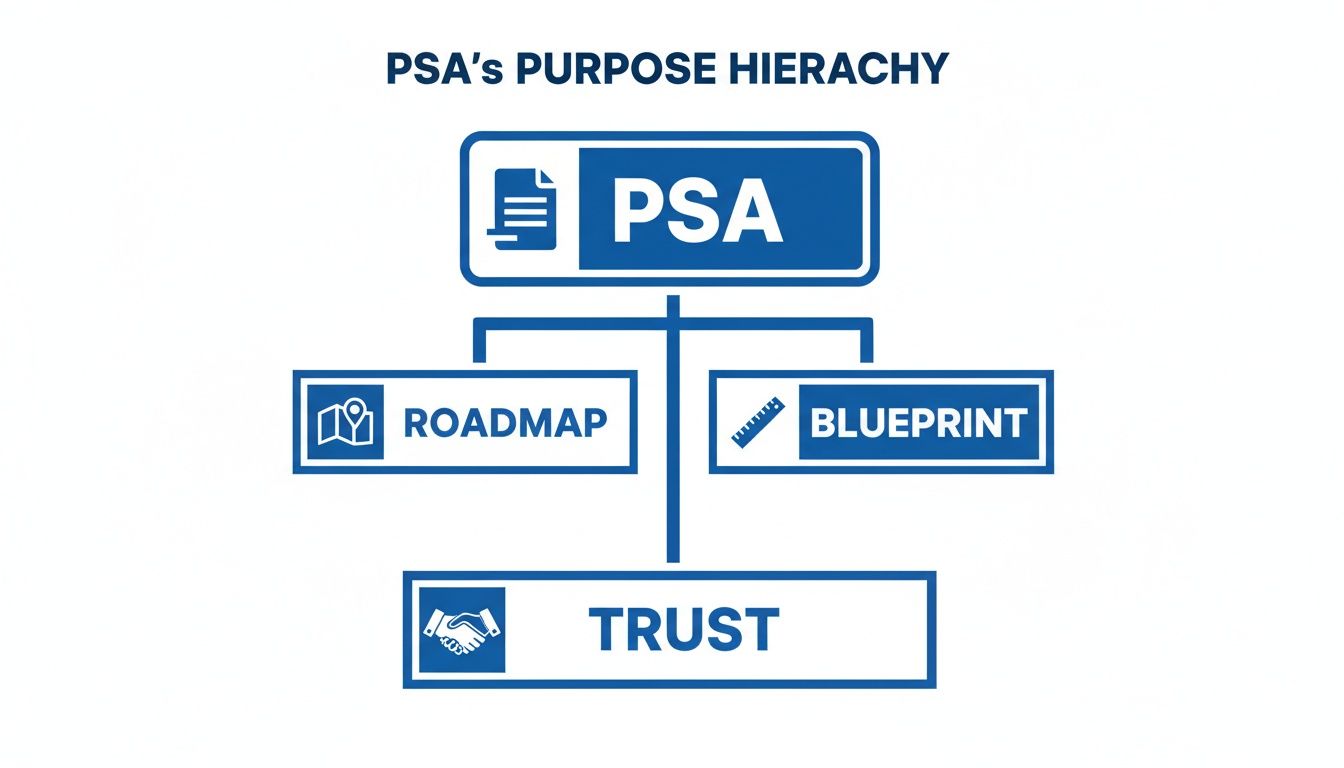
This diagram gets to the heart of it: a PSA isn’t just a legal hoop to jump through. It’s the tool that turns a plan into a tangible roadmap, which is ultimately how you build trust and keep everyone aligned.
Here’s a friendly rundown of the clauses you absolutely can’t afford to get wrong.
| Clause | What It Defines | Why It’s Important |
|---|---|---|
| Scope of Work | Exactly what will (and won’t) be delivered. | Prevents scope creep and sets clear expectations from day one. |
| Payment Terms | How much, when, and how you get paid. | Ensures healthy cash flow and avoids awkward money conversations. |
| Term & Termination | The project’s start, end, and exit strategy. | Provides a clear lifecycle and a professional way out if things go south. |
| Confidentiality | Protection of sensitive client information. | Builds trust and assures clients their proprietary data is safe. |
| Intellectual Property | Who owns the work created during the project. | Clarifies ownership of final deliverables and protects your processes. |
Now, let’s dig into what makes each of these components so crucial for protecting your firm.
The Scope of Work: Your Project’s Blueprint. The Scope of Work (SOW) is, without a doubt, the most important clause in your entire agreement. It’s the detailed blueprint that defines precisely what you will deliver and, just as crucially, what you will not deliver. Any gray area here is a direct invitation for scope creep and messy client disputes down the road.
A rock-solid SOW should clearly list:
- Specific Tasks and Activities: Don’t just say “build a website.” Break it down. Specify “design a five-page responsive website including Home, About, Services, Blog, and Contact pages.”
- Deliverables: What tangible results will the client hold in their hands? This could be anything from reports and designs to code repositories or strategic plans.
- Exclusions: Be explicit about what’s out of bounds. For example, “This agreement does not include copywriting, stock photography licensing, or ongoing website maintenance.”
Payment Terms: How (and When) You Get Paid. This clause takes all the guesswork out of the money side of things, ensuring you maintain a healthy cash flow. It outlines the entire financial arrangement, leaving zero room for awkward conversations about payments later. Without crystal-clear payment terms, you’re setting yourself up for delayed invoices and unpredictable revenue.
Your payment terms should always specify:
- Billing Method: Is this a fixed fee, an hourly rate, or a monthly retainer?
- Invoice Schedule: Will you bill upfront, upon completion, or at specific milestones? (e.g., 50% at kickoff, 50% at launch)
- Payment Due Dates: State your net terms clearly (e.g., Net 15 or Net 30 days).
- Late Fees: Don’t be shy. Include a provision for interest on overdue invoices to encourage prompt payment.
For instance, you might include a line like: “All invoices are due within 15 calendar days of receipt. A late fee of 1.5% per month will be applied to all outstanding balances.”
Term and Termination: The Start and Finish Line. Every project needs a defined lifecycle. The “Term and Termination” clause sets the official start and end dates and, importantly, provides a clean, professional exit strategy if the relationship needs to end early.
This section defines how the engagement kicks off, how long it will last, and the specific conditions under which either party can walk away. This foresight prevents projects from dragging on forever and gives you a graceful way out if things just aren’t working.
A termination clause isn’t about planning for failure; it’s about ensuring a professional and orderly conclusion, no matter the circumstances. It protects both parties by defining a fair process to end the working relationship.
Confidentiality: Keeping Secrets Safe. During any project, you’ll likely become privy to sensitive client information, things like business strategies, financial data, or customer lists. A confidentiality clause, sometimes called a Non-Disclosure Agreement (NDA), creates a legal obligation for both parties to protect that information.
Think of this clause as a promise of trust. It reassures your client that their proprietary information is in safe hands, which is absolutely fundamental to building a strong, long-lasting professional relationship.
Intellectual Property: Who Owns What. Finally, the Intellectual Property (IP) clause clarifies who owns the work you create. This is especially vital for creative, design, and engineering firms. Who gets the rights to the final website design, the architectural drawings, or that brilliant marketing slogan?
A common setup is for the client to own the final, delivered product once you’ve been paid in full. However, the service provider (that’s you) often retains the rights to their underlying methodologies, tools, and the right to use the work in their portfolio. A simple clause might state, “Upon final payment, Client will own the completed website design. Provider retains the right to display the work in their portfolio.” For a deeper look at how to structure these provisions, Consulting Success has a comprehensive guide to consulting agreements that walks through IP and other critical clauses in detail.
As you get better at integrating these agreements into your daily operations, you’ll start to see how important it is to manage them efficiently. Learning what is PSA software can make a real difference, as it helps centralize all these crucial business functions into one place.
Smart Clauses That Protect You from Project Chaos

While the basics like scope and payment are the engine of your agreement, certain clauses act as your project’s advanced safety system. Think of them like the airbags and anti-lock brakes in your car. You hope you never need them, but you’ll be incredibly grateful they’re there if you hit a bump in the road.
These clauses are all about managing risk and creating a clear path forward when things get messy. They turn potential shouting matches into structured conversations, protecting your client relationships and, just as importantly, your bottom line.
Liability and Indemnification. Let’s be direct and friendly: who foots the bill when something goes wrong? That’s exactly what liability and indemnification clauses are for. They work as a team to set financial boundaries and assign responsibility before mistakes or damages ever occur.
A limitation of liability clause is your financial ceiling. It caps the amount of money one party can be on the hook for. A common approach is to limit your liability to the total fees paid under the contract. Nothing more.
Indemnity, on the other hand, is like a promise to have the other party’s back. If your client gets sued by a third party because of work you delivered, this clause means you agree to step in and cover their legal costs.
Practical Example: A marketing firm rolls out an ad campaign using an image they didn’t have the right license for. The stock photo company sues the client for copyright infringement. The indemnity clause would kick in, requiring the marketing firm to pay for the client’s legal fees and any settlement costs.
Change Control Process. “Could you just add…?” These four little words are the sound of scope creep knocking at your door. A Change Control clause is your plan for answering that knock politely but firmly. It establishes a formal process for handling any request that falls outside the original statement of work.
This process doesn’t need to be complicated. It usually just involves:
- A formal change request: The client has to submit their request in writing. No more hallway conversations turning into new deliverables.
- An impact assessment: You evaluate how the change will affect the timeline, budget, and resources needed.
- Written approval: Both you and the client must sign off on the new scope and any extra costs before any new work begins.
Having a structured approach like this is non-negotiable. It transforms potential misunderstandings into documented agreements, ensuring you get paid for all the work you do. Integrating a clear change process with tools for project management and time tracking makes it even easier to handle project adjustments without torpedoing your profitability.
Warranties and Guarantees. A warranty is simply a professional promise about the quality of your work. It’s your way of saying, “I stand behind what I deliver, and it will meet these specific standards.” This isn’t just a feel-good statement; it sets a clear, objective benchmark for what the client can and should expect.
For instance, a software developer might warrant that their code will be free from major bugs for 90 days post-launch. An engineering firm might guarantee that their designs comply with all relevant building codes. Being upfront with what you warrant builds immense trust and shows you’re a pro.
Dispute Resolution. Even with the most detailed plan, disagreements can pop up. A dispute resolution clause outlines the steps you’ll both take to solve them without immediately escalating to an expensive lawsuit. Think of it as a pre-agreed-upon roadmap for handling conflict.
The most common, and sensible, approaches follow a clear escalation path:
- Negotiation: A good-faith discussion between the key people on both sides to find a solution.
- Mediation: If talking doesn’t work, a neutral third party steps in to help facilitate a resolution. It’s not about picking a winner, but finding common ground.
- Arbitration: A more formal process where an arbitrator (or panel) hears both sides and makes a binding decision, keeping you out of the courtroom.
How to Tailor Your Agreement for Different Industries
Think of a generic professional service agreement like a one-size-fits-all t-shirt. Sure, it technically covers you, but it rarely fits well. Using a generic template is a lot like that; it gets the basics right but misses the critical details that matter in your specific industry.
Every field has its own language, its own risks, and its own definition of success. When you tailor your agreement, you’re not just adding legal protection; you’re showing clients that you speak their language and understand their world. It proves you’re a professional who’s prepared for the unique challenges of their sector.
By customizing the key clauses, a standard document transforms into a strategic tool. You can head off common friction points before they even become problems, building client confidence and setting the project up for a smooth ride from day one.
IT and Technology Services. For IT providers, the stakes couldn’t be higher. You’re often dealing with mission-critical systems where downtime or a data breach can have catastrophic consequences for a client. Your agreement has to reflect that reality.
The global IT professional services market hit USD 870.05 billion in 2023 and is on track to reach USD 1,598.41 billion by 2030, which tells you just how vital these services are. The growth in the IT service market is staggering, and solid agreements are the bedrock of it all.
Here’s where to focus:
- Service Level Agreements (SLAs): Get incredibly specific. Don’t just promise support; define it. We’re talking uptime guarantees (e.g., 99.9% availability), firm response times for support tickets (e.g., “1-hour response for critical issues, 4 hours for non-critical”), and what happens if you miss those benchmarks.
- Data Security and Privacy: Spell out your responsibilities for protecting sensitive client data. Mention compliance with regulations like GDPR or CCPA and lay out the exact procedure for how you’ll handle a data breach. Clients need to see you have a plan.
- Intellectual Property: This is a big one. Who owns the custom code or configurations you build? Does the client get full ownership, or do you retain the rights to your underlying tools and scripts? Settle this before a single line of code is written.
Creative and Marketing Firms. In the creative world, success can be subjective, and the work is almost always iterative. Your agreement needs to bring some much-needed structure to that creative chaos. Otherwise, you risk getting trapped in a cycle of endless revisions or facing confusion over who owns what.
Key clauses to nail down:
- Revision Rounds: Be crystal clear about how many rounds of revisions are included in the fee. For example, “This quote includes two rounds of major revisions and one round of minor textual edits.” Anything beyond that should automatically trigger your change control process and a conversation about additional costs.
- Intellectual Property Rights: Clarify what the client is actually buying. Are they purchasing full ownership of the final designs, or are they just licensing them for specific uses? Also, be sure to state whether you retain the right to feature the work in your portfolio, which is crucial for your own marketing.
- Acceptance Criteria: Define the finish line. How is a deliverable officially considered “approved”? This could be a formal sign-off email or an approval click in your project management system. This simple clause prevents projects from dragging on in a state of near-completion.
Engineering and Architecture. For engineering and architectural firms, the entire game is about precision, compliance, and professional liability. Your work has real-world, physical consequences and is governed by strict regulations. Your agreement needs to be as meticulously drafted as your blueprints.
Your professional service agreement should be a blueprint for the business relationship, just as your technical drawings are a blueprint for the structure. Every line should have a purpose.
Elements you absolutely cannot overlook:
- Professional Liability: Address insurance head-on. Specify the exact amount of professional liability (Errors & Omissions) insurance you carry. This isn’t just a formality; it’s a critical assurance for your client.
- Standard of Care: Define the quality of work your client can expect. A common and effective phrase is that services will be performed “with the care and skill ordinarily used by members of the profession practicing under similar circumstances.” It sets a professional, defensible benchmark.
- Compliance with Laws: Clearly state your responsibility to adhere to all applicable building codes, zoning laws, and other industry regulations. This provides peace of mind for the client and draws a clear line around the boundaries of your duties.
Your Checklist for Reviewing Any Service Agreement

Before you put ink on that final page, a last careful review is your best defense against future headaches. Think of it less like a legal chore and more like a final quality check, like a proofreader catching a typo just before a book goes to print. This checklist will help you break down the review into simple, actionable steps.
Taking a systematic approach now ensures you don’t miss the small details that can mushroom into scope creep or payment disputes down the line. It’s all about being thorough up front to guarantee a smooth partnership later.
Pre-Drafting and Initial Review. This is your foundation. This first phase is all about making sure everyone is starting from the same page, aligning the core project details with the actual language in the contract.
- Are all parties correctly identified? Double-check the full legal names and addresses for both your firm and the client. A simple typo here can create surprisingly big problems.
- Is the scope of work crystal clear? Read the SOW and ask yourself, “Could a total stranger understand exactly what we’re supposed to deliver?” It’s often a good idea to explicitly list what is not included to shut the door on ambiguity.
- Are deliverables and milestones defined? Every deliverable needs to be tied to a specific deadline or project milestone. This simple step builds a clear timeline and keeps everyone accountable.
Getting these basics right is critical. These agreements are the engine of a massive global ecosystem valued at around USD 6.3 trillion. In 2019 alone, the US generated a USD 114 billion trade surplus in these services, exporting expertise on the back of ironclad contracts. You can learn more about the global professional and commercial services market to see just how big this is.
Pro Tip: Try reading the agreement out loud. It sounds silly, but this simple trick forces you to slow down and often reveals awkward phrasing or confusing sentences that your brain might otherwise skim over.
Financial and Legal Scrutiny. Next up, it’s time to focus on the money and the “what-ifs.” This is where you protect your firm’s financial health and get ahead of potential risks before they become real problems.
- Is the payment schedule fair and timely? Check that payment terms (like Net 30) are realistic for your business and that the schedule aligns with your cash flow. Are late fees clearly spelled out?
- Are liability and indemnity clauses balanced? You need to be sure you aren’t accepting an unreasonable amount of risk. A common practice is to limit your firm’s liability to the total value of the fees paid under the agreement.
- Does the termination clause provide a clear exit ramp? Make sure the process for ending the agreement is fair to both sides, detailing the required notice periods and how final payments will be handled.
Even with a solid grasp of what goes into a professional service agreement, a few practical questions always seem to pop up. Let’s tackle the most common ones head-on, with clear, no-nonsense answers. Think of this as your friendly quick reference guide to handling these documents with total confidence.
PSA vs. Statement of Work: What’s the Real Difference?
This is easily one of the most common points of confusion, and it’s a great question. While they’re definitely related, they play two very different roles on the team.
Think of it like this:
- A Professional Service Agreement (PSA) is the master rulebook for your entire relationship with a client. It’s the foundational legal framework—covering things like confidentiality, liability, payment terms, and how to part ways—that governs every project you do for them.
- A Statement of Work (SOW) is the specific playbook for a single project. It lives under the umbrella of the PSA and gets into the nitty-gritty: the exact tasks, deliverables, timelines, and milestones for that one engagement.
You might have a single PSA with a client that lasts for years, but you could easily generate a dozen different SOWs under it, one for each new project you kick off.
Is Grabbing an Online Template a Good Idea? The temptation to download a generic template from the internet is real, but it’s a risky shortcut. It might feel like a quick win, but those one-size-fits-all documents often leave you exposed. They rarely have the specific protections your line of work or unique project requires.
An agreement drafted for an IT consultant, for example, needs to address completely different risks than one for an architect managing a construction project.
A template is a starting point, not a finished product. If you do go this route, it’s crucial to have a legal professional review it. They can help tailor it to your specific business risks and make sure it complies with local regulations.
What Are the Biggest Red Flags to Watch For? When a client hands over their standard PSA, it pays to know what to look for. Vague or ambiguous language is a huge one, especially when it comes to the scope of work. If it’s not crystal clear what’s included (and what isn’t), you’re setting yourself up for scope creep and disputes down the road.
Also, keep a sharp eye out for one-sided liability clauses that pin all the risk on you. Another classic red flag is unclear payment terms that aren’t tied to specific deliverables or milestones. And finally, be wary of any contract that makes it nearly impossible for you to terminate the relationship, even if the client isn’t holding up their end of the bargain.
A fair agreement protects both parties, not just one.
Putting these agreements into practice is the final piece of the puzzle.
With Drum you can connect your signed contracts directly to your proposals, project plans, and invoices. It creates a single source of truth that keeps your operations perfectly aligned, from the initial sale to the final payment.
See how it brings everything together with a 14 day free trial