
 Pipeline & Proposals
 Project Management
 Resource Planning
 Time & Costs
 WIP & Invoicing
 Commercial Reporting
 Consulting Engineers
 Architects
 Town Planners
 Building Designers
What Is Capacity Planning? How to Match Your Team's Bandwidth to Incoming Work

Ben Walker
Written for Drum

In This Article
What Is Capacity Planning? A Practical Guide
Capacity planning is all about matching your team’s available work hours with your pipeline of projects. Think of it as the art and science of ensuring you have the right people with the right skills available at the right time, without burning everyone out or letting projects grind to a halt. It’s the secret sauce to running a smooth, predictable, and profitable services business. According to Kantata’s State of Professional Services report, capacity constraints remain severe across the industry, with firms consistently turning away work because they cannot staff it.
What Is Capacity Planning Really About?
Imagine you’re running a top-tier restaurant. Trying to get through a Saturday night service without knowing your reservations, how many steaks are in the fridge, or how many chefs are in the kitchen would be pure chaos. You’d have unhappy diners, wasted food, and a team on the verge of quitting.
For professional services firms, whether you’re in consulting, engineering, or a creative agency, operating without a clear view of your capacity is the exact same gamble. This isn’t some complex, abstract theory; it’s about practical business survival and growth.
It forces you to move beyond a simple headcount and dig into the nitty-gritty of your team’s true availability, their specific skills, and the real demands of all the work heading your way. Capacity planning is the essential bridge connecting your sales pipeline to your project delivery team, making sure one doesn’t completely overwhelm the other.
The Consequences of Getting It Wrong.
When capacity planning gets ignored, the consequences aren’t minor hiccups. They ripple through the entire business, often kicking off a vicious cycle of expensive problems that directly hammer your bottom line and your reputation.
The most common pitfalls we see are:
- Team Burnout: Constantly overloading your people leads to stress, mistakes, and plummeting productivity. According to Deloitte, a staggering 77% of professionals have experienced burnout, a fire often fueled by unrealistic workloads and impossible deadlines.
- Unhappy Clients: When teams are stretched thin, project timelines slip, quality takes a nosedive, and communication breaks down. The result? Dissatisfied clients who won’t be coming back for more.
- Shrinking Profits: The constant firefighting, project delays, and the high cost of replacing burned-out employees directly eat away at your project margins and overall profitability.
Before we go further, here’s a quick breakdown of what capacity planning really involves for a services business.
Capacity Planning at a Glance.
| Component | What It Means | Why It’s Important for Services |
|---|---|---|
| Resource Availability | The actual, bookable hours your team has, minus holidays, leave, and admin time. | Your people are your product. Knowing their true availability is step one to profitability. |
| Demand Forecasting | Predicting the workload from your sales pipeline and current projects. | It lets you see what’s coming and staff up or adjust sales efforts before it’s a crisis. |
| Skills Matching | Aligning the specific skills required for a project with the right people on your team. | Prevents putting a junior on a senior-level task or having the wrong expertise on a critical project. |
| Utilization Tracking | Measuring how much of an employee’s available time is spent on billable work. | This is a direct lever for profitability. High utilization means you’re making the most of your biggest asset. |
This table just scratches the surface, but it highlights how each piece connects to the core goal: running a smoother, more predictable, and more profitable business.
The Strategic Business Advantage.
Capacity planning first became a big deal in the IT world, where misjudging resource needs led to system outages that could cost millions. Today, that same strategic mindset is absolutely vital for any service-based business where your people are your primary asset. In fact, research shows that optimized planning can lead to huge cost savings, making it a must-have to stay competitive. You can explore more data on the capacity management market to see just how big its impact is.
The goal of capacity planning is to offset two common (and costly) problems: an insufficient amount of resources, leading to performance issues, and an environment with excess capacity, which leads to wasted money.
Ultimately, getting capacity planning right transforms how you operate. It shifts your firm from a reactive, chaotic state to a proactive, controlled one. It’s the key to achieving sustainable growth, delivering exceptional work, and building a resilient business where both your clients and your team can actually thrive.
The Three Levels of Capacity Planning
To really get your head around capacity planning, it helps to stop thinking of it as a single task. Instead, see it as a set of nested strategies, kind of like using Google Maps. You’ve got the long-range “world view,” the medium-term “city view,” and the immediate “street view.” Each one gives you a different perspective, but they all have to work together to get you where you’re going.
This layered approach is what connects the high-level business goals dreamed up in the boardroom to the actual, day-to-day decisions your teams make. It’s how you get everyone, from the top down, pulling in the same direction.
Strategic Planning: The World View.
Strategic capacity planning is your long-term forecast, typically looking out 12 months or more. This is where you wrestle with the big questions. Are we launching a new service line next year? Do we expect a major shift in what our clients are asking for? Think of it as your “world view” for understanding the business landscape.
A great example is an architecture firm that decides it needs to beef up its sustainability consulting division over the next year. Looking at market trends and their own sales goals, the leadership team might decide they need to hire five new LEED-certified specialists to handle the demand they see coming. This isn’t about which projects those people will work on; it’s about building the muscle to hit those long-term goals.
This is the foundation for everything else. Without a clear strategic direction, all your shorter-term planning is just busywork.
Getting this right helps you sidestep some serious business pitfalls, as the diagram below shows.
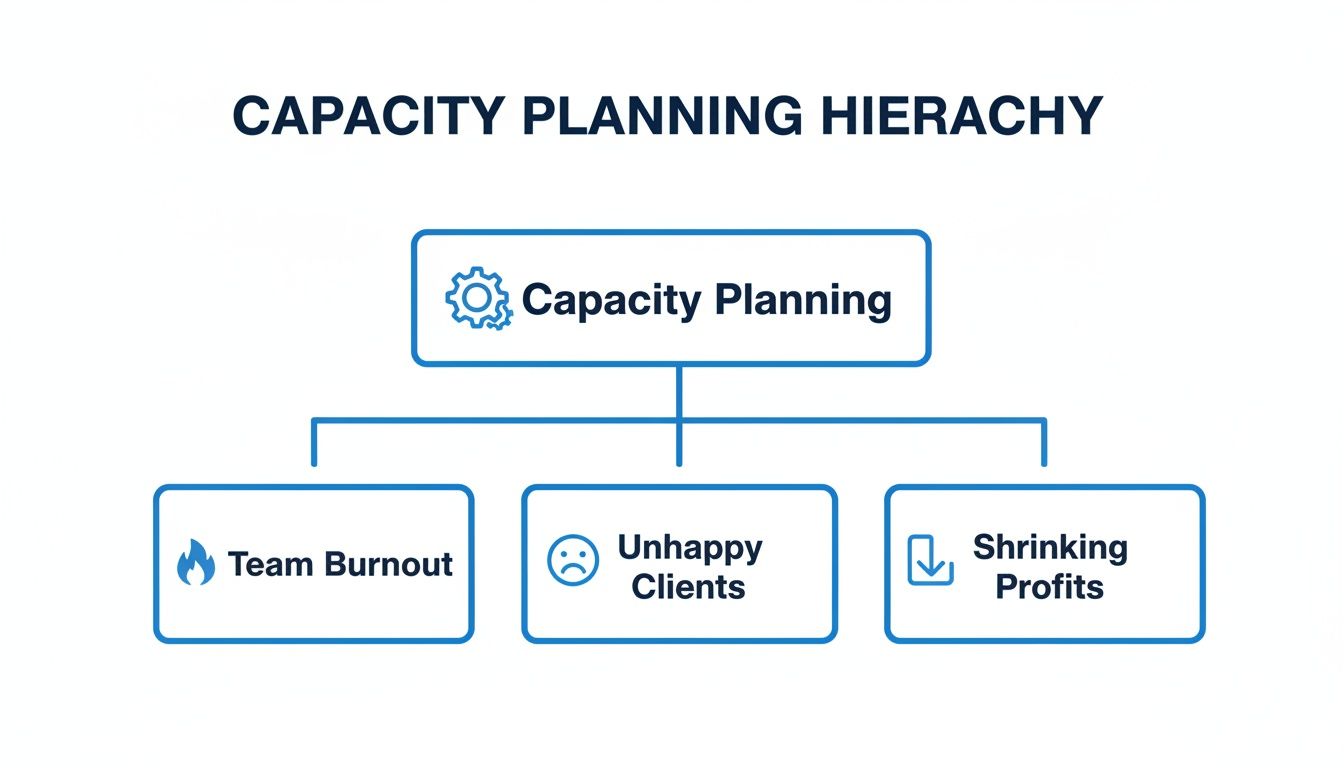
As you can see, a lack of planning creates a direct path to team burnout, unhappy clients, and shrinking profits. These are the exact problems that a three-tiered planning approach is built to prevent.
Tactical Planning: The City View.
Next, we zoom in to tactical capacity planning, which is your “city view.” This level is more concrete, usually looking ahead to the next quarter or six months. It’s all about turning that broad strategy into a solid resource plan. If strategic planning said, “hire five new specialists,” tactical planning figures out how to actually put them to work over the coming months.
Tactical planning is where your big-picture strategy gets real. It’s the critical step of assigning your people to specific upcoming projects, making sure you can actually deliver on the promises you’ve made.
Back to our architecture firm. They’d now look at their project pipeline for the next two quarters. They can see three large commercial building projects coming up that require sustainability expertise. Tactical planning is where they pencil in those new specialists for those key initiatives to make sure they’re properly staffed. This is also the stage where you spot skills gaps and figure out if you’ll need to bring in contractors for a specialized task, like acoustic engineering.
If you want to go deeper on this, our guide on resource planning and management is a great next step.
Operational Planning: The Street View.
Finally, we get down to the “street view” with operational capacity planning. This is the day-to-day, week-to-week grind. We’re talking about managing weekly timesheets, shuffling schedules to cover an unexpected sick day, and handing out specific tasks to team members. It’s intensely detailed and all about the here and now.
For example, the project manager at the architecture firm assigns one of the new sustainability consultants to wrap up the energy modeling task for “Project Alpha” this week. They are managing the immediate workload, making sure daily progress is being made and that it all rolls up to the larger project goals. This is where the rubber meets the road, turning all that planning into finished work.
Essential Metrics for Effective Capacity Planning
Moving from the idea of capacity planning to actually pulling it off comes down to one thing: good data. If you want to make smart decisions, you’ve got to track the right numbers. Think of these metrics as the dashboard for your firm’s engine room, giving you a clear, real-time view of your operational health and turning planning from a guessing game into a measurable science.
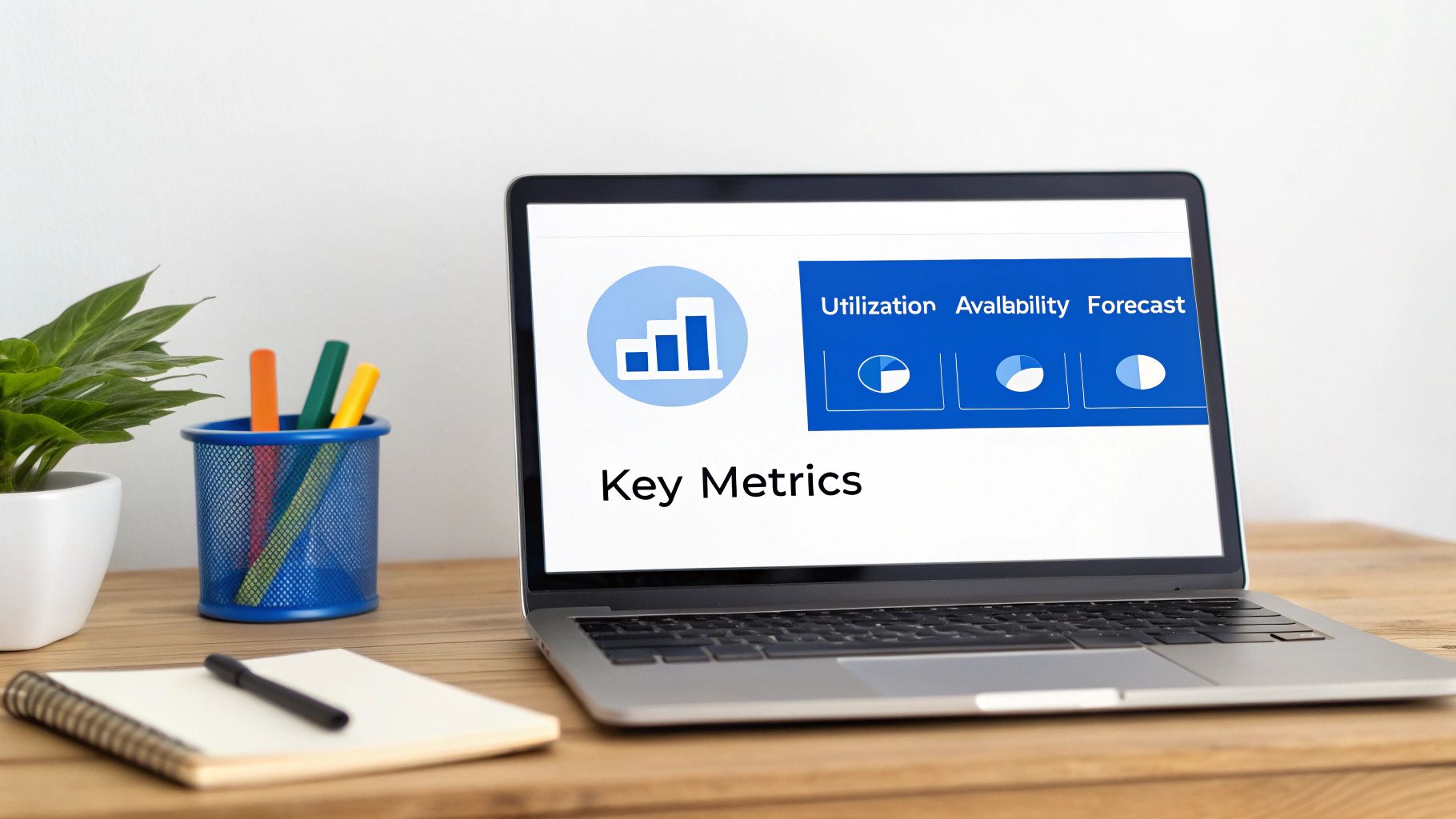
Without reliable data, even the most brilliant strategies fall apart. Recent surveys paint a pretty stark picture: despite how important it is, only 33% of organizations feel they’re any good at using data for planning. Worse, a tiny 13% rate their forecasting as “extremely effective.” It’s clear many firms are flying blind, which is why getting a handle on these metrics is non-negotiable. You can read the full resource management survey findings to get a deeper sense of the challenges out there.
To get started, let’s compare the most important metrics side-by-side.
Essential Capacity Planning Metrics Compared.
| Metric | What It Measures | Business Question Answered |
|---|---|---|
| Utilization Rate | The percentage of an employee’s available hours spent on billable client work. | Are my people busy on work that makes us money? |
| Availability | An employee’s future capacity to take on new work, calculated in hours or days. | Who is free to start a new project, and when? |
| Demand Forecast | Predicted future workload based on confirmed projects and the sales pipeline. | What skills will we need in the next 3-6 months? |
Each of these numbers tells a different part of the story. Utilization is your rear-view mirror, availability is what’s right in front of you, and demand is your GPS showing you the road ahead. Let’s dig into each one.
Understanding Utilization Rate.
For any professional services firm, the utilization rate is king. It’s a simple percentage that shows how much of an employee’s available time is spent on billable client work. It’s not just about keeping people busy; it’s about keeping them busy on the right things.
Here’s the simple math behind it:
Utilization Rate = (Total Billable Hours Logged / Total Available Hours) x 100
So, if an engineer has 40 available hours in a week and logs 32 billable hours on a project, their utilization rate is 80%. Most firms aim for a sweet spot around 75-85%. Pushing for 100% is a recipe for burnout, leaving zero time for professional development, internal initiatives, or just catching up on emails.
Tracking Team Availability.
While utilization looks backward at what’s been done, availability (or capacity) looks forward to what your team can do. This number tells you exactly who is free to take on new projects and for how many hours. For your project managers and sales team, this metric is pure gold.
Figuring out true availability means starting with total work hours and then subtracting all the other stuff:
- Total Hours: The standard work week (e.g., 40 hours).
- Minus Non-Project Time: Public holidays, PTO, and internal meetings.
- Minus Existing Project Work: Time that’s already booked for current projects.
What’s left is a person’s real availability. A project manager at a creative agency can glance at their team’s availability and confidently tell the sales team, “We have a senior designer with 20 hours a week free starting next Monday.” No more over-promising and under-delivering.
Forecasting Future Demand.
Demand forecasting is your crystal ball. It’s all about looking at your sales pipeline and current projects to predict the work (and the specific skills) you’ll need over the next few weeks and months. This is how you spot a resource gap before it becomes a five-alarm fire.
To get an accurate forecast, you need to pull in data from two places:
- Confirmed Projects: The work you’ve already won and have on the books. This is your baseline.
- Pipeline Opportunities: Potential projects sitting in your CRM, weighted by how likely they are to close. A deal with a 90% chance of closing should obviously count for more in your forecast than one sitting at 20%.
Solid demand forecasting lets you see that you’re going to be short on project managers three months from now, so you can start the hiring process today instead of scrambling when the work is already piling up.
Mastering these metrics all comes back to having accurate data. That’s why solid time tracking software is so foundational. When your team can easily log their hours against specific projects, you get the clean, reliable data needed to calculate utilization, availability, and demand, the three pillars of great capacity planning.
A Step-by-Step Guide to Implementing Capacity Planning
Knowing you need to get better at capacity planning is one thing. Actually building a repeatable process is another beast entirely. The good news? You don’t need a ridiculously complex system from day one. By breaking it down into four manageable steps, you can finally move from reactive scrambling to proactive control.
Think of this as a roadmap for any professional services firm. It transforms what feels like a daunting task into a clear, actionable process. You’re building a solid foundation. Once these steps become routine, you’ll have the operational clarity needed to drive real growth.
Step 1: Measure Your Team’s True Capacity.
Before you can plan for the future, you need an honest look at what your team can handle right now. This goes way beyond just counting heads. True capacity is about understanding the real, billable hours your team has available after you account for everything else that devours their work week.
Start by auditing your team’s total available hours. A standard 40-hour work week equals 2,080 hours per person, per year. But nobody (and I mean nobody) works on client projects for all of those hours. You have to subtract all the other stuff:
- Non-Billable Time: This is the obvious stuff, like public holidays, paid time off, and sick leave.
- Administrative Work: Time sucked into internal meetings, clearing the email inbox, and filling out timesheets.
- Professional Development: Hours dedicated to training, certifications, and keeping skills sharp.
What’s left is your team’s effective capacity, the actual number of hours you have to sell to clients. Getting this number right is the absolute bedrock of any realistic capacity plan.
Step 2: Forecast Your Future Demand.
Once you have a clear picture of your supply (your team’s capacity), it’s time to get an equally sharp view of your demand. This means looking beyond your confirmed projects and peering into your sales pipeline to see what’s coming down the road. This is where you absolutely need tight collaboration between project managers and the sales team.
Your demand forecast should blend two key data sources:
- Confirmed Workload: All the projects you’ve already won and scheduled. This is your baseline.
- Pipeline Opportunities: Potential projects from your CRM, each weighted by its probability of closing. A project with a 90% win probability should be taken far more seriously in your forecast than one sitting at 20%.
For example, an engineering firm might have 1,000 hours of confirmed work for the next quarter. They also have a proposal out for a big project (400 hours) with an 80% chance of closing, and a smaller one (100 hours) at 50%. Their demand forecast would be 1,000 + (400 * 0.8) + (100 * 0.5) = 1,370 hours. That simple bit of math gives them a much more accurate picture of what they’ll actually need.
This forward-looking approach is becoming non-negotiable. The IT Capacity Planning market, currently valued at USD 4.8 billion, is set to expand rapidly, largely driven by AI-powered modeling and predictive analytics that make forecasting more accurate than ever. To see how these trends are shaping up globally, you can explore more insights on the IT capacity planning market.
Step 3: Analyze the Gaps.
Okay, now it’s time to bring supply and demand together. Compare your team’s effective capacity against your forecasted demand to pinpoint the gaps. This analysis will reveal one of two scenarios, and both demand a response.
- Capacity Deficit: Your demand is greater than your capacity. You have more work than people to do it.
- Capacity Surplus: Your capacity is greater than your demand. You have people on the bench without enough billable work.
This gap analysis is the moment of truth in your capacity planning process. It’s where raw data turns into strategic insight, clearly showing you where you are overstretched or underutilized.
Imagine your analysis shows a massive deficit in senior developer hours for the next quarter but a surplus of junior designers. That specific insight is infinitely more valuable than a vague feeling that “we’re busy.” It tells you exactly where the pressure points are and allows you to make a surgical fix, like hiring a contract developer, rather than just panicking.
Step 4: Create an Action Plan.
The final step is turning your analysis into a concrete plan of attack. Your response will depend on whether you have a deficit or a surplus, and how long you expect that situation to last.
To tackle a capacity deficit, your options include:
- Hiring: If the demand looks long-term, bringing on new full-time employees is the most sustainable fix.
- Subcontracting: For short-term projects or to fill specialized skill gaps, freelancers or contractors give you flexibility without the overhead.
- Training: Upskilling your current team can help fill emerging skill gaps from within.
If you’re dealing with a capacity surplus, you might:
- Boost Sales Efforts: Work with the sales team to pull in more projects that are a good fit for your available team members’ skills.
- Invest in Internal Projects: Use the downtime for innovation, process improvement, or creating new intellectual property.
- Focus on Professional Development: Encourage your team to chase training and certifications, making them even more valuable for future projects.
By consistently running through these four steps, you create a dynamic loop of measurement, forecasting, and action. This transforms capacity planning from a stressful, one-off headache into a core operational habit that drives stability and profitability.
Overcoming Common Capacity Planning Challenges
Even the most perfectly crafted capacity plan will eventually collide with reality. Projects rarely follow the script, and learning to handle the inevitable bumps in the road is what separates the good planners from the great ones. Instead of getting discouraged, it’s far better to anticipate these common roadblocks and have a game plan ready.
Managing capacity well isn’t about creating a flawless, unbreakable forecast. It’s about building a resilient process that can absorb shocks and adapt on the fly. McKinsey research indicates that lack of an effective workforce planning strategy can lead to a 20-30% loss in productivity during transitions caused by talent shortages. This honest look at the pitfalls will get you ready to handle the messy realities of managing projects, clients, and people.
Dealing with Inaccurate Forecasts.
One of the biggest headaches in capacity planning is the gap between the sales team and the delivery team. When sales forecasts are a bit too optimistic or light on detail, project managers are left scrambling to staff projects that either change drastically or never even get off the ground. This just creates a cycle of frustration and wastes a ton of planning time.
The fix? Build a tighter, more collaborative feedback loop. Don’t let the forecast be a one-way street from sales to delivery.
- Schedule Regular Sync-Ups: Get sales and project leads in the same room (virtual or otherwise) every single week to walk through the pipeline.
- Use Probability Weighting: Work with sales to tag each deal with a realistic close probability. A deal sitting at 90% should carry a lot more weight in your capacity plan than one at a speculative 20%.
- Share Capacity Data: Give the sales team a window into resource availability. If they can see the design team is booked solid for the next six weeks, they can set much more realistic timelines with new clients right from the first conversation.
Managing Uncontrolled Scope Creep.
Scope creep is the silent killer of capacity. It usually starts small, a “quick favor” for a client, and slowly snowballs, piling on unbilled hours that drain your team’s availability and sink project profitability. Without a formal process, your team’s capacity gets secretly siphoned off, leaving them overworked and unavailable for the next big thing.
To fight back, you need to establish clear boundaries and a formal change-order process. This isn’t about being difficult with clients; it’s about protecting your team and your margins.
Scope creep isn’t a client problem; it’s a process problem. A clear change request system protects your team’s time and reminds everyone of the value of their work.
When a client asks for something outside the original scope, just trigger a simple process:
- Acknowledge the Request: Thank them for the idea and let them know you’re on it.
- Document the Impact: Quickly map out the extra time, resources, and cost required.
- Present the Options: Send over a formal change order for them to review and approve.
This little workflow turns an informal favor into a proper business decision, making sure you get paid for all the work you do.
Handling Unexpected Staff Turnover.
Losing a key team member out of the blue can throw even the best-laid plans into chaos, especially when you’re up against a tight deadline. While you can’t stop people from leaving, you can build a system that makes your team less fragile and your projects more resilient when it happens.
The key is to reduce dependency on any single person through cross-training and better knowledge sharing. For example, encourage your senior engineer to document critical server processes and have a mid-level engineer shadow them on key tasks. That way, when someone does move on, you have others who can step in and keep the project moving while you focus on hiring their replacement. This proactive approach turns a potential crisis into a manageable bump in the road.
Are you tired of wrestling with a tangled web of spreadsheets just to figure out who’s working on what? For way too many professional services firms, this is the painful reality. It turns capacity planning—what should be a strategic advantage—into a soul-crushing admin task that’s obsolete the second you finish it.
The good news is that modern resource management software completely flips the script. These tools act as a central hub for your entire operation, automating the grunt work and freeing you up to focus on what actually matters: making smart, forward-looking decisions.
From Disconnected Spreadsheets to a Single Source of Truth.
The fundamental flaw with planning in spreadsheets is that the data goes stale almost instantly. The moment a team member calls in sick, a client pushes a deadline, or a project’s scope creeps, your perfectly crafted plan is wrong. This kicks off a never-ending cycle of manual updates and frantic cross-checking that’s both exhausting and riddled with errors.
Modern tools fix this by putting all your data in one place. Imagine a world where your sales pipeline, team schedules, and timesheets all live in the same system and actually talk to each other. That’s the power of a unified platform. It gives everyone, from project managers to the C-suite, the same clear, up-to-the-minute view of the business.
Getting a Real-Time View With Dashboards.
One of the biggest immediate wins you’ll get from a purpose-built tool is the instant clarity from a real-time dashboard. No more digging through three different files to answer a simple question. Instead, you get a live snapshot of your team’s workload and availability.
You can see at a glance exactly who is free and who is slammed.
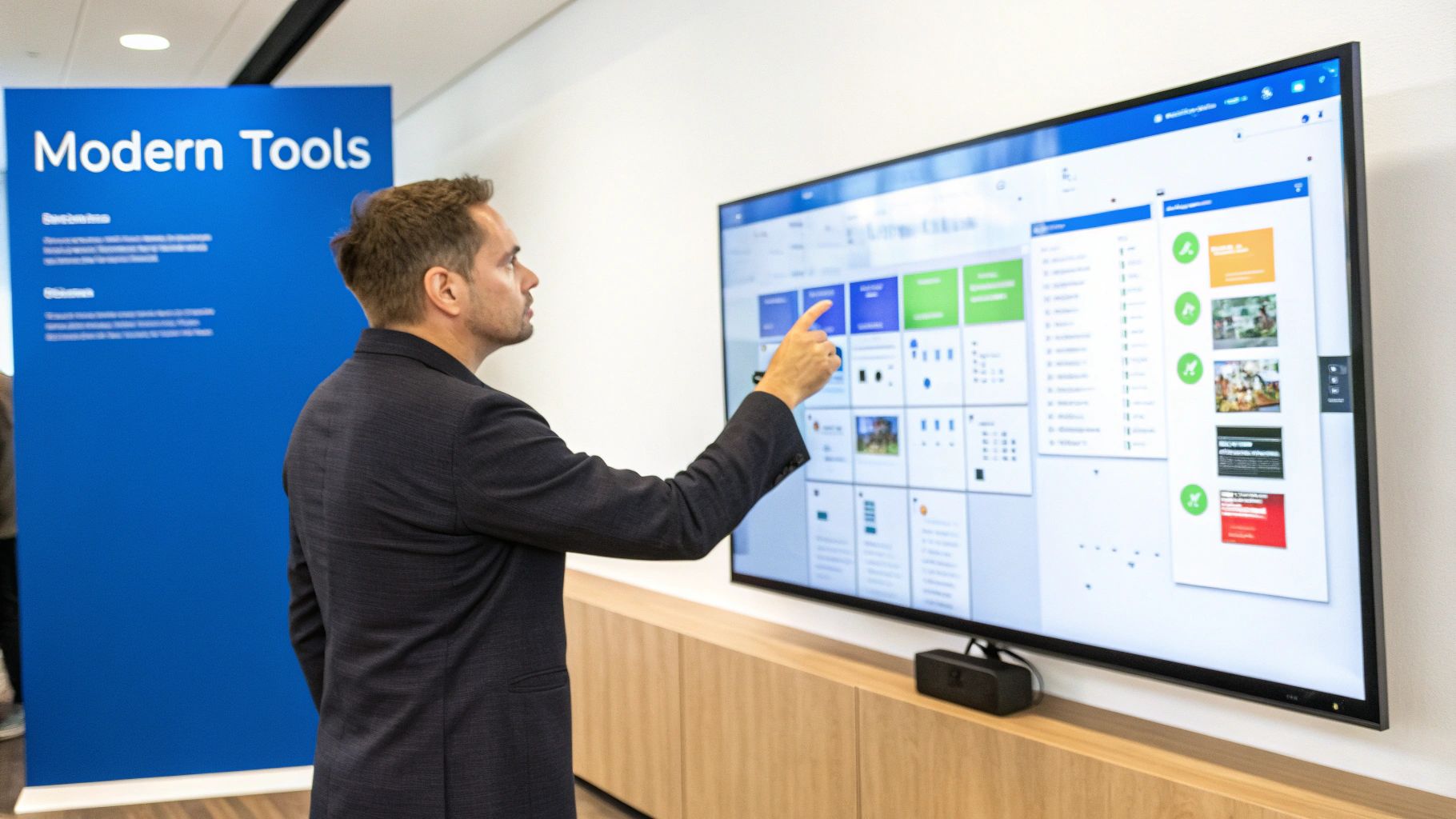
This kind of visual insight lets managers spot potential bottlenecks weeks ahead of time, allowing them to make proactive staffing moves before a small problem becomes a full-blown crisis.
Forecasting With Confidence, Not Guesswork.
As we’ve covered, solid forecasting is the engine that drives effective capacity planning. But for most firms, it feels more like throwing darts in the dark. Modern tools bring a data-driven approach to the table, using historical project data and pipeline probabilities to generate much more reliable demand forecasts.
This unlocks a few powerful advantages:
- Smarter Hiring: Instead of hiring based on a “gut feeling,” you can see a clear projection that shows you’ll need two more engineers in Q3. This lets you get ahead of recruiting instead of making last-minute, panicked hires.
- Tighter Sales Alignment: When your sales team has a real-time view of capacity, they can set realistic start dates with clients. This leads to happier customers and much smoother project kickoffs.
- Better Financial Planning: Trustworthy forecasts lead to more accurate revenue projections, giving leadership the confidence to invest in growth initiatives.
The right software doesn’t just tell you what your team is doing today; it helps you confidently predict what they’ll need to be doing six months from now.
Specialized tools are built to handle the unique messiness of service operations. For firms ready to move beyond basic task lists, exploring consulting project management software shows how an integrated system can connect everything from resource allocation to invoicing, turning your operational data into a genuine strategic asset.
As you start putting these ideas into practice, a few common questions are bound to pop up. Think of this section as your quick-reference guide to clarify the tricky parts, build confidence in your strategy, and make sure your capacity planning process gets off to a solid start.
What Is the Difference Between Capacity and Resource Planning?
It’s easy to mix these two up, but they operate at totally different altitudes.
Capacity planning is your strategic, 30,000-foot view. It answers the big-picture question: “Do we have enough designers in the whole studio to handle the work we expect to win next quarter?” It’s all about the forest.
Resource planning, on the other hand, gets right down to the ground level. It’s tactical and answers the immediate question: “Who exactly is available to start on the Miller account next Monday?” It’s about the individual trees.
In short, capacity planning makes sure you have enough builders for the entire construction season, while resource planning assigns a specific builder to lay a specific brick on a specific wall today.
How Often Should We Revisit Our Capacity Plan?
There’s no single right answer, but the best approach is to treat it as a continuous process with regular check-ins, not a one-and-done document.
- Strategic (Annually): A high-level review once a year is perfect for aligning with long-term business goals, like expanding into a new service area or hitting a major revenue target.
- Tactical (Quarterly): Check in every quarter to adjust for shifts in your sales pipeline. This is where you’ll make those medium-term decisions about hiring, training, or bringing on contractors.
- Operational (Weekly/Bi-Weekly): Your project managers should be looking at the immediate runway every single week. This is about managing the day-to-day reality of project work and spotting small issues before they become big problems.
Your capacity plan shouldn’t be a static document gathering dust. Think of it as a living dashboard that needs regular attention to stay relevant and useful. It’s your early warning system.
Can a Small Firm Really Benefit from This?
Absolutely. In fact, for a smaller firm, getting capacity planning right is even more critical.
When you have a lean team, the ripple effect of one overbooked person or an unexpected project delay is felt across the entire business. It’s not a minor headache; it’s a potential crisis.
For a small architecture studio, for instance, knowing they have a capacity gap two months out gives them breathing room to find the right freelance drafter. Without that foresight, they’d be forced into a rushed, expensive hire just to keep a project from derailing, or worse, turn down a great new client.
Research from Edstellar shows that companies can save up to 30% in operational costs by optimizing their workforce capacity through careful planning. Effective capacity planning allows small firms to punch well above their weight, operating with the efficiency and foresight of a much larger organization. The principles of balancing what you have with what you need are universal, and getting it right is a key driver of sustainable growth.
Ready to move beyond chaotic spreadsheets and get a real-time, crystal-clear view of your team's capacity?
Drum brings your projects, people, and pipeline into a single source of truth, turning complex planning into a simple, powerful process.
See how you can boost profitability and empower your team. Start your free 14-day trial now.