
- Mastering Consulting Project Management for Predictable Success
- What Is Consulting Project Management Really About
- More Than Just Managing Tasks
- The Foundation of Profitability and Growth
- The Unique Challenges of Managing Consulting Projects
- Navigating Scope Creep and Stakeholder Agendas
- Proving Value and Demonstrating ROI
- Discipline-Specific Hurdles in Consulting
- Walking Through the Consulting Project Lifecycle
- Phase 1: Proposal and Scoping
- Phase 2: Project Kickoff
- Phase 3: Execution and Monitoring
- Phase 4: Delivery and Closing
- Measuring What Matters for Consulting Success
- Core KPIs for Consulting Profitability
- Key Financial and Performance KPIs for Consulting Projects
- Establishing Strong Project Governance
- A Step-By-Step Workflow for Flawless Delivery
- Standardize Your Project Setup
- Implement Proactive Risk Management
- Centralize Communication and Documentation
- Streamline Time and Expense Tracking
- How Technology Unifies Your Consulting Practice
- Moving to a Single Source of Truth
- The Financial Impact of a Unified System
- On-the-Ground Reality: Answering Your Toughest PM Questions
- How Do I Handle a Difficult Client?
- What’s the Best Way to Deal with Scope Creep?
- What Should I Look for in Consulting Project Management Software?
Mastering Consulting Project Management for Predictable Success
When someone says “consulting project management,” what comes to mind? If it’s just Gantt charts and deadlines, you’re only seeing a tiny piece of the puzzle. Let’s explore what it really takes to guide projects to predictable, profitable success.
What Is Consulting Project Management Really About
Let’s get real—consulting project management is less about ticking off boxes and more about the art of navigating a client from a complex, often murky problem to a crystal-clear solution. It’s a delicate dance between technical execution and genuine human connection.
A traditional project manager is usually focused on internal resources, timelines, and budgets. A consultant, on the other hand, is doing all that plus managing external expectations, navigating tricky client politics, and constantly proving the value of their work. It’s a completely different ballgame, and it requires a special blend of skills.
More Than Just Managing Tasks
At its heart, this discipline is about orchestrating success in a high-stakes world where your “product” is expertise. You aren’t just delivering a report or a new system; you’re delivering confidence, clarity, and cold, hard results.
This means a project manager in a consulting firm has to be a master of a few key things:
- Relationship Management: Building trust and keeping the lines of communication wide open with client stakeholders, who often have their own competing agendas. For example, ensuring the CFO feels heard about budget constraints while also addressing the marketing lead’s need for a quick launch.
- Expectation Setting: Defining the scope of work with surgical precision right from the start. This is your best defense against scope creep that loves to disguise itself as a “minor tweak.”
- Value Demonstration: Always, always connecting project tasks back to the client’s business goals. You have to constantly show them the return on their investment. For instance, explaining that “this week’s user research phase will directly inform the website design to reduce customer support calls by an estimated 20%.”
In consulting, the project plan is both a roadmap for your team and a pact with your client. If one side fails, the other feels it immediately. Great project management is the essential bridge connecting your firm’s expertise to the client’s goals.
The Foundation of Profitability and Growth
Think of effective consulting project management as the engine that powers a healthy firm. It’s what fights back against the silent killers of profitability: scope creep, blown budgets, and putting the wrong people on the wrong tasks. Without it, even the most brilliant consultants can watch their projects go completely off the rails.
And the stakes couldn’t be higher. The global management consulting market blew past the US$1.0 trillion mark in the mid-2020s and is on track to hit US$1.32 trillion by 2029. That incredible growth means one thing: consultants who can’t deliver projects on time and on budget will be left behind. You can dig deeper into these numbers by exploring the full consulting industry outlook.
Ultimately, getting this right isn’t just about wrapping up one project successfully. It’s about building a rock-solid reputation for reliability, creating long-term client partnerships, and building a business that’s not just profitable, but sustainable. In the next sections, we’ll break down the practical steps to make that a reality.
The Unique Challenges of Managing Consulting Projects
Why do consulting projects feel so different from the ones you run internally? Because they are. Managing a project inside your own company is one thing; guiding an external client through a high-stakes engagement is another beast entirely. The context adds layers of complexity that can quickly send the best-laid plans off the rails.
Consulting projects live at the intersection of expertise, relationships, and raw commercial pressure. You’re not just managing tasks on a timeline. You’re managing a client’s expectations, their team’s anxieties, and the constant need to prove the value you’re delivering every single day. This pressure cooker creates a unique set of hurdles you just don’t find anywhere else.
Navigating Scope Creep and Stakeholder Agendas
One of the most persistent threats is scope creep, and it rarely announces itself. It usually shows up disguised as a “clarification” or a “small request.” A client might ask for “just one more data dashboard,” not realizing it requires days of development work that was never factored into the original budget. Just like that, your timeline is squeezed and your profit margin starts to evaporate.
This problem gets even messier when you’re juggling multiple stakeholders with competing agendas. Picture an IT consulting project: the CFO wants to slash costs, the Head of Sales needs new features rolled out yesterday, and the IT Director is rightly concerned about security protocols. As the consultant, you’re stuck in the middle, trying to find a path forward that keeps everyone happy without torpedoing the project’s integrity. It’s a delicate balancing act that requires serious communication and negotiation chops.
The success of a consulting engagement often hinges less on the technical execution and more on the consultant’s ability to manage the human elements—the politics, the expectations, and the personalities involved.
History shows us just how real this risk is. For instance, roughly 80% of public-sector IT projects blow past their schedules, a number significantly higher than the 52% seen in the private sector. These figures aren’t just abstract stats; they highlight the very real delivery risks that shape modern consulting and underscore why solid project governance is non-negotiable. You can dive deeper into these trends by exploring more project management statistics.
Proving Value and Demonstrating ROI
Unlike an internal project where the value is often implicitly understood, every consulting engagement comes with an invoice. This creates constant pressure to demonstrate a clear return on investment (ROI). Every deliverable, every meeting, and every hour you bill has to be justifiable and tied directly back to the client’s business goals. You’re not just a project manager; you’re a value communicator.
Discipline-Specific Hurdles in Consulting
The exact flavour of these challenges also shifts dramatically depending on your industry. A “one-size-fits-all” approach to consulting project management is doomed to fail because the dependencies, risks, and feedback loops are fundamentally different from one discipline to the next.
It’s easy to see how a generic project plan can fall apart when you look at how these challenges show up in different types of firms.
| Consulting Discipline | Primary Challenge | Example Scenario |
|---|---|---|
| Engineering & Architecture | Tangible, Sequential Dependencies | A two-week delay in a specific steel beam delivery halts all subsequent construction phases, causing a massive cascading effect on the timeline and budget. The critical path is rigid and unforgiving. |
| Marketing & Creative Agencies | Subjective Feedback & Revision Cycles | The marketing director loves the new campaign concept, but the CEO thinks it’s “off-brand.” This leads to weeks of endless revisions, burning through hours and pushing deadlines. |
| IT & Software Consulting | Technical Complexity & User Adoption | The new CRM system is technically deployed, but the sales team finds it clunky and refuses to use it, sticking to their old spreadsheets. The project isn’t truly “done” until people adopt the new workflow. |
As the table shows, the core problem might be a delay or a stakeholder issue, but the impact is wildly different. An architect’s dependency is physical and often unchangeable, while an agency’s is subjective and requires deft political handling. Understanding these nuances is the first step toward building a project management process that actually works for your firm.
Walking Through the Consulting Project Lifecycle
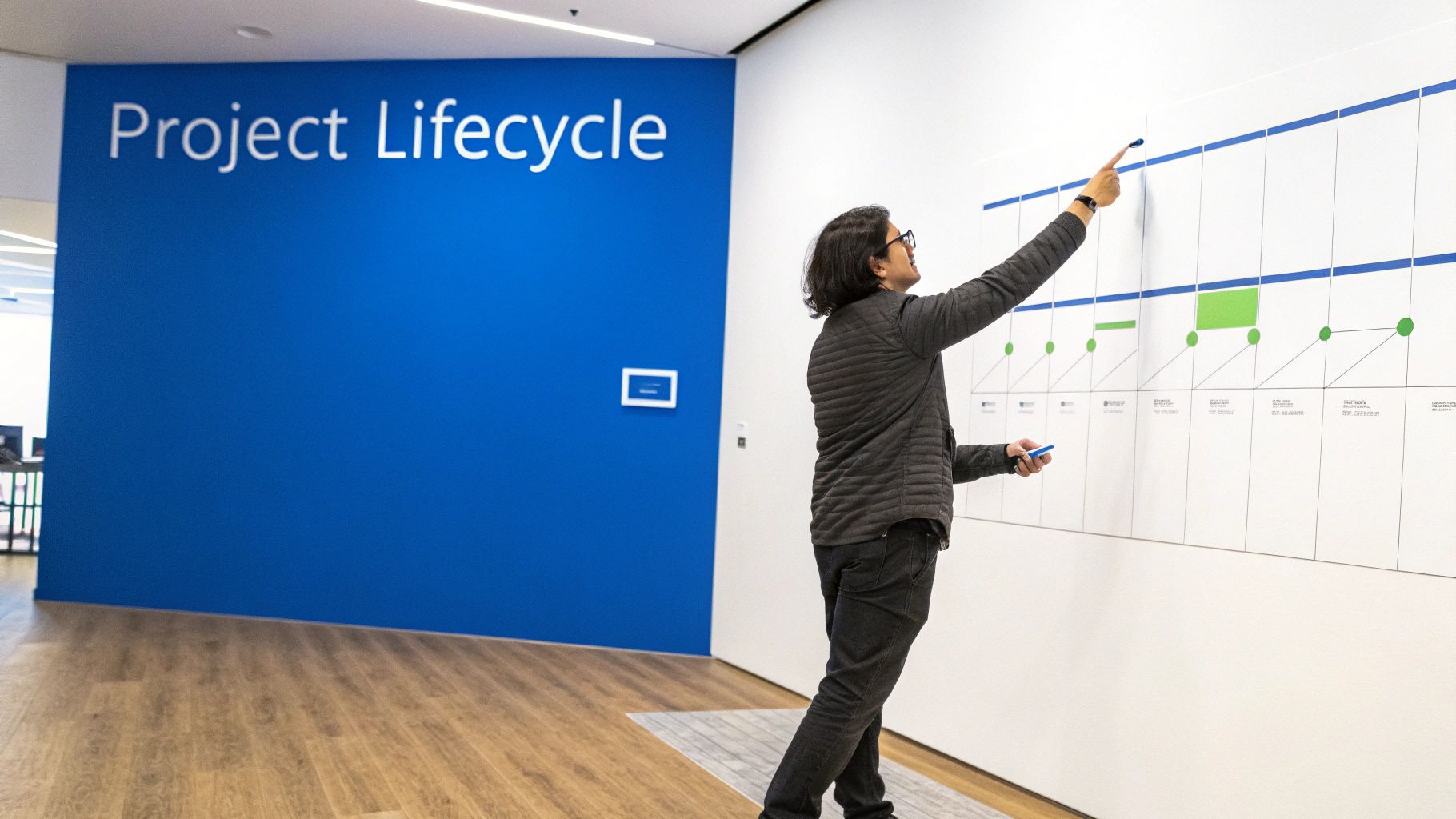
Every single consulting project tells a story. It has a beginning where the client’s problem is defined, a middle filled with the hard work of solving it, and an end where you deliver real, tangible value. Understanding this narrative—the consulting project lifecycle—is the key to making sure that story has a happy (and profitable) ending.
When you start thinking of a project as a journey with distinct stages, you can anticipate what’s coming around the bend. It’s like having a map that turns a potentially chaotic engagement into a series of predictable, manageable steps. Let’s walk through that journey together, phase by phase.
Phase 1: Proposal and Scoping
This is where projects are truly won or lost, often before a single task even exists. The proposal and scoping phase isn’t just about winning the business; it’s your opportunity to build a rock-solid foundation for success. Getting this stage right means defining exactly what you will do, what you won’t do, and how everyone will know when you’re done.
Your main goal here is to stop scope creep before it even has a chance to start. That requires crystal-clear language that leaves zero room for interpretation down the line.
- Practical Example: An engineering firm is bidding on a bridge inspection. A vague proposal might say they’ll “assess structural integrity.” A great proposal specifies they will conduct “visual inspections, ultrasonic thickness testing on 25 designated support beams, and a final report outlining deficiencies and remediation recommendations.” This precision is their shield when the client later asks for soil sample analysis, which was clearly out of scope.
A well-defined scope is a mutual agreement that both you and your client can point to throughout the project. Think of it as your project’s constitution.
Phase 2: Project Kickoff
The project kickoff meeting is so much more than a formality. It’s a critical ceremony that sets the tone for the entire relationship. This is your one shot to get everyone—your team and the client’s key people—aligned around a shared vision and a common set of ground rules.
During the kickoff, you’ll introduce the players, go over the project goals and scope one last time, and lock down the communication plan. Will you have weekly check-in calls? Do they expect bi-weekly status reports? Answering these questions now prevents a world of frustration later.
The project kickoff isn’t really about starting the work; it’s about defining how the work will get done. A strong start builds momentum and, just as importantly, builds the client’s confidence in you.
This is also the perfect time to bring up potential risks with the client’s input. Getting these concerns out in the open early shows foresight and starts the project off with a spirit of true collaboration.
Phase 3: Execution and Monitoring
With the plan set, your team dives into the execution phase. This is where the bulk of the work happens—the research, the analysis, the design, the actual doing. As the project manager, your role pivots from planner to conductor, making sure every section of the orchestra is playing in tune and on tempo.
Effective consulting project management during this phase is all about proactive communication and relentless monitoring. You need to keep a close eye on three things at all times:
- Budget: How are we tracking against the planned spend?
- Timeline: Are we hitting our key milestones on schedule?
- Scope: Are new requests being properly managed through a formal change order process, not just added on the fly?
Regular check-ins allow you to spot tiny deviations before they become massive problems. If a task is taking longer than planned or a cost is creeping up, you can deal with it right away instead of having a crisis later. This is where having a single source of truth for all project data becomes an absolute game-changer.
Phase 4: Delivery and Closing
The final phase is all about delivering on your promise and formally wrapping up the engagement. This is more than just emailing a final PDF. It means presenting your findings in a way the client understands, managing the handover, and making sure they feel they got their money’s worth.
A crucial, and often skipped, step is the project retrospective or “post-mortem.” This internal meeting is where your team discusses what went well, what went wrong, and what was learned. These lessons are pure gold, giving you insights that will make your very next project even more successful.
Finally, the project closes out with the final invoice and a confirmation of payment. A clean, well-managed closing doesn’t just ensure you get paid on time; it leaves a lasting positive impression that opens the door for repeat business and valuable referrals.
Measuring What Matters for Consulting Success
Simply finishing a project on time and within budget feels like a win, but does it really tell the whole story? Not even close. True success in consulting project management goes much deeper, focusing on metrics that reveal the actual health and profitability of your engagements.
These are the numbers that tell you if you’re just busy or genuinely building a sustainable business. When you start measuring what truly matters, you shift from a reactive mindset of just getting work done to a proactive one of optimizing every project for financial health and client delight. It’s the difference between flying blind and having a full dashboard of instruments guiding your decisions.
Core KPIs for Consulting Profitability
To get a clear picture of performance, consulting firms rely on a handful of key performance indicators (KPIs). These metrics cut through the noise and give you an honest look at your firm’s operational and financial efficiency.
Let’s unpack three of the most essential ones:
-
Billable Utilization: This is the big one. It’s the percentage of a consultant’s available time that is spent on billable client work. A direct measure of productivity, it shows you how much of your team’s capacity is actually generating revenue. If a consultant has 40 available hours in a week and logs 32 billable hours, their utilization is 80%.
-
Project Margin: This metric tells you exactly how profitable a specific project is. To calculate it, you subtract all project-related costs (salaries, subcontractor fees, software, etc.) from the total revenue that project brought in. For instance, if a project brings in $50,000 and costs $35,000 in salaries and expenses, your project margin is $15,000, or 30%. A healthy project margin is a sign of efficient scoping, staffing, and execution.
-
Client Satisfaction (CSAT): How happy are your clients? CSAT answers this question, often through a simple survey asking them to rate their satisfaction on a scale. It’s a powerful leading indicator of repeat business, referrals, and long-term relationships.
Tracking these KPIs is fundamental, not just a nice-to-have. In fact, billable utilization is such a critical financial lever that when it fell to 68.9% in a recent year—well below the typical target of 75%—it put direct pressure on firms to get smarter with their staffing and scoping. You can find more details about these industry benchmarks and other insightful project management statistics to guide your plans.
The table below provides a quick overview of the most critical metrics for measuring the success and profitability of consulting engagements.
Key Financial and Performance KPIs for Consulting Projects
| KPI | What It Measures | Why It’s Important |
|---|---|---|
| Billable Utilization | Percentage of an employee’s time spent on revenue-generating work. | Directly impacts revenue and reveals team productivity and capacity. |
| Project Margin | The profitability of an individual project (Revenue - Costs). | Shows the financial success of each engagement and the effectiveness of your scoping and delivery. |
| Client Satisfaction (CSAT) | Client happiness with the project’s outcome and process. | A leading indicator of client retention, referrals, and future business opportunities. |
| Schedule Variance (SV) | The difference between planned project progress and actual progress. | Helps identify if a project is ahead of or behind schedule, allowing for proactive adjustments. |
| Cost Performance Index (CPI) | The ratio of earned value to actual cost, measuring cost efficiency. | A CPI less than 1 indicates a budget overrun, providing a clear signal to rein in spending. |
| Resource Capacity | The total available work hours of your team versus their scheduled work. | Prevents team burnout and ensures you have the right people available for upcoming projects. |
By keeping a close eye on these numbers, you can move beyond simple project completion and start making data-driven decisions that consistently boost your bottom line.
Establishing Strong Project Governance
Beyond just tracking numbers, successful projects need a clear structure for making decisions and managing accountability. This is where project governance comes in. Think of it as the project’s operating system—a framework that defines roles, responsibilities, and the rules of engagement from the get-go.
Without clear governance, projects easily get bogged down in confusion. Who has the final say on a design change? Who needs to sign off on a budget increase? Answering these questions upfront prevents delays and keeps everyone moving forward smoothly.
A common mistake is assuming the client’s internal hierarchy will automatically work for your project. Great project governance establishes a dedicated framework, like a steering committee, that is purpose-built to guide the engagement and make decisions efficiently.
For larger, more complex projects, establishing a steering committee is a fantastic governance tool. This committee typically includes key stakeholders from both your firm and the client’s organization. They meet regularly to review progress, resolve major issues, and ensure the project stays aligned with its strategic goals.
A well-defined governance structure gives everyone clarity and confidence. Your team knows who to go to for decisions, and the client knows their investment is being managed with professional rigor. It’s a crucial component for navigating the complexities of high-stakes consulting work, especially when the client’s environment is politically charged. And as you get better at this, integrating project management and accounting systems can give you the real-time data to make these governance meetings even more effective.
A Step-By-Step Workflow for Flawless Delivery
Knowing the theory behind consulting project management is one thing, but execution is where you make money and keep clients happy. Moving from a plan to actually doing the work requires a repeatable, battle-tested workflow. This is what brings consistency to your projects and gives clients that unshakable confidence in your firm.
This isn’t about creating rigid, soul-crushing processes. It’s about building a smart, adaptable framework that empowers your team to deliver their best, project after project. Let’s walk through a practical workflow you can start using today to nail your delivery and protect your margins.
Standardize Your Project Setup
The first move toward flawless delivery is to stop reinventing the wheel every time a new contract is signed. By standardizing your project setup, you guarantee nothing gets missed during that critical kickoff phase. It all comes down to creating and using templates for your key documents and activities.
A solid setup process usually includes:
- A Standardized Project Charter: A go-to template that nails down the project goals, scope, key players, and high-level risks before any real work kicks off.
- A Kickoff Meeting Checklist: A repeatable agenda ensuring every single kickoff covers the essentials, like how you’ll communicate, what success looks like, and a final review of the SOW.
- Pre-configured Task Lists: Templates for common project types (think “Phase 1 Website Audit” or “Building Code Compliance Review”) that you can quickly deploy and tweak as needed.
This approach doesn’t just save a ton of time; it also slashes the risk of human error. It creates a professional, organized first impression that sets the tone for the entire engagement.
Implement Proactive Risk Management
Too many teams wait for fires to start before they grab the extinguisher. The best consulting firms hunt for smoke. Proactive risk management isn’t about being a pessimist; it’s about being prepared. It’s the simple act of asking, “What could go wrong?” long before it actually does.
One of the most powerful—and simple—tools for this is a Risk Register. This is just a live document where you track potential risks, their likelihood, their potential impact, and your mitigation plan.
Practical Example: Before starting a big software implementation, your team runs a “pre-mortem.” You get everyone to imagine the project has failed spectacularly six months down the line and brainstorm all the reasons why. This might uncover a hidden risk—like the client’s IT team not having the skills to maintain the new system—letting you build a training plan into the scope before it becomes a crisis.
This forward-thinking approach shifts your role from firefighter to strategist. It gives clients immense confidence that you can steer the ship safely to its destination. The demand for this kind of skilled management is booming; estimates show that the global workforce of 40 million project managers will need to grow by another 30 million by 2035 to keep up. You can dig into the data behind this skills gap by reading more about global project management statistics.
Centralize Communication and Documentation
Where’s the latest client feedback? Who signed off on that change request? If the answers are buried in a dozen different email threads and Slack channels, your project is already on shaky ground. Having a single source of truth for all project communication and documentation is absolutely non-negotiable.
This central hub ensures everyone—your team and your client—is on the same page. It cuts through the confusion, stops important details from slipping through the cracks, and creates an official record of every decision made.
Streamline Time and Expense Tracking
Accurate time and expense tracking is the bedrock of a profitable consulting firm. It’s what drives your invoicing, tells you if you’re on budget, and gives you the data for crucial KPIs like billable utilization and project margin. And yet, it’s often the most hated part of the workflow.
Making this process as painless as possible is the key to getting your team to actually do it. Pick tools that make it dead simple for consultants to log hours and expenses from anywhere, whether they’re at their desk or on-site with a client. The goal is to capture this data in real-time, not weeks later when everyone’s memory is fuzzy. For firms looking to tighten up this area, it’s worth exploring dedicated time tracking software for consultants to see how the right tech can solve this common headache.
How Technology Unifies Your Consulting Practice

If you’ve ever tried to stitch together a project’s financial health from a mess of spreadsheets, email chains, and a separate time-tracking app, you know the feeling. It’s chaotic. And it’s a massive drain on profitability.
This disconnected, patchwork approach creates data silos where critical information gets lost. Decisions slow to a crawl, and budget blowouts become a nasty surprise instead of a predictable risk.
The fix isn’t just another tool; it’s about fundamentally changing how you operate. The smartest consulting firms are ditching the app-for-everything model and moving to a single, unified system—the central nervous system for their entire business.
Moving to a Single Source of Truth
The most powerful way to make this happen is with a Professional Services Automation (PSA) platform. Think of it as the complete operating system for your consulting firm, pulling every piece of the consulting project management puzzle into one cohesive place.
Instead of your team jumping between a half-dozen different programs, they get a single hub to manage everything:
- From Proposal to Project: A won proposal can automatically kick off a new project, pre-populated with its scope, budget, and initial tasks. No manual setup needed.
- Integrated Time and Expenses: Consultants log hours and expenses directly against specific project tasks, giving you a live view of budget burn without any manual data entry.
- Unified Resource Planning: See who is working on what, who has bandwidth, and who is overbooked, all from a single dashboard.
A unified platform gets your team out of the administrative weeds and back into high-value client work. It hands back the time and mental energy you need to focus on what clients are actually paying you for: your expertise.
This isn’t just about convenience; it’s a strategic advantage. It gives you complete, real-time visibility into the health of every project and the firm as a whole.
The Financial Impact of a Unified System
The push for better tooling is undeniable. Valued at US$7.24 billion in 2025, the project management software market is expected to rocket to US$12.02 billion by 2030. That growth is being driven by firms just like yours needing to scale delivery and automate reporting to stay in the game. You can dig into these trends in the latest project management market statistics.
When you bring project management and accounting into the same system, you unlock incredibly powerful insights. You can instantly see which projects are your most profitable, which clients are draining resources, and where your team is hitting their billable targets.
This is the kind of data that lets you make confident, proactive decisions that go straight to your bottom line.
When your firm runs on a single source of truth, everything from invoicing to forecasting becomes faster and more accurate. To see how this works in practice, check out our deep dive into consulting project management software and see how it connects all the dots.
On-the-Ground Reality: Answering Your Toughest PM Questions
Even the most buttoned-up project plan runs into trouble. It’s just the nature of consulting. Here are a few common curveballs we see all the time, along with some practical advice for navigating those tricky situations without derailing your project.
How Do I Handle a Difficult Client?
Let’s be honest, “difficult” clients are often just nervous clients. The first step isn’t to be defensive, but to listen. Get to the root cause of their frustration—is it a budget worry, a timeline crunch, or a disconnect on the expected outcome?
Once you really understand where they’re coming from, you can calmly walk them back through the agreed-upon scope of work and the project plan. Frame it as a partnership. Reaffirming your commitment to their success and outlining a clear path forward can work wonders. Sometimes, just setting up a regular 15-minute check-in is enough to rebuild confidence and keep everyone on the same page.
What’s the Best Way to Deal with Scope Creep?
The only way to win the battle against scope creep is to have a rock-solid change request process in place from day one. It’s non-negotiable.
When a client asks for “just one more thing,” your response shouldn’t be a simple yes or no. Instead, try this: “That’s a great idea. Let me put together a quick change order that shows the impact on our timeline and budget. You can approve it from there.”
This simple script accomplishes three critical things:
- It formally documents every new request.
- It forces an immediate, transparent conversation about trade-offs (time vs. cost).
- It puts the client in the driver’s seat, letting them make an informed decision.
This isn’t about being rigid; it’s about protecting the project’s health so you can actually deliver what you originally promised.
What Should I Look for in Consulting Project Management Software?
The right software should feel like a partner, not another problem to solve. Stop looking for single-feature tools and start looking for a unified platform that brings everything together—proposals, time tracking, project financials, the works.
Your goal is a single source of truth. You need real-time visibility into project health, who’s available to do the work, and whether you’re actually making money. A clunky, complicated interface will just gather dust, so an intuitive user experience is just as important. If your team won’t use it consistently, it’s worthless.
Ready to unify your consulting practice and swap chaos for clarity?
Drum is the all-in-one platform built to run your entire business, from the first conversation to the final invoice.
Start your free 14-day trial and see how much simpler project management can be.