
- How to compute overhead rate: a simple guide
- Your Quick Guide to Calculating Overhead Rate
- Why Your Overhead Rate Is a Big Deal
- Identifying Your Direct and Indirect Costs
- What Are Your Direct Costs?
- Pinpointing Your Indirect (Overhead) Costs
- Choosing the Right Allocation Base for Your Agency
- Direct Labor Hours
- Direct Labor Costs
- Mastering the Overhead Rate Formula with Examples
- Calculating an Overhead Rate Percentage
- Calculating a Rate Per Direct Labor Hour
- Using Your Overhead Rate to Drive Profitability
- Informing Your Client Pricing Strategy
- Monitoring Your Financial Health Over Time
- Answering Your Top Questions About Overhead Rates
- How Often Should I Run These Numbers?
- What’s a “Good” Overhead Rate for a Services Firm?
- What Are the Most Common Mistakes People Make?
- How Does Remote Work Change the Overhead Calculation?
How to compute overhead rate: a simple guide
Ever feel like you’re putting in the hours, but the profits just don’t seem to reflect the effort? More often than not, the culprit is hiding in one critical number: your overhead rate. It’s a common feeling, and you’re in the right place to figure it out.
To get your overhead rate, you simply divide your total indirect costs (that’s your overhead) by a chosen business metric, like your team’s direct labor costs or billable hours. This simple calculation tells you exactly how much you’re spending on essentials like rent, software, and admin for every dollar you spend—or hour you work—on direct client projects.
Your Quick Guide to Calculating Overhead Rate
Think of your overhead rate as a financial health check for your agency or consultancy. A high rate might be a red flag for inefficiency, while a lean rate suggests you’re running a tight, effective operation. Nailing this number is the first real step toward smarter pricing, better budgeting, and genuinely profitable projects.
Let’s break down how to turn this simple formula into your most powerful tool for financial clarity.
Why Your Overhead Rate Is a Big Deal
At its core, the overhead rate is the bridge between all your background operational spending and your actual revenue-generating work. Without it, you’re just guessing how much it really costs to deliver a project for a client.
Getting this number right is a game-changer. It helps you with:
- Spot-On Project Pricing: You can finally create quotes that cover not just your team’s time, but also each project’s fair share of the company’s running costs. No more accidental charity work.
- True Profitability Analysis: Figure out which clients or services are your cash cows and which ones are secretly draining your bank account.
- Smarter Budgeting and Forecasting: Use your historical overhead rate to build financial forecasts you can actually trust and set budgets that aren’t just wishful thinking.
- Boosting Operational Efficiency: When you track your rate over time, you’ll immediately spot rising costs. This gives you a chance to plug financial leaks before they sink the ship.
A good rule of thumb is to keep your overhead ratio at or below 35% of your total revenue, but this can definitely vary between industries. The real goal is to track your own trend and aim for stability or a gradual decrease.
For consultancies and creative agencies, the most practical methods usually involve calculating the rate as a percentage of your direct labor costs or as a dollar amount per direct labor hour. Each method gives you a slightly different lens to view your business’s financial health. We’ll dive into these next, so you can pick the one that makes the most sense for you and start making decisions that fuel real, sustainable growth.
Identifying Your Direct and Indirect Costs
Before you can nail down an overhead rate, you first need to sort all your business expenses into two distinct piles. Think of it as spring cleaning your finances! Getting this first step right is everything; a miscategorized expense will throw off your entire calculation. The goal here is simple: separate the costs that directly generate revenue from the costs that just keep the lights on.
Think of it like this: direct costs are the expenses you can point to and say, “That was for Client X’s project.” In any consulting firm or creative agency, this is almost always your team’s time.
On the other hand, indirect costs—your overhead—are all the essential background expenses. You absolutely need them to operate, but you can’t logically tie them to a single client deliverable.
What Are Your Direct Costs?
Direct costs are any expenses you can trace directly back to a specific, paying project. For almost any professional services firm, the single biggest direct cost is direct labor.
This includes the salaries and wages of your team for the time they spend working on billable client projects. For example, if a designer spends 40 hours on the “Acme Corp Rebranding” project, that portion of their salary is a clear-cut direct cost. Another example could be the cost of stock photography purchased specifically for one client’s advertising campaign.
Key Takeaway: If an expense wouldn’t exist without a specific, revenue-generating client project, it’s almost certainly a direct cost. This clarity is essential when you compute your overhead rate.
Pinpointing Your Indirect (Overhead) Costs
Indirect costs are all the other expenses your business needs to function. They support your revenue-generating activities but aren’t tied to any single project.
Getting a firm grip on these is vital. Using a dedicated platform to manage and tag every expense as it comes in makes this a whole lot easier. For a deeper dive, check out our guide on time tracking and expense software.
To make sure nothing slips through the cracks, here’s a quick checklist of common overhead expenses for agencies and consultancies:
- Administrative Salaries: The pay for your non-billable staff, like office managers, internal accountants, and administrative assistants.
- Rent and Utilities: The cost for your office space, electricity, internet, and phone bills.
- Software and Subscriptions: Your CRM, accounting software (like QuickBooks or Xero), project management tools, and other general business software.
- Marketing and Advertising: Any money spent promoting your business, from ad campaigns and website hosting to the salaries of your marketing team.
- Professional Fees: Costs for legal advice, external accounting services, or other business consultants you hire.
- Insurance: Business liability, property, and any other necessary insurance policies.
- Office Supplies and Equipment: Computers, furniture, stationery, and other general office gear.
- Non-Billable Time: This is a big one. It’s the portion of your billable employees’ salaries that covers their time spent on internal meetings, training, or business development.
Once you’ve sorted through your expenses, add up everything in your indirect cost list for a consistent period—like a month, quarter, or year. That final number is your total overhead, which is the numerator you’ll use in the overhead rate formula.
Choosing the Right Allocation Base for Your Agency
Once you’ve tallied up your total overhead costs, the next big question is how to spread them fairly and logically across your projects. This is where an allocation base comes into play. Think of it as the yardstick you use to measure business activity and assign a slice of the overhead pie to each project or client.
Your choice here is more than just an accounting detail—it’s a critical decision that directly impacts how accurately you calculate your overhead rate. The right base ensures your project costs are a true reflection of the resources they actually burn. For agencies, consultancies, and other service businesses, this usually boils down to two main options.
Direct Labor Hours
Using direct labor hours as your allocation base is a straightforward and popular choice. Here, you simply divide your total overhead by the total number of billable hours your team worked during that period.
This method works beautifully when your team members have similar pay rates. If everyone’s hourly cost to the business is in the same ballpark, allocating overhead based on the time they spend is perfectly logical. A project that takes 100 hours gets double the overhead of a 50-hour project. Simple.
But this approach can get a bit skewed if you have a wide range of salaries. An hour from a junior designer costs the business far less than an hour from a senior partner. If you treat both hours the same for overhead purposes, you might accidentally over-price projects led by junior staff and under-price those requiring senior-level expertise.
Direct Labor Costs
This brings us to the second, and often more precise, option: using direct labor costs. Instead of hours, you divide your total overhead by the total direct payroll cost for the period. This method ties overhead allocation directly to the actual dollar cost of the labor involved.
For agencies with a mix of junior, mid-level, and senior talent, direct labor cost is usually the more accurate choice. Because it’s based on salary, it automatically assigns more overhead to the projects that use your most expensive resources. This gives you a much truer picture of what each project really costs to deliver.
Key Insight: A foundational method to compute the overhead rate involves what’s known as a predetermined overhead rate, often calculated before an accounting period begins. It’s found by dividing estimated total overhead costs by an estimated activity base, such as direct labor costs. Uncover more about this proactive approach to predetermined overhead rates on flxpoint.com.
Ultimately, tracking these different cost structures effectively is crucial for accurate calculations. Solid project management and accounting systems make it easier to see how labor costs and hours are distributed across your entire portfolio.
Let’s look at a quick example to see how these two bases can produce dramatically different results.
Fictional Agency Scenario: “Creative Spark Marketing”
- Total Monthly Overhead: $30,000
- Total Direct Labor Hours: 1,000 hours
- Total Direct Labor Costs: $75,000
Here’s how the overhead rate calculation changes:
- Based on Labor Hours: $30,000 / 1,000 hours = $30 per direct labor hour
- Based on Labor Costs: $30,000 / $75,000 = 40% of direct labor cost
The right choice depends entirely on your agency’s structure. If your team has varied pay scales, leaning on direct labor costs will give you the most accurate insight into project profitability.
Mastering the Overhead Rate Formula with Examples
Alright, you’ve done the hard work of sorting your costs and picking an allocation base. Now for the fun part: putting those numbers to work.
We’re going to walk through how to calculate an overhead rate using the two most common formulas for service-based businesses. To keep things grounded, we’ll use some realistic numbers from our fictional agency, “Creative Spark,” so you can see exactly how the logic flows and apply it to your own books.
Think of these formulas as the keys to unlocking your true project profitability. They turn a long list of abstract expenses into a single, concrete metric you can use to price jobs, build budgets, and generally make smarter financial calls.
Calculating an Overhead Rate Percentage
One of the most popular methods is to calculate your overhead rate as a percentage of your direct costs. This gives you a fantastic, high-level snapshot of your cost structure. It answers the question: “For every dollar I spend on direct, billable work, how many cents do I spend on overhead?”
For this run-through, we’ll use direct labor cost as our allocation base, which makes sense for Creative Spark since they have a mix of junior and senior talent on different pay scales.
Here are Creative Spark’s quarterly numbers:
- Total Overhead Costs: $200,000 (This includes rent, admin salaries, software, etc.)
- Total Direct Labor Costs: $500,000 (This is the total payroll for billable client work)
The formula itself is pretty straightforward.
Overhead Rate (%) = (Total Overhead Costs / Total Direct Labor Costs) x 100
Plugging in Creative Spark’s numbers, we get: ($200,000 / $500,000) x 100 = 40%
This number is incredibly insightful. It means for every dollar Creative Spark spends paying its team for direct client work, it has to spend another 40 cents just to keep the lights on and support that work. Knowing this is vital for making sure your pricing covers all your costs, not just the obvious ones. You can find more helpful examples of overhead rate accounting on vintti.com if you want to dig deeper.
Calculating a Rate Per Direct Labor Hour
Another incredibly useful method is to figure out a dollar amount per direct labor hour. This is a great approach for firms that primarily bill by the hour, as it helps you build your billable rates from the ground up. It directly tells you how much overhead each hour of billable work needs to cover.
This side-by-side comparison shows the two most common allocation bases used to compute an overhead rate for service businesses.
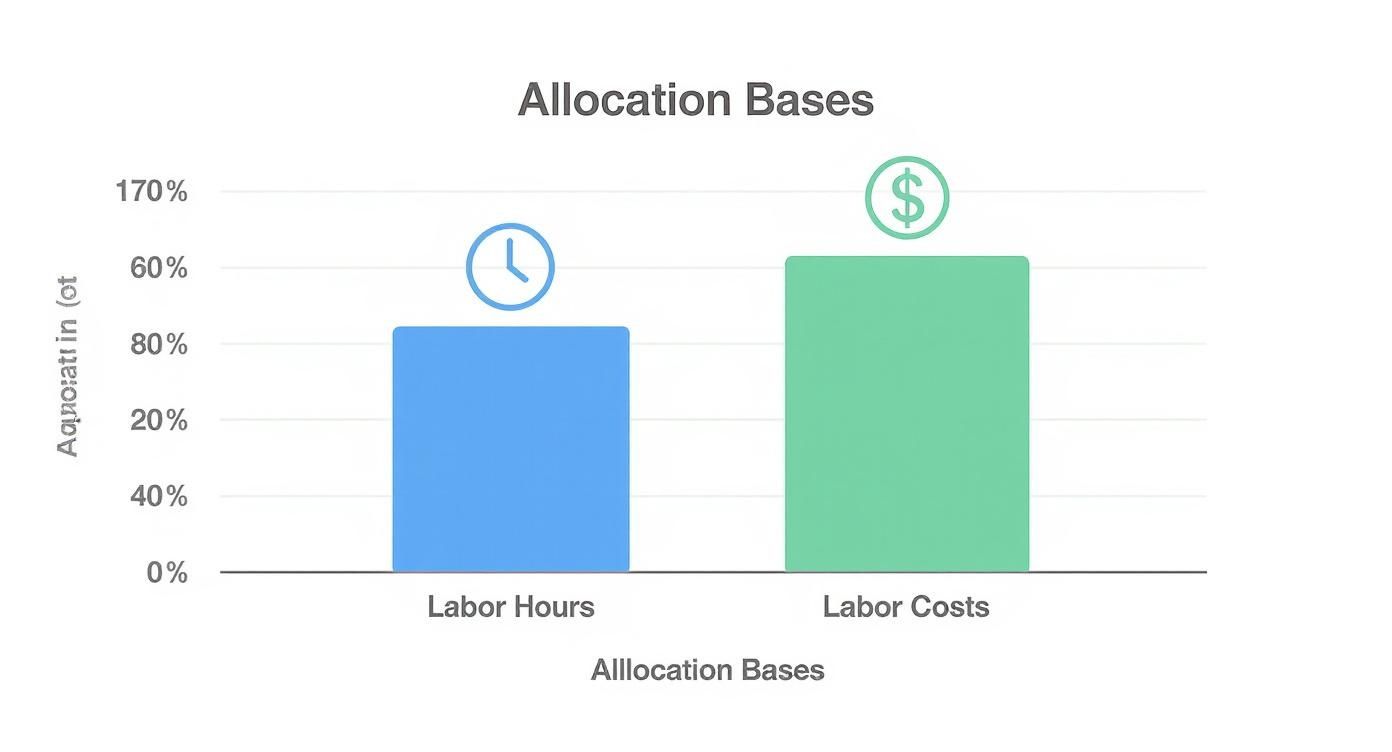
Whether you use labor hours or labor costs really comes down to your team’s salary structure. If you have big pay gaps between roles, using costs is usually more accurate. If your team’s pay is relatively consistent, hours work just fine.
Let’s stick with Creative Spark, but this time we’ll need their total direct labor hours for the quarter.
Creative Spark’s quarterly numbers:
- Total Overhead Costs: $200,000
- Total Direct Labor Hours: 8,000 hours
Here’s the formula for your hourly overhead burden.
Overhead Rate ($) = Total Overhead Costs / Total Direct Labor Hours
Using their figures, the math looks like this: $200,000 / 8,000 hours = $25 per hour
This is a powerful piece of information for the leadership team. It tells them that every single billable hour logged must cover $25 in overhead costs before the company even thinks about making a profit. When they build their client rates, they can now add this $25 to an employee’s direct hourly cost (their salary divided by hours worked) and their desired profit margin to arrive at a truly sustainable and profitable billable rate.
Using Your Overhead Rate to Drive Profitability
Figuring out your overhead rate is a massive step, but the number itself is just the starting point. The real magic happens when you start using that rate to make smarter, more strategic business decisions. This is where your overhead rate transforms from a simple accounting metric into a powerful tool for boosting your bottom line.
By putting this number into action, you can finally move from guessing to knowing. You’ll ensure every single project you take on is set up for financial success from day one.
Informing Your Client Pricing Strategy
One of the most immediate and impactful uses for your overhead rate is setting client prices. If you only price projects based on direct labor costs and a desired profit margin, you’re leaving a huge chunk of your operational expenses on the table. It’s a classic mistake that can make a busy agency surprisingly unprofitable.
Let’s jump back to our “Creative Spark” example. We calculated their overhead rate as $25 per direct labor hour.
Here’s how that plays out in the real world:
- Imagine a senior designer’s direct cost to the business is $50 per hour.
- When you add the overhead burden, the true “break-even” cost for that designer’s time is actually $75 per hour ($50 + $25).
- To hit a 25% profit margin, Creative Spark needs to bill that designer’s time at a minimum of $100 per hour ($75 / (1 - 0.25)).
Without factoring in that $25 overhead rate, they might have priced the work at $67, completely wiping out their intended profit and possibly even losing money.
Monitoring Your Financial Health Over Time
Your overhead rate isn’t a “set it and forget it” number. Tracking it over time—quarter by quarter or year over year—gives you an invaluable health check on your agency’s efficiency. A stable or gradually decreasing rate is a fantastic sign that you’re managing costs effectively as you grow.
On the flip side, a rising rate can be an early warning signal. It might mean your administrative costs are ballooning faster than your billable work, or maybe you’re paying for software and services you just don’t need anymore. Keeping an eye on this trend lets you get ahead of potential issues before they seriously dent your profitability.
A practical way to look at this is by comparing overhead costs to your revenue. For instance, a firm with $200,000 in monthly sales and $40,000 in overhead has a 20% overhead-to-sales ratio. This means 20 cents of every dollar earned goes to cover overhead. You can dig deeper into this overhead-to-sales ratio on wallstreetprep.com.
Tracking these metrics gives you the clarity to make confident decisions. This is where having a single source of truth for all your numbers becomes essential, and it’s where you see the real power of strong financial performance management tools. When all your data is integrated, you can spot trends, manage costs, and guide your agency toward sustainable growth with far more precision.
Answering Your Top Questions About Overhead Rates
Let’s dig into some of the most common questions that pop up when firms start calculating their overhead rate. Getting these right will give you a ton of confidence in your numbers and your bigger financial picture.
How Often Should I Run These Numbers?
For most agencies and consulting firms, looking at this quarterly is the sweet spot. It’s frequent enough to spot trends and make adjustments without getting bogged down in administrative work.
That said, if your business is going through a big change—like a hiring spree, moving offices, or shifting to a fully remote model—you’ll want to switch to a monthly calculation. Things are just moving too fast to wait three months. And, of course, an annual calculation is a must for setting your yearly budget and financial goals.
What’s a “Good” Overhead Rate for a Services Firm?
Honestly, there’s no magic number. A “good” rate is completely dependent on your specific situation—your industry, business model, and size all play a huge role. A small, fully remote marketing agency will have a completely different overhead profile than a large engineering firm with a big office and expensive equipment.
Instead of getting hung up on industry benchmarks, your real goal should be tracking your own rate over time. If you see that number staying stable or, even better, trending downward, that’s a brilliant sign. It means you’re getting more efficient and driving up your profitability.
What Are the Most Common Mistakes People Make?
A few classic slip-ups can really throw your numbers off. The most frequent one I see is misclassifying costs. A classic example is treating project-specific software as general overhead when it should really be a direct cost tied to that project.
Another common pitfall is using the wrong allocation base. If you have a wide range of salaries on your team, using direct labor hours as your base can seriously distort the picture. And it sounds simple, but always double-check that you’ve included all your indirect costs, from admin salaries and insurance right down to the non-billable hours your team logs.
How Does Remote Work Change the Overhead Calculation?
Going remote or hybrid definitely shakes things up. You’ll almost certainly see a drop in the usual office-related overheads like rent, utilities, and coffee supplies.
But don’t assume it’s all savings. New costs always creep in. You’ll likely see increases in other areas, such as:
- Software subscriptions for all the new collaboration tools.
- Home office stipends or allowances for your team’s equipment.
- Beefed-up cybersecurity to keep everyone’s distributed data safe.
It’s critical to track these new expenses just as carefully as the old ones to get a true picture of your overhead in a modern work setup.
Ready to stop guessing and start knowing your numbers?
Drum brings your project management, time tracking, and financial reporting together into one place, making it simple to calculate and monitor your overhead rate with total confidence.
Start your free 14-day trial and see how it works.