
 Pipeline & Proposals
 Project Management
 Resource Planning
 Time & Costs
 WIP & Invoicing
 Commercial Reporting
 Consulting Engineers
 Architects
 Town Planners
 Building Designers
How to Manage Client Expectations: Scripts, Frameworks, and Real Examples

Ben Walker
Written for Drum
In This Article
How to Manage Client Expectations Without the Headaches
You can’t manage client expectations if you never set them in the first place. The real secret isn’t some mid-project damage control technique; it’s about meticulously co-creating a shared reality from day one. It’s about making sure the promises your sales team made can actually be delivered by your project team, and doing it with a friendly, professional approach.
Build a Foundation of Clarity Before Day One

The single biggest mistake we see in professional services is assuming you and your client are on the same page. A vague proposal or a simple handshake agreement is a recipe for disaster. It leaves far too much room for interpretation, which almost always leads to mismatched expectations and painful conversations down the road.
Your goal is to move from a general idea (“we need a new website”) to a concrete, shared understanding of what success actually looks like. Think of it as building a house: you wouldn’t start without a detailed blueprint, and your project is no different.
This whole process starts long before the official kickoff meeting. It begins with the very first discovery call and really takes shape in the proposal. Your proposal shouldn’t just be a price list; it needs to be the first draft of your project’s constitution. For more on this, check out our guide on how to write a consulting proposal.
From Proposal to Project Blueprint. Think of your Statement of Work (SOW) as the project’s official blueprint. This is the document everyone (your team, your client, their stakeholders) will refer back to when questions arise. It’s where you translate all those early conversations into firm commitments.
A killer SOW goes way beyond a simple list of deliverables. It has to explicitly define:
- Project Goals and Objectives: What does success actually look like? Use clear, measurable terms. For example, instead of “Improve online presence,” aim for “Increase organic search traffic by 20% within six months.”
- Key Deliverables: What tangible things will you produce? Be painfully specific. Don’t say “website design.” Say “Homepage wireframe, three internal page mockups, and a mobile-responsive final design in Figma.”
- Timelines and Milestones: When will key phases be done? When will deliverables be ready for the client to review?
- What’s Out of Scope: This is just as critical as what’s in scope. Clearly stating what you’re not doing prevents future arguments. For example, “This project includes the new logo design but does not include creating brand guideline documentation.”
Uncovering Hidden Assumptions in the Kickoff. The kickoff meeting is your golden opportunity to pressure-test that SOW and dig up any assumptions that are still hiding under the surface. This isn’t a presentation where you talk at the client; it’s a collaborative working session. Your job is to facilitate a conversation that gets everyone nodding in agreement on every critical point.
A well-structured kickoff agenda is your best friend here. Don’t just read the SOW out loud. Ask probing questions that get to the “why” behind what the client is asking for.
Below is a simple but effective agenda structure we’ve seen work time and time again. It’s built around three core pillars (Goals, Scope, and Process) to ensure you cover all your bases.
Your Kickoff Meeting Agenda for Total Alignment
| Pillar | Key Questions to Ask | Example Goal |
|---|---|---|
| Goals | What does a “win” look like for you in 6 months? Who needs to be happy with the outcome? How will we measure success? | Confirm that the primary business objective is to increase qualified leads by 25%, not just to launch a new website. |
| Scope | Walking through the SOW, what deliverable are you most excited about? Is there anything listed that feels less critical? | Clarify that “content migration” means moving existing text and images only, not creating new blog posts or rewriting copy. |
| Process | Who is our day-to-day contact? What’s your preferred feedback process? How often should we plan to meet for status updates? | Establish a weekly 30-minute check-in call on Thursdays and agree that all consolidated feedback will come from a single point of contact. |
This isn’t just about ticking boxes; it’s about forcing the clarifying conversations that prevent major headaches later.
Key Takeaway: The goal of the kickoff isn’t just to start the project; it’s to ensure everyone is starting the same project. This meeting is your last, best chance to surface and resolve misunderstandings before they become costly problems.
In the high-stakes world of management consulting, this initial clarity is proven to reduce project failures. Misaligned expectations often result in scope creep, which torpedoes 52% of all projects and leads to massive budget and timeline overruns. On the flip side, well-managed relationships built on this kind of clear foundation can lead to client return rates of up to 80%. You can see more statistical consulting findings on precisionconsultingcompany.com.
By investing this time upfront, you transform the client relationship from a simple transaction into a genuine partnership. This effort pays for itself over and over by creating a smoother project, happier clients, and a more predictable, profitable workflow for your team.
Create a Proactive Communication Rhythm
Once a project gets rolling, silence is your worst enemy. An information vacuum is a breeding ground for anxiety, leaving clients to wonder what’s happening, or worse, assume the worst. The trick to managing expectations mid-project is to ditch the reactive updates and build a proactive communication rhythm that replaces guesswork with genuine confidence.
This isn’t about spamming them with every tiny detail. It’s about creating a predictable, reliable cadence of meaningful information. When you do this right, they feel less like a customer waiting at the finish line and more like a true partner in the project.
Choosing the Right Channel for the Message. Not all updates carry the same weight, and your communication channel needs to match the message’s urgency and importance. A mismatch (like flagging an urgent budget issue in a casual Slack message) is a recipe for confusion. Setting clear protocols from the start avoids this headache entirely.
Think of your channels as different tools for different jobs:
- Quick Syncs (Slack/Teams): This is your go-to for informal, rapid-fire questions or sharing a quick win. Something as simple as, “Hey team! Just wanted to share that the initial design mockups are looking fantastic. Can’t wait to walk you through them on our weekly call!” keeps the positive momentum going.
- Weekly Status Updates (Email): This is your workhorse. A structured email that lands in their inbox at the same time every week builds an incredible amount of trust. It needs to be scannable, summarizing progress, outlining next steps, and flagging any immediate needs from the client.
- Real-Time Dashboards (Project Management Tools): For clients who want to get into the nitty-gritty, a shared dashboard is invaluable. Tools like Drum give clients a clear window into progress, time spent, and budget burn without you having to manually pull reports every time they ask.
By offering a mix of high-level summaries and on-demand details, you’re catering to different stakeholders. The CEO might only read the weekly email summary, while the project manager on their end might live in the dashboard. You’re giving everyone exactly the level of insight they need to feel comfortable and informed.
The Anatomy of an Effective Status Report. A great status report does more than just list off completed tasks. It tells the story of the project’s journey. It should be digestible in under two minutes while clearly answering the client’s three biggest unasked questions: Are we on track? Are we on budget? What’s next?
Here’s a simple structure that works wonders:
- Overall Project Health: Kick things off with a simple color code (Green, Yellow, Red) or a one-sentence summary. For example, “Project is Green: We are on schedule and on budget this week.” This gives them the bottom line right away.
- What We Accomplished This Week: Use a bulleted list to highlight key milestones. Don’t just say “Worked on website.” Instead, try “Completed the final wireframes for the homepage and product pages.” Be specific.
- What’s Planned for Next Week: Another bulleted list showing what’s coming up. This demonstrates forward momentum and sets clear expectations for the next few days.
- Action Items or Blockers: Clearly state if you need anything from them. For instance, “We need your team’s feedback on the wireframes by Wednesday EOD to keep the design phase on schedule. Thanks in advance!”
This proactive approach is backed by hard data. Consistent communication is the absolute backbone of project success, with some analysis showing poor communication contributes to a staggering 56% of project failures. On the flip side, regular updates correlate with a 25% improvement in client satisfaction scores, and firms that nail this can see 60% higher project success rates. You can explore more consulting industry statistics on Runn.io to see the full picture.
Ultimately, a strong communication rhythm is about control. Not controlling the client, but controlling the project’s narrative. You are actively shaping their perception of progress through consistent, honest, and clear updates. This simple discipline eliminates surprises, builds unshakable trust, and is one of the most powerful tools in your arsenal.
Handle Scope Creep With Confidence
Nothing sinks projects, budgets, and team morale faster than scope creep. We’ve all seen it happen. It almost always starts with a seemingly innocent client request to “just add one more thing,” but those small additions can quickly snowball, derailing an entire engagement.
The secret to managing new requests isn’t about building a wall; it’s about building a better door.
Instead of reacting with a stressed-out “yes” or a defensive “no,” you need a simple, repeatable process. This turns a potentially tense conversation into a strategic one where you and your client can look at the impact together and decide on the best path forward.
Establish A Clear Change Request Process. The moment a client asks for something outside the original Statement of Work (SOW), your process should kick in. Don’t hash it out casually over the phone or in a messy email chain where details are guaranteed to get lost.
Instead, guide them toward a formal change request. This doesn’t have to be some bureaucratic nightmare. A simple flow can look like this:
- Acknowledge and Redirect: Thank them for the idea and immediately explain the next step. A simple, friendly script works wonders: “That’s a great suggestion! To make sure we capture it properly and assess its impact on the timeline, could you pop the details into a quick change request form? It helps us keep everything organized.”
- Evaluate the Impact: Once you have the formal request, your team needs to figure out what it really means. How many extra hours will it take? What’s the actual cost? Will it push back the final delivery date? This is where guesswork gets you into trouble.
- Present the Options: Go back to the client with clear, data-driven choices. This is where you elevate yourself from a simple service provider to a strategic partner.
When you have a solid process, you’re not just reacting; you’re guiding the conversation. It helps manage expectations by showing them that every change has a ripple effect on the project’s core constraints: scope, time, and budget.
From “No” to “Yes, and…“ The goal isn’t always to say no. More often than not, it’s about saying, “Yes, and here’s what that means.”
This subtle shift in language changes the entire dynamic. It shows you’re a flexible partner willing to accommodate their needs, but also a professional who understands the value of your team’s time.
Here’s how this plays out in the real world:
Client Request: “Can we add an extra round of revisions for the design mockups?”
Your Response: “Absolutely, we can definitely do that. The original scope included two rounds, so this extra cycle will add about 10 hours of design time and will push the final delivery of the designs back by three days. If you’re comfortable with that adjustment, I can send over a revised timeline and budget for your approval.”
This response is friendly, collaborative, and professional. You’ve agreed to their request but have also clearly and immediately laid out the consequences. The decision is now theirs, armed with all the facts.
Proactive scope management is critical, as uncontrolled changes are a leading cause of project failure. Industry reports show that scope creep can lead to cost increases of 28%, but firms with disciplined change order processes capture significantly more additional services revenue and reduce disputes compared to firms relying on informal arrangements.
A structured communication rhythm underpins your ability to handle these conversations effectively.
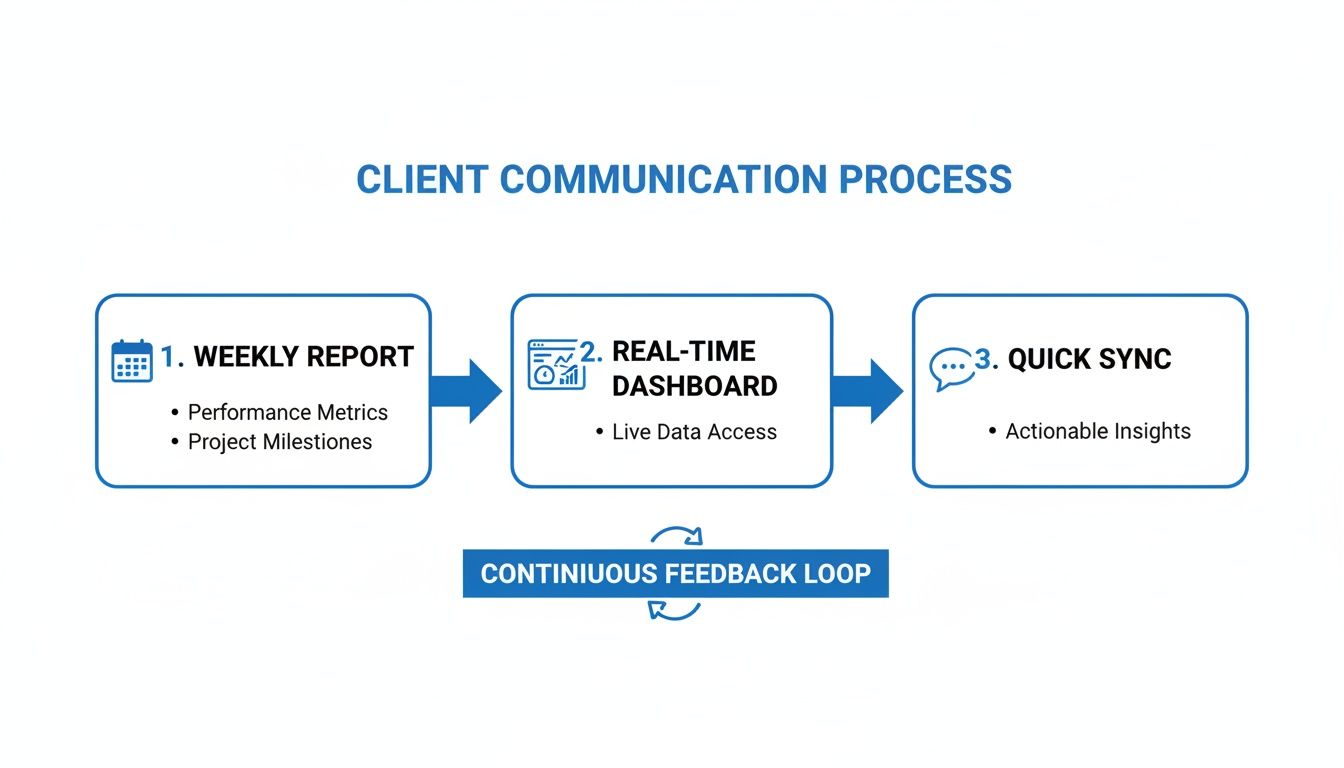
By combining regular reports with real-time data and quick syncs, you create a foundation of transparency that makes these scope discussions feel like a natural part of the process, not a confrontation.
The difference between a reactive and a proactive approach is stark. One leads to friction and lost profits, while the other builds trust and protects your bottom line.
A Guide to Handling Client Change Requests
| Step | Reactive Approach to Avoid | Proactive Approach to Use |
|---|---|---|
| 1. The Ask | Agreeing verbally to a “small change” on a call or via email. | Acknowledging the request and directing the client to a formal change request form. |
| 2. Evaluation | Guessing the effort required, leading to under-quoting and rushed work. | Performing a detailed impact analysis on the budget, timeline, and resources. |
| 3. The Conversation | Saying “yes” immediately, then trying to claw back the time and money later. | Presenting the client with clear options: “We can do this, and it will add X hours and Y days.” |
| 4. The Outcome | Damaged client trust, team burnout, and eroded project profitability. | A collaborative decision is made, the project is formally updated, and expectations are reset. |
Following a structured process like the one on the right turns a potential conflict into a simple business discussion.
Use Data to Depersonalize the Conversation. The best way to handle scope creep is to take the emotion out of it. When a client requests a change, they’re naturally focused on their desired outcome. It’s your job to show them the full picture, and solid data is your best tool for that.
Platforms like Drum are built for this exact scenario. When a client asks for something new, you don’t have to guess the impact. You can instantly see:
- Team Workload: Who has the capacity to take this on? Will it push someone toward burnout?
- Budget vs. Actuals: How will these extra hours torpedo the project’s budget and profitability?
- Timeline Impact: Which subsequent tasks and milestones will be delayed as a result?
With this information at your fingertips, the conversation is no longer about your opinion versus theirs. It’s about looking at the project data together. You can literally share your screen and walk them through the implications, turning a potentially awkward negotiation into a straightforward business decision.
This data-driven approach is fundamental to managing scope creep in project management without damaging the client relationship. By combining a formal process, collaborative language, and transparent data, you can handle scope creep with complete confidence. You’ll not only protect your projects and your team but also reinforce your value as a partner who helps clients make smarter decisions.
Use Data to Build Transparency and Trust

In professional services, trust isn’t some fuzzy concept; it’s a tangible asset built on a foundation of transparency. The single most effective way to manage what a client expects is to stop hiding the numbers and start using data as your most powerful communication tool.
When clients are left in the dark about project progress, they tend to fill that silence with anxiety and worst-case scenarios. By proactively sharing key metrics, you answer their biggest questions before they even have a chance to ask, turning a simple vendor transaction into a genuine partnership.
Focus on the KPIs That Actually Matter to Clients. Look, your internal metrics like team utilization and profit margins are vital for running your business, but they mean next to nothing to your clients. To build real trust, you have to share the data that speaks directly to their main concerns: their investment and the health of their project.
The key is presenting this information in a way that’s simple, visual, and tells a clear story. Ditch the overwhelming spreadsheets and focus on these core indicators:
- Budget vs. Actuals: This is the big one. Clients need to see exactly where their money is going and how the project is tracking against the budget we all agreed on. A simple burn-down chart can make this crystal clear.
- Milestone Progress: Are we hitting our key deadlines? A simple visual tracker showing completed, in-progress, and upcoming milestones gives them instant clarity.
- Project Velocity: This metric simply shows the pace of work. It helps clients understand the team’s output and reassures them that things are moving forward consistently.
When you share these KPIs regularly, you shift potentially awkward budget conversations into straightforward, fact-based discussions. It’s no longer about your opinion; it’s about what the data shows.
Turn Reporting into a Trust-Building Ritual. Manually compiling reports is a time-sucking chore that, let’s be honest, is one of the first things to get dropped when things get busy. This is where automation becomes your secret weapon for consistently managing client expectations.
Instead of wrestling with a spreadsheet at the end of the month, you can give clients a live window into the project’s performance.
Key Takeaway: True transparency isn’t sending a static report once a month. It’s giving clients controlled, real-time access to the data they care about, empowering them with information and proving the value you deliver every single day.
This approach of providing a live view boosts accountability and dramatically reduces that nagging client uncertainty. When clients can see progress for themselves, they feel more in control and are far less likely to send those “just checking in” emails that kill your team’s focus.
Using a Centralized Platform for Total Transparency. This is where a unified platform becomes a non-negotiable. When your project management, time tracking, and financial data all live in the same place, generating these reports becomes completely effortless.
For example, a tool like Drum connects all these dots automatically. When your team tracks time against a specific task, that data instantly updates the project’s budget vs. actuals report. No manual entry, no risk of human error.
This creates a single source of truth that both you and your client can rely on. When they have a question about the budget, you can point them to a live dashboard that shows exactly where every dollar and hour has been spent. This level of openness is the ultimate tool for building unshakeable trust.
This data-driven approach is a cornerstone of any strong agency or consulting firm. You can learn more about how to track these metrics by exploring tools designed for monitoring your firm’s financial performance.
By embedding data into your communication rhythm, you’re not just managing expectations. You’re proving your value. You’re showing the client you’re a responsible steward of their investment and a strategic partner dedicated to their success. This kind of transparency turns data from a simple internal metric into one of your strongest relationship-building assets.
Handle Difficult Conversations and Reset Expectations
Even with the tightest project plan, things go sideways. It happens. A key deadline gets missed, the budget starts creeping up, or the client suddenly has a “brilliant” new idea that shifts the project’s entire focus.
These are the moments that truly test a client relationship. But handled correctly, they’re also massive opportunities to show you’re a strategic partner who can solve problems, not just a service provider who follows orders. The trick is knowing how to steer those tough conversations.
It all comes down to facing these moments head-on with a plan, a solution, and a mindset that you’re in it together.
Diagnose the Problem Before You Ever Speak to the Client. Before you even think about picking up the phone or drafting an email, you need to become a detective. You have to know exactly what went wrong and why. Walking into a tough conversation armed with vague excuses is the fastest way to obliterate trust.
Instead, you need data. Cold, hard facts.
Let’s play out a classic scenario: the budget is getting out of control. An agency is halfway through a digital marketing campaign and realizes they’re on pace to blow the budget by 15%.
- The Reactive Approach: Panic. Wait until the last possible second, then send a meek email that basically says, “So… we’re going to need more money.”
- The Strategic Approach: Go straight to your project data. What’s the root cause? Did the client make a bunch of small, unbilled requests that added up? Did ad spend on one channel suddenly skyrocket? Is a specific team member logging way more hours than you estimated?
When you dig into the numbers first, the entire dynamic of the conversation changes. You’re no longer making an apology; you’re presenting a data-driven analysis. You can pinpoint the exact cause and prepare a crystal-clear explanation.
Own It and Arrive with a Solution. Once your facts are straight, it’s time to reach out. The goal here isn’t to point fingers or make excuses. It’s about taking ownership and showing them a clear path forward.
My number one rule for this situation: Never bring a client a problem without at least one proposed solution.
When you start the conversation, be direct and professional. Keep your cool. A simple script framework can make a world of difference:
“Hi [Client Name], I wanted to give you a proactive update on the project budget. We’re currently tracking to come in about 15% over our initial estimate, and I want to walk you through exactly why that’s happening and what our options are.”
This opener is perfect. Why? It immediately accomplishes three critical things:
- It shows you’re on top of it and not trying to hide anything.
- It states the problem clearly without any sugarcoating.
- It pivots instantly to a collaborative, solution-focused discussion.
Reframe the Conversation Around Their Goals. Now you’ve got the issue on the table. The next move is to immediately re-center the conversation around the project’s original goals. This reminds the client that you’re still completely focused on their success and frames the next step as a joint decision.
Let’s go back to our budget overrun example. You could lay out a few clear choices for them:
- Option 1 (Reduce Scope): “We’ve pinpointed that the extra spend is coming from [Specific Area]. To get us back on budget, we can scale back our efforts here. The trade-off is that we’ll likely see a small dip in results from that particular channel.”
- Option 2 (Increase Budget): “The data is actually showing this extra spend is generating a fantastic return. If we keep this up, we’re projecting an even better outcome than we hoped for. We can put through a formal change order to increase the budget and capitalize on this.”
- Option 3 (Reallocate Resources): “We can pull back from [Lower-Performing Area] and shift that portion of the budget to cover the overages in [Higher-Performing Area]. This keeps us on budget overall without sacrificing the great results we’re seeing.”
This approach completely changes your role. You’re not just the person asking for more money. You’ve become the expert partner helping them make an informed business decision based on fresh data.
Handling these bumps with transparency and a solid plan doesn’t just salvage a project; it builds rock-solid, long-term trust.
Even with the best framework in place, managing client expectations is more art than science. Things get messy. Here are a few common curveballs we’ve seen and how to handle them.
What’s the Single Biggest Mistake to Avoid?
Jumping into the work too fast. It’s easy to get caught up in the excitement of a new project, but the most dangerous mistake is assuming you and your client have the same unspoken definition of success.
This happens when firms skip the nitty-gritty details in a project charter or Statement of Work. It creates an “expectation gap” where the client’s mental picture of the outcome is worlds away from the reality of the work. The fix? Be painfully, almost ridiculously, clear about everything upfront. I’m talking deliverables, timelines, who communicates when, review cycles, and especially what is not included.
How Can I Prevent Scope Creep Without Upsetting My Client?
The key is to set up a clear, collaborative change control process from day one. Don’t frame it as a barrier; frame it as a tool that protects everyone’s interests: their budget and your timeline. It’s a mechanism for making smart decisions together.
When a new request pops up, don’t shut it down. Instead, pull out your script: “That’s an interesting idea. Let’s get that into a quick change request so we can properly look at its impact on our plan.” This shifts the dynamic. You’re no longer an inflexible vendor saying “no,” but a strategic partner helping them think through the implications of a new idea.
How Often Should I Really Be Communicating with My Client?
Consistency beats frequency, every single time. It’s the predictable rhythm that builds trust and kills client anxiety. For most projects, a scheduled weekly touchpoint is a fantastic place to start.
This could be a quick 15-minute sync call or a detailed summary email. The format doesn’t matter as much as the reliability.
A regular cadence means clients aren’t left wondering what’s happening. It also puts a stop to those random “just checking in” emails that torpedo your team’s focus. Lock this down in your kickoff meeting and set the expectation from the get-go.
What’s the Best Way to Deliver Bad News?
When things go wrong, and they will, your mantra should be: prompt, direct, and solution-focused. Whatever you do, don’t wait, hoping the problem will magically solve itself. It won’t.
Pick up the phone or jump on a video call for anything significant—never hide behind an email. Start by stating the issue clearly and calmly, and take ownership. For instance, “I wanted to let you know we’ve hit a technical snag that will likely delay the launch by two days.”
Immediately follow up with a brief “why” and, most importantly, your proposed solution or a few options. When you come to the table with a plan, you show you’re in control. It turns a moment that could break trust into one that proves your value as a genuine problem-solver.
Ready to stop juggling projects with scattered spreadsheets and endless email chains?
Drum brings your proposals, projects, time tracking, and invoicing together into one clean, intuitive platform.
See how you can build stronger client trust, boost profitability, and deliver better outcomes. Start your free 14-day trial today.