
 Pipeline & Proposals
 Project Management
 Resource Planning
 Time & Costs
 WIP & Invoicing
 Commercial Reporting
 Consulting Engineers
 Architects
 Town Planners
 Building Designers
How to Write a Consulting Proposal That Wins: Structure, Examples, and Pricing Tips

Ben Walker
Written for Drum
In This Article
How to Write a Consulting Proposal That Wins More Clients
Writing a consulting proposal is all about laying out the client’s problem, your plan to fix it, and what that will look like in terms of scope, deliverables, timeline, and cost. The real trick is to stop selling your services and start proving you can solve their specific problem. A good proposal should feel less like a pitch and more like a warm confirmation of a great conversation you’ve already had.
Your Blueprint for a Winning Consulting Proposal
Let’s be honest, a great consulting proposal is more than just a document. It’s your first real handshake with a potential partner. It’s where you show them you’ve actually listened to their challenges and have a clear, credible plan to tackle them. This guide isn’t about filling in a generic template; it’s about adopting the friendly, problem-solving mindset that actually wins business.
The most successful consultants I know have all figured this out: the proposal isn’t the sales pitch. It’s the confirmation. By the time your client gets to reading it, they should already be nodding along because it just puts on paper the value-driven conversation you’ve already had with them. Think of it less like a cold application and more like a collaborative roadmap you’re building together.
From Seller to Problem-Solver. The most critical mental shift is moving from ‘selling services’ to ‘solving problems’. A client isn’t buying your time; they’re buying an outcome. Your proposal has to reflect this by focusing entirely on their world: their goals, their pain points, and the tangible results you’re going to deliver. Forget listing what you’ll do; instead, illustrate what they will achieve.
A compelling consulting proposal is your first act of leadership. It shows clients how you think, how you solve problems, and how you align with their needs before a single dollar is spent.
This approach builds instant trust and immediately sets you apart from competitors who are just sending over a glorified resume and a list of services.
Why a Strong Proposal Matters More Than Ever. Nailing this skill has never been more important. The consulting world is getting more competitive, and the demand for clear, professional proposals is shooting up. In fact, the global market for proposal writing services was valued at around USD 2.1 billion in 2024 and is projected to more than double by 2035. This growth spells out a clear business reality: a well-crafted proposal is a massive competitive advantage. Recent data from Flowcase’s 2025 proposal benchmarking report shows that nearly 70% of consultants have a proposal win rate below 60%, which means the firms that invest in polished, client-centered proposals have a real edge over the competition.
To manage this crucial step without getting bogged down, many firms are turning to specialized software. The right tools can make the whole process smoother, from that first contact to the final invoice. Using a platform with built-in consulting project management software, for example, lets you connect your winning proposal directly to project execution. It’s a smooth transition for both you and your brand-new client.
Building the Core Components of Your Proposal
Think of your proposal as a story. Every section is a chapter that builds on the last, guiding your client from their current challenge to their future success. While templates can give you a starting point, the real value comes when you understand the why behind each component and connect it to the conversations you’ve already had.
Let’s break down how to build these pieces, one by one, to create a document that feels less like a generic form and more like a personalized roadmap.
Before you write a single word, get your mindset right. It’s a simple three-step process: listen intently, plan with precision, and then solve their problem. That’s the foundation of a proposal that actually wins business.
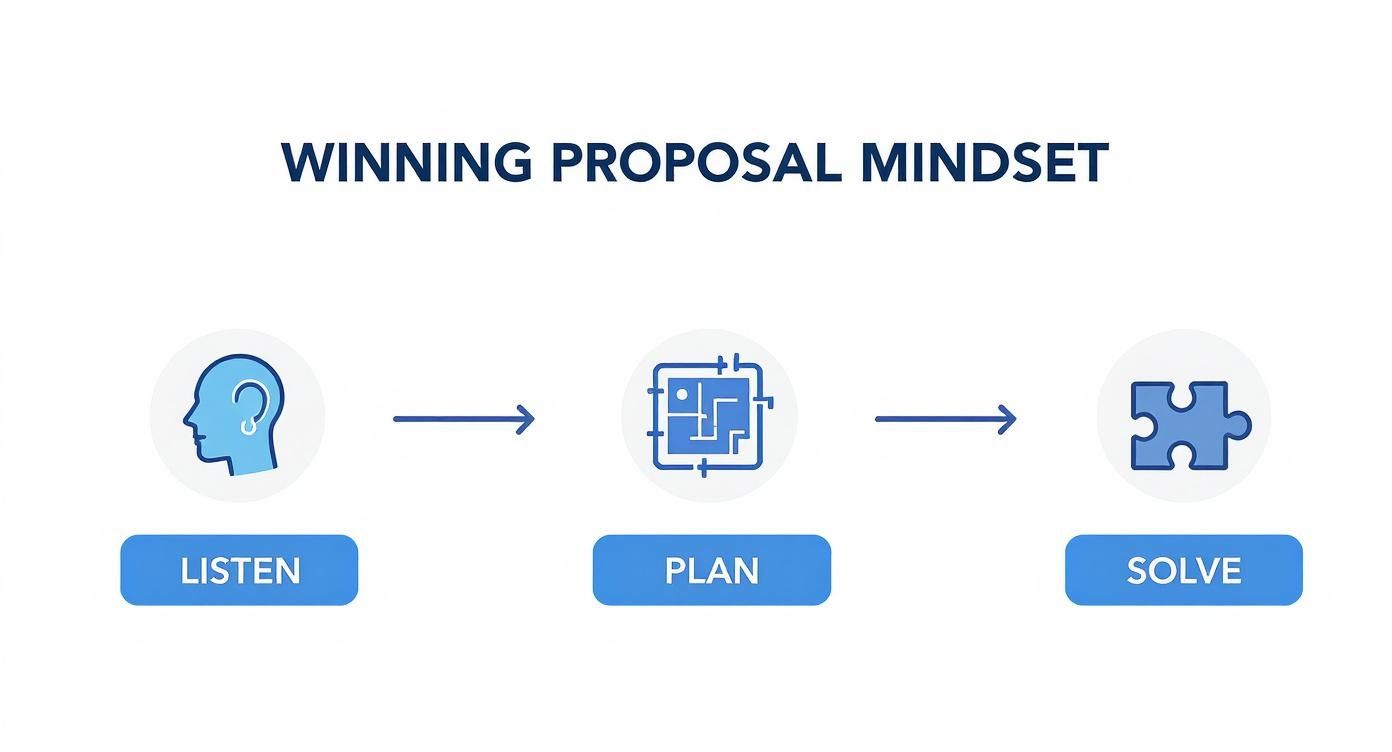
This simple flow (Listen, Plan, Solve) ensures every part of your proposal is directly tied to a client need you’ve already discussed. It makes the document a confirmation of your shared understanding, not a sales pitch.
A Quick Look: Anatomy of a Winning Proposal. Every solid proposal needs to cover a few key bases. Each section has a specific job to do, from grabbing the client’s attention to spelling out the fine print. Here’s a quick rundown of the essential parts, what they’re for, and a friendly tip for making each one count.
| Proposal Section | Core Purpose | Pro Tip |
|---|---|---|
| Executive Summary | Hook the reader by showing you understand their core problem and have a clear solution. | Focus on outcomes, not activities. Use their language and key metrics to make it resonate. |
| Scope & Deliverables | Define the exact boundaries of the project and list the tangible outputs you’ll provide. | Be ruthlessly specific. Clearly state what’s in scope and, just as importantly, what’s out of scope. |
| Timeline | Show the client a clear, phased path from kickoff to completion with key milestones. | Break it down into phases. A visual timeline builds confidence and makes the project feel manageable. |
| Assumptions | List the conditions that must be met for the project to succeed on schedule and budget. | Frame assumptions collaboratively, like, “We’ll need your team’s feedback within 48 hours.” |
| Terms & Conditions | Outline the business rules of the engagement, like payment schedules and ownership of work. | Keep it simple and direct. Use plain language, not dense legalese, for things like payment terms. |
Getting these sections right isn’t just about good form; it’s about building trust and setting the stage for a smooth project.
Nailing the Executive Summary. Let’s be honest: the executive summary is your proposal’s first impression, and for many busy decision-makers, it’s the only part they’ll read carefully. This isn’t the place to summarize everything you’re about to say. Your real goal is to tell a concise, compelling story that screams, “I get it, and I have a credible plan.”
Think of it as the “why you” and “why now.” It should immediately reflect the client’s main challenge, present your high-level solution, and touch on the business outcomes they care about. Keep it sharp and focused, no more than a page.
Here’s a practical example:
Don’t say: “Our firm will provide marketing consulting services to increase brand awareness.”
Instead, try: “GrowthCo is facing a 15% decline in quarterly leads, which is directly impacting sales pipeline targets. We’ve developed a three-phase digital marketing strategy focused on optimizing SEO and targeted content creation. This plan is designed to not only reverse the lead decline but to generate a 20% increase in qualified leads within six months.”
See the difference? The second version connects a specific pain point (declining leads) to a measurable outcome (20% increase), making it instantly more powerful.
Defining Scope and Deliverables with Precision. This section is where you kill “scope creep” before it even starts. Ambiguity is your worst enemy here. The scope defines the boundaries of the project: what’s in and what’s out. Deliverables are the tangible things you will actually produce.
Get granular. Instead of just saying you’ll “develop a new website,” break it down into specifics that leave no room for misunderstanding.
- Project Scope: This project includes the design and development of a five-page responsive marketing website (Home, About, Services, Blog, Contact). It does not include e-commerce functionality or ongoing content creation after launch.
- Key Deliverables:
- One set of high-fidelity wireframes for all five pages.
- A fully developed and tested WordPress website.
- A 60-minute training session for your team on how to update the site.
This level of detail sets crystal-clear expectations for everyone involved from day one.
Laying Out a Timeline That Builds Confidence. A timeline does more than just state when the project will be done; it builds trust by showing your client a clear path from A to B.
Break the project into logical phases with key milestones. This approach makes large projects feel manageable and proves you have a thoughtful, organized process. A simple table or a visual graphic works wonders here.
| Phase | Key Activities | Estimated Timeline |
|---|---|---|
| Phase 1 | Discovery & Strategy | Weeks 1-2 |
| Milestone 1 | Project Kickoff & Strategy Sign-off | End of Week 2 |
| Phase 2 | Design & Content Creation | Weeks 3-5 |
| Milestone 2 | Final Design Approval | End of Week 5 |
| Phase 3 | Development, Testing & Launch | Weeks 6-8 |
| Milestone 3 | Website Go-Live | End of Week 8 |
This structure gives the client clear checkpoints to anticipate and turns the timeline from a simple schedule into a tool for collaborative project management.
Handling Assumptions and Terms Like a Pro. These final sections are your professional safety net. They aren’t about being confrontational; they’re about creating clarity and protecting both you and the client.
The Key Assumptions section lists the conditions that must be true for your project plan to hold water. For instance:
- The client team will provide all necessary content and branding assets by Week 3.
- Key stakeholders will be available for a weekly 30-minute check-in call.
- Feedback on deliverables will be provided within two business days.
The Terms and Conditions section covers the business side of things: payment schedules, confidentiality, and ownership of work. Be direct. A common and effective term is “50% payment upon signing, 50% upon project completion.”
Getting these components right is a huge factor in success. Industry surveys show that the average win rate for proposals hovers around 45%. Hitting that benchmark often comes down to how well you align with client needs and present your solutions with absolute clarity. You can read more about consulting industry statistics and benchmarks to see how you stack up. By investing time in these core components, you’re not just writing a document; you’re building the foundation for a great partnership.
Pricing Your Services with Confidence
Let’s get to the part of the proposal that ties most consultants in knots: the price.
Setting your rates can feel like a high-wire act, but it doesn’t have to be. Forget about pulling a number out of thin air. The goal is to choose a pricing model that makes sense for the project, feels right for the client, and fairly reflects the incredible value you’re about to deliver.
Let’s walk through the most common models so you can confidently pick the right one for your next engagement.

The Classic Hourly Rate Model. Charging by the hour is as straightforward as it gets. You set your rate, you track your time, and you send an invoice. Clients get it, and it works beautifully for projects where the scope is a bit murky or you know the client’s needs will change along the way.
Practical example: A local business needs you for ongoing, on-call IT support. The work is totally unpredictable. One month could be 10 hours of firefighting, the next just two hours of maintenance. Proposing a rate of $150/hour is perfect because the client only pays for what they need, giving both of you total flexibility.
But there’s a big catch with hourly billing: it punishes you for being good at your job. The more efficient you are, the less you earn. It also shifts the client’s focus from the results you’re driving to the minutes you’re clocking. If you go this route, using professional time tracking software for consultants is non-negotiable for keeping things transparent and your invoices dispute-free.
The Predictable Fixed Project Fee. A fixed fee is a single, all-in price for the entire project. This is a fantastic option when you have a crystal-clear scope and a well-defined set of deliverables. Clients often breathe a sigh of relief with this model because it gives them complete budget certainty. No surprises.
The upside for you? You get rewarded for your expertise and efficiency. If you knock the project out of the park faster than you estimated, your effective hourly rate skyrockets.
- Best For: Projects with a defined beginning and end, like a full rebrand, building a specific software module, or mapping out a Q3 content strategy.
- Requires: You absolutely must have a bulletproof grasp of the scope. Underprice it or let scope creep in, and you’ll end up working for free.
Practical example: A tech startup wants a full brand identity package: logo, color scheme, typography, the works. After a thorough discovery call, you map it all out and estimate it will take around 80 hours. You confidently propose a fixed project fee of $12,000, covering every deliverable you discussed.
The Strategic Value-Based Model. This is the big leagues. With value-based pricing, you detach your fee from the hours you work and anchor it to the business outcome you generate for the client. It’s all about the ROI you create.
This approach requires you to truly understand the client’s business, their specific pain points, and what solving that pain is worth to them in cold, hard cash.
Value-based pricing flips the entire conversation. It’s no longer about your costs; it’s about their gain. When you can clearly demonstrate how your $50,000 fee will help them land $500,000 in new business, your price tag suddenly looks like a bargain.
This is by far the most profitable way to price your services, but it demands the most confidence and upfront work. You have to be able to quantify the value you bring to the table.
How to Choose the Right Pricing Model. There’s no magic bullet here. The “best” model is the one that fits the project, the client, and your working style. This table should help you make the call.
| Pricing Model | Pros | Cons | Ideal Scenario |
|---|---|---|---|
| Hourly Rate | Simple to explain and flexible for evolving scopes. Low risk when the work is undefined. | Penalizes efficiency and focuses client attention on time, not outcomes. Can create budget anxiety. | Ongoing support retainers, projects with an unclear scope, or initial discovery phases. |
| Fixed Project Fee | Gives clients budget certainty and rewards your efficiency. The focus is on the final deliverables. | Demands an iron-clad scope. High risk of underpricing if the project balloons unexpectedly. | Well-defined projects with concrete deliverables and a predictable schedule. |
| Value-Based | Uncaps your earning potential by tying your fee directly to client ROI. Positions you as a high-level strategic partner. | Requires significant upfront discovery and confidence. You must be able to prove and quantify the value. | High-impact projects where your work directly moves a key business metric, like revenue or cost savings. |
Graduating from hourly rates to fixed-fee or value-based pricing is a critical growth step for any consultant. It reframes your work from a cost to be managed into an investment with a clear return, letting you price your services with the confidence they truly deserve.
Using Language That Connects and Persuades
What you say in your proposal is important. But how you say it can make all the difference.
The language you choose can turn a dry, formal document into the beginning of a genuine partnership. This is where we move beyond the structure and into the art of writing a proposal that feels collaborative, not confrontational. Your goal is to write with authority while maintaining a warm, approachable tone. You want the client to feel like they’re getting a plan from a trusted advisor, not a demand from a vendor.
Speak Your Client’s Language. The fastest way to lose a client’s attention is to fill your proposal with industry jargon and acronyms they don’t understand. Decision-makers, especially those in leadership or finance, need to see the business case in plain English. Your expertise should shine through in your clarity, not your complexity.
Think about it this way: your client has a problem. Your job is to show them you understand that problem better than anyone else and have a straightforward plan to fix it. Drowning them in technical terms only creates confusion and distance.
Key Takeaway: Trade complexity for clarity. The easier your proposal is to understand, the easier it is for your client to say “yes.” Clear language builds trust; jargon builds walls.
For instance, instead of leaning on buzzwords to describe your process, focus on the action and the benefit. This small shift makes your value immediately obvious.
From Jargon to Results: A Practical Guide. Let’s look at some real-world “before and after” examples. The goal isn’t just to simplify the words but to reframe the entire concept from what you do to what they get.
Before: “We will leverage synergistic paradigms to optimize your go-to-market strategy, creating a comprehensive framework for scalable growth.”
- Why it fails: It’s vague and packed with buzzwords like “synergistic paradigms” and “comprehensive framework.” It sounds impressive but tells the client nothing tangible.
After: “We will help your sales and marketing teams work together to find more qualified leads. This plan will give you a clear, step-by-step process to grow your customer base.”
- Why it works: It’s simple, direct, and focused on a clear business outcome (more qualified leads). The client immediately sees the value.
Here’s another one:
Before: “Our proprietary methodology will facilitate the smooth integration of cross-functional workflows, enhancing operational efficiency.”
After: “We’ll introduce a new project management system that helps your different departments share information more easily. This will reduce project delays and help everyone get more done.”
The “after” examples aren’t just easier to read; they sound more collaborative and grounded in reality.
Phrases That Build Partnership. The words you choose can either create a sense of teamwork or put up a defensive wall. You want to frame your proposal as the start of a conversation, not a final ultimatum.
Here are a few language shifts that invite collaboration:
-
Instead of: “The client is responsible for…” Try: “For this project to be successful, we’ll need your team’s help with…” This frames their involvement as a critical part of the solution.
-
Instead of: “Our firm will deliver…” Try: “Together, we will achieve…” This simple change from “I” to “we” makes the entire engagement feel like a partnership from the get-go.
-
Instead of: “The fee for these services is…” Try: “Your investment in this solution is…” The word investment reframes the cost as something that will produce a return, not just an expense.
Ultimately, persuasive language in a consulting proposal comes down to empathy. It’s about stepping into your client’s shoes and writing a document that speaks directly to their needs, concerns, and goals in a language they instantly understand. This thoughtful approach shows you’re not just an expert for hire; you’re a partner invested in their success.
Speeding Up Your Proposal Workflow with Modern Tools
Building every single proposal from a blank page is a surefire way to burn out. As your firm grows, you absolutely need a repeatable process to keep your quality high without drowning in admin work. The secret isn’t working longer hours; it’s about building a system that does the heavy lifting for you.
A smart place to start is with reusable content. Just think about the sections you find yourself writing over and over again: your company’s background, team bios, specific case studies, and your standard terms and conditions. These are perfect candidates to be saved as content blocks you can just drop into any new proposal.
So, instead of rewriting your project management methodology for the tenth time, you just pull in the pre-approved, perfectly worded block. This isn’t just about saving a few hours; it ensures every proposal that goes out is consistent, professional, and perfectly on-brand.
The Power of Automation and PSA Software. Creating a library of templates and content blocks is a fantastic first step, but modern tools can take your efficiency to a whole different level. This is where Professional Services Automation (PSA) software enters the picture, acting as the central nervous system for your entire proposal and sales engine.
These platforms are built to solve the specific headaches consulting firms deal with daily. It’s no surprise the global proposal management software market was valued at around USD 2.33 billion in 2022 and is projected to hit USD 5.81 billion by 2030, growing at over 12% a year. That boom tells a clear story: firms everywhere are finally turning to technology to work smarter, not harder.
With a solid PSA in your corner, you can:
- Automate Template Creation: Instantly spin up a new proposal by pulling in the right client data, content blocks, and pricing tables automatically.
- Manage Approvals: Set up simple, clear workflows to get that crucial sign-off from technical leads or finance before a proposal ever sees the light of day.
- Track Everything: Get real-time alerts when a client opens, views, or comments on your proposal. No more guessing. You’ll know the exact right moment to follow up.
The right software transforms a messy, manual process into a smooth, predictable system. With features designed specifically for sales and proposals in consulting firms, you can spend less time copying and pasting and more time actually building relationships with clients.
The image below gives you a glimpse of how a PSA tool can bring all your project information together, offering a crystal-clear view of tasks, progress, and financials in one spot.
This kind of unified dashboard is the ultimate goal. It connects your winning proposal directly to project execution without skipping a single beat.
The real win with a faster workflow isn’t just speed. It’s headspace. When you’re not bogged down by administrative details, you can focus on the high-value strategic thinking that clients are actually paying you for.
Ultimately, adopting modern tools is about more than just getting things done faster. It’s about building a scalable foundation for your business. It means every client gets the same polished, professional experience, your best people are freed up to focus on strategy, and you have the data you need to grow with confidence. Even with the best framework in hand though, writing proposals can still throw a few curveballs your way. Here are some of the most common questions we get from consultants, with quick, practical answers for when you’re staring at the screen, wondering what to do next.
How Long Should a Consulting Proposal Be?
The honest answer? As long as it needs to be, and not a word longer.
For most projects, a tight two to five-page proposal is plenty. It’s enough to cover the essentials without burying your client in details. You have to remember who you’re writing for: a busy decision-maker, not an academic review board. This is a business document, plain and simple.
A longer proposal almost never means a better one. In fact, padding it out with long-winded company histories, team bios, or dense technical jargon can come across as a lack of confidence. The goal here is clarity and impact, not just hitting a page count. Show them you understand their problem and have a clear, direct plan to solve it.
What if the Client Says They Don’t Have a Budget? Ah, the classic scenario. But let’s be clear: this is usually a signal that you need to do a bit more discovery before you even think about writing. When a client says, “We don’t have a budget,” it rarely means the money doesn’t exist. More often, it means they haven’t yet grasped the true value of solving their problem.
Your job is to help them connect the dots. You need to quantify the pain. Ask pointed questions that tie their challenge to a real, tangible business cost:
- “How much time is your team losing each week because of this bottleneck?”
- “If this lead generation issue isn’t fixed in the next six months, what’s the potential revenue hit?”
By digging into the cost of inaction, you completely reframe the conversation. It’s no longer about your fee; it’s about their potential ROI. Once they see the problem is actively costing them $50,000 a month, your $30,000 proposal suddenly looks like a brilliant investment.
How Should I Handle Requests for Proposals (RFPs)? Tread very, very carefully. Responding to RFPs can feel like a necessary part of business development, but they’re often a trap. Many are just “cattle calls” designed to collect a stack of bids and drive down prices, and worse, a preferred vendor might have already been chosen behind the scenes. The average win rate for competitive RFPs is notoriously low, often hovering somewhere around 30-50%, according to Loopio’s comprehensive RFP statistics report.
Before you pour dozens of hours into an RFP response, you need to qualify the opportunity ruthlessly. Ask yourself: Do we have a real relationship with anyone there? Do we have a unique, undeniable advantage? If you can’t say yes, your time is almost always better spent on proactive business development where you can control the conversation.
If you absolutely have to respond, your number one goal should be to get a real conversation with the decision-maker. Go beyond the formal document to understand the true needs. That personal connection is your best shot at standing out from a pile of generic, cookie-cutter responses.
Should I Follow Up if I Haven’t Heard Back? Yes, one hundred percent. But you need to be strategic about it. The best way to avoid that dreaded, weak “just checking in” email is to set the expectation for a follow-up before you send the proposal.
As you’re wrapping up your call, try saying something like this: “Great, I’ll send the proposal over this afternoon. How about we book a quick 15-minute call for Thursday to walk through it together and tackle any questions you might have?”
This simple move accomplishes three things instantly:
- It puts a firm date on their calendar.
- It gives you a natural, agreed-upon reason to follow up.
- It gives you a live opportunity to reiterate your value and address concerns in real time.
If you didn’t get that call booked, a polite follow-up after about a week is perfectly fine. Just keep it short and try to add value. Maybe share a relevant article or an insight that popped into your head after your last conversation.
Managing your proposals, from creation to signature, is a core business function that can make or break your pipeline.?
Drum gives you the tools to automate templates, track exactly how clients are engaging with your proposals, and convert a signed document directly into a live project. Stop wrestling with docs and start winning more business.
Start your free 14-day trial and see how it works.