
 Pipeline & Proposals
 Project Management
 Resource Planning
 Time & Costs
 WIP & Invoicing
 Commercial Reporting
 Consulting Engineers
 Architects
 Town Planners
 Building Designers
Project Planning Steps: A Clear Process From Brief to Kickoff

Ben Walker
Written for Drum
In This Article
- Mastering the Essential Steps for Planning Projects
- Why Great Project Planning Is Your Firm’s Competitive Edge
- Get on the Same Page: Defining Scope & Aligning Stakeholders
- Translating Big Goals into Actionable Tasks
- Building a Realistic Project Timeline and Resource Plan
- Aligning Your Project Plan with Financial Goals
Mastering the Essential Steps for Planning Projects
Proper project planning isn’t just about ticking boxes. It’s about defining your goals, breaking down massive undertakings into manageable tasks, creating a schedule that actually works, and aligning the right people to the right work. This foundational process is what keeps your professional services firm delivering on time, protecting your profitability, and keeping clients happy.
Frankly, it’s the only thing standing between you and chaos.
Why Great Project Planning Is Your Firm’s Competitive Edge
Before we jump into the “how,” let’s spend a minute on the “why.” In the world of professional services, solid project planning is much more than just an organizational habit. It’s a direct lever for profitability and client satisfaction.
Picture a marketing agency trying to juggle five high-stakes campaigns at once. Without a rock-solid plan, they’re staring down the barrel of scope creep, missed deadlines, and a completely fried team. That scenario isn’t just stressful; it torches your bottom line through wasted hours and erodes the trust you’ve built with your clients. Mastering these planning steps is the single most effective way to protect your margins.
A structured approach has a ripple effect, benefiting your firm’s profitability, your client relationships, and your team’s sanity.
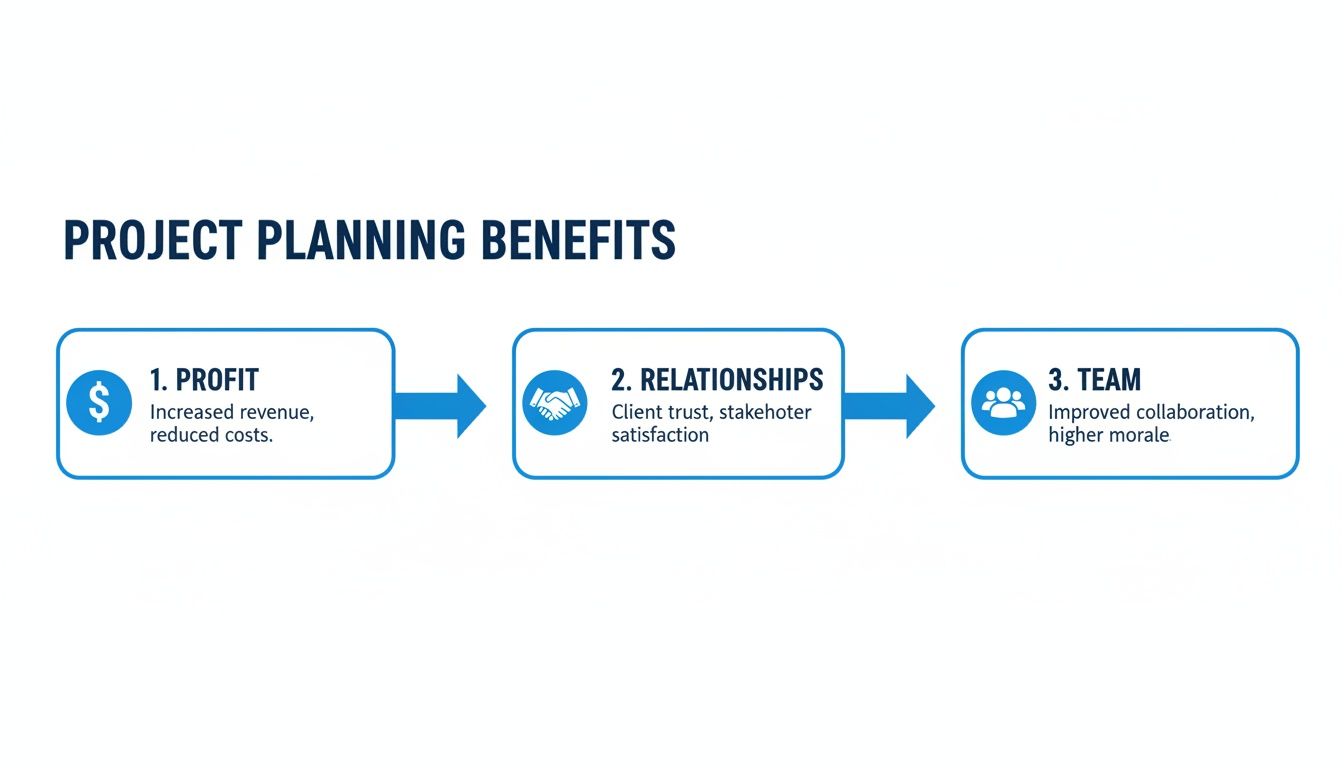
The key takeaway here is how interconnected these benefits are. Stronger client relationships and a healthier team environment are not just “nice-to-haves”; they directly fuel your financial success.
The Growing Need for Project Excellence. The pressure to plan well has never been higher. The global economy needs to fill 2.3 million new project-oriented roles every year through 2030 just to keep up with demand. For consulting firms, this intensifies the competition for skilled talent, making it absolutely critical to get the most out of your current team through smarter, more thorough planning. You can dig deeper into this global project management talent gap in PM Study Circle’s comprehensive project management statistics.
A structured approach transforms project management from a source of anxiety into your firm’s greatest strength. It provides the clarity and control needed to manage complexity and deliver exceptional results consistently.
This guide isn’t about theory. We’re walking through the actionable steps that will empower your team to turn great planning into your firm’s most powerful competitive advantage.
Get on the Same Page: Defining Scope & Aligning Stakeholders
Every project that ends with a high-five and a happy client starts the same way: with everyone agreeing on what success actually looks like. Before you even think about assigning a single task, the absolute first step is to nail down the project scope. This isn’t just about a to-do list; it’s a mutual understanding of boundaries, goals, and what “done” really means.
If you skip this, you’re basically sending an open invitation to scope creep, that quiet killer of budgets and deadlines. Getting this right from day one saves you from those painful, costly revisions and strained client relationships down the road.
Start with a Crystal Clear Kickoff. Let’s say you’re an architecture firm hired to design a new office. The client’s initial brief is simple: “a modern, open-concept workspace.” Great. But what does “modern” mean to them? Is it industrial-chic with exposed brick, or are they picturing sleek minimalism with floor-to-ceiling glass?
A well-run kickoff meeting is your chance to dig past those assumptions and uncover the real expectations. This is where you ask the right questions:
- Goals: “What business outcome are you hoping for with this new space? Is this about fostering collaboration, impressing clients, or attracting top talent?”
- Boundaries: “Are there any non-negotiables we need to be aware of? Think building codes, hard budget caps, or immovable deadlines.”
- Success Metrics: “Six months from now, what needs to have happened for you to call this project a massive win?”
The answers you get here are the building blocks of your Scope Statement. This doesn’t have to be a complicated document. It’s just a straightforward summary of the project’s objectives, key deliverables, and any assumptions or constraints that everyone can agree on.
Figure Out Who Does What with a RACI Matrix. Once you’ve locked down the “what,” it’s time to clarify the “who.” Confusion over roles is a classic source of project friction and delays. This is where a RACI matrix makes all the difference. It’s a simple chart that maps out who is Responsible, Accountable, Consulted, and Informed for every major task or deliverable.
Back to our architecture firm: the lead architect might be Accountable for the final design, while a junior designer is Responsible for creating the initial 3D models. The client is Consulted for feedback at key stages, and the firm’s finance team is kept Informed of budget milestones.
This simple exercise cuts through the ambiguity before it can cause problems. Everyone on the project knows exactly what their role is, what’s expected of them, and who they need to go to for decisions. It’s a proactive way to build alignment and make sure your team and your client are rowing in the same direction from the get-go.
Translating Big Goals into Actionable Tasks
With everyone aligned on the project’s goals, it’s time to get into the weeds of how you’ll actually get it done. An ambitious project, like a major infrastructure assessment for a city, can feel impossibly large at the start. The secret is to break it down.
This is where a Work Breakdown Structure (WBS) becomes your best friend. A WBS is a powerful project planning tool that deconstructs a massive objective into a series of clear, bite-sized tasks and deliverables. It’s not just a schedule or a to-do list; it’s a hierarchical map of everything your team needs to produce to call the project complete.

Think of it this way: you can’t just “build a house.” You have to lay the foundation, frame the walls, install the plumbing, and so on. The WBS provides that same level of granular clarity for any project, making sure nothing important gets missed.
Choosing Your WBS Approach. There are a couple of common ways to structure a WBS, and the right choice really hinges on your project’s specific nature. Nailing this is one of the most effective steps in planning successful projects.
-
Deliverables-Based WBS: This approach focuses on the outputs of the project, the tangible things you’re handing over. For our infrastructure assessment example, top-level items would be the final reports, like “Traffic Flow Analysis Report,” “Structural Integrity Audit,” and “Public Utility Assessment.” This method is perfect for projects with very distinct, tangible outcomes.
-
Phase-Based WBS: This structure is all about the timeline, organizing work chronologically around the project’s phases. For that same project, the top-level items would look more like “Phase 1: Data Collection,” “Phase 2: On-Site Inspections,” and “Phase 3: Analysis & Reporting.” This works beautifully for projects where the process itself is the main organizing principle.
The core idea of a WBS is to break the work down until you reach what’s called a “work package.” This is the smallest, most manageable unit of work: a task or group of tasks that can be realistically estimated and assigned to a single person or team.
From Breakdown to Effort Estimation. Once you have your work packages defined, you can move on to the crucial step of estimating the effort required for each one. This is where your project plan starts to feel real. But it’s not about guessing; it’s about having a real conversation with the people who will actually be doing the work.
For a task like “Conduct Bridge Structural Analysis,” you’d sit down with your lead engineer. They can give you an accurate estimate based on the number of bridges, the complexity of the inspections, and the data processing involved. It’s a friendly chat that yields hard data.
When you sum up all these individual estimates, you get a far more accurate picture of the total project effort than a top-down guess could ever provide. This bottom-up estimation is the bedrock for building a realistic schedule, an accurate budget, and an effective resource plan.
Building a Realistic Project Timeline and Resource Plan
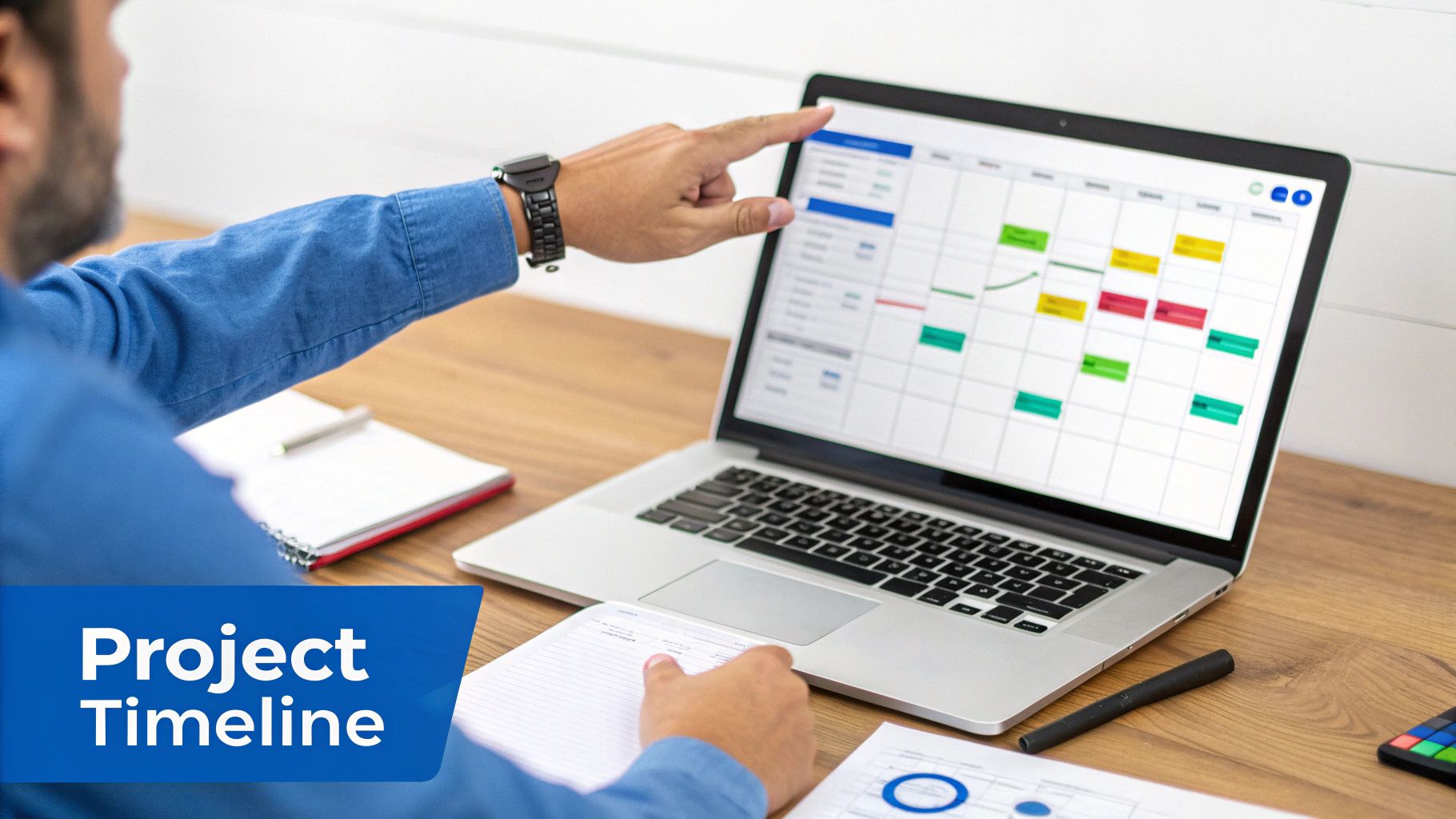
You’ve done the hard work of breaking down a massive, intimidating goal into a clear list of tasks with your Work Breakdown Structure (WBS). Now it’s time to put those pieces together into a realistic project timeline your team can actually execute.
This is more than just slapping due dates on a list. The real magic happens when you start to understand how each task connects to the others. You need to map out your task dependencies, recognizing, for instance, that the design team can’t even start on mockups until the client has signed off on the initial wireframes.

Defining these relationships is what turns a simple to-do list into a strategic project flow. Tools like Gantt charts are brilliant for this, giving you a visual representation of how a delay in one task can cause a domino effect across the entire schedule. That kind of visibility is what lets you manage proactively, not reactively.
Matching the Right People to the Right Work. A schedule is just a piece of paper (or a digital file) without the right people to bring it to life. This is where resource and capacity planning comes in, and it’s both an art and a science. It’s all about making sure you have the right people, with the right skills, free at the right time.
Think about a creative agency gearing up for a new website launch. The project manager doesn’t just hand the “Build Homepage” task to the first developer they see. They’re looking at the bigger picture:
- Availability: Is our senior front-end developer, Sarah, already booked 80% of her time on another high-stakes project?
- Skills: Does this particular build need some tricky JavaScript that only David on the team has mastered?
- Workload: Is our go-to designer, Maria, already juggling three other active projects and on the verge of burnout?
A great project schedule isn’t just about dates; it’s a living document that balances project demands with human capacity. Real-time visibility into your team’s workload is essential for making smart assignments that prevent bottlenecks and protect your team’s well-being.
By getting answers to these questions, the PM can make much smarter assignments. Maybe a mid-level developer can handle the initial homepage build, which frees up Sarah for the more complex integration work down the line. It’s this kind of strategic thinking that keeps projects humming along. For a more detailed look, check out our guide on effective resource planning for project management.
Choosing Your Scheduling Approach. Not all projects are the same, so your scheduling approach shouldn’t be one-size-fits-all. In professional services, you’ll most often see two major methodologies: Waterfall and Agile. Each has its place.
Deciding between a structured or flexible approach is a critical step in project planning. The table below breaks down the core differences between Waterfall and Agile to help you determine the best fit for your next project.
Project Scheduling Methodologies for Professional Services
| Aspect | Waterfall Methodology | Agile Methodology | Best Suited For |
|---|---|---|---|
| Structure | Linear and sequential; one phase must be completed before the next begins. | Iterative and incremental; work is done in short cycles called “sprints.” | Projects with well-defined requirements and a fixed scope, like a building construction. |
| Flexibility | Low. Changes are difficult and costly to implement once a phase is complete. | High. Changes are welcomed and can be incorporated between sprints. | Projects where requirements are expected to evolve, like software development or a marketing campaign. |
| Client Involvement | Primarily involved at the beginning (requirements) and end (approval). | Highly involved throughout the project, providing regular feedback. | Collaborative projects where client input is crucial for success. |
The right choice really boils down to your project’s context. A civil engineering firm designing a bridge will lean on the predictable, rigid structure of Waterfall. On the other hand, a digital agency running a social media campaign needs the flexibility of Agile to adapt its strategy based on real-time performance data. Interestingly, research compiled by Breeze shows that 31.5% of companies now use a hybrid model combining predictive and Agile approaches, reflecting the growing need for flexible but structured planning.
Ultimately, the best timeline isn’t just realistic; it’s also resilient enough to handle whatever comes its way.
Aligning Your Project Plan with Financial Goals
A project can be a creative masterpiece and still be a total financial failure. It happens more often than you’d think. This is where we bridge that all-too-common gap between brilliant execution and actual profitability, a critical step that often gets overlooked until the damage is done.
Your Work Breakdown Structure isn’t just a fancy to-do list; it’s the bedrock of your project budget. By using it to estimate the real costs of labor, materials, and overhead, you build a financial forecast from the ground up. This granular view is absolutely essential for protecting your firm’s bottom line.
This process also forces an upfront conversation about your billing model. Are you working on a fixed fee, or is it strictly time and materials? Your entire project plan has to reflect that decision to keep cash flow healthy. That means making sure invoicing milestones are directly tied to when you complete key deliverables.
From Budgeting to Real-Time Monitoring. Let’s walk through a real-world scenario. A design agency lands a new e-commerce website build for a client on a fixed-fee contract. They’ve carefully budgeted 120 hours for the core development phase.
Three weeks in, the project manager pulls up the numbers and sees the team has already burned through 105 hours. The kicker? They’re only about 60% done with the development work.
Without real-time data, this disaster-in-the-making wouldn’t surface until the phase was “complete,” by which time the budget would be completely blown. But with live data, the PM can jump on it immediately. She can huddle with the dev team to figure out what’s causing the overage, have an honest conversation with the client about a potential scope tweak, and re-forecast the project’s profitability before it turns into a loss.
This is why visibility is so powerful. An integrated system that connects time tracking directly to project budgets gives you a clear, up-to-the-minute view of financial health, empowering you to make data-driven decisions on the fly.
The Power of Integrated Systems. Pulling this off is much, much easier with the right tools in your corner. In fact, a whopping 77% of high-performing projects use dedicated project management software to stay on course. These platforms give you the real-time insights needed to actively manage profitability, not just hope for it. You can see more compelling stats on the impact of PM software over at monday.com.
To see how modern tools are built for this, explore how platforms combine project management and accounting. It changes how you run your business. And let’s be honest: even the most perfectly crafted project plan will get punched in the mouth. Things happen. The goal isn’t to create a rigid, unbreakable plan; it’s to build in the flexibility to handle the inevitable curveballs. This is where solid risk and change management becomes your project’s insurance policy.
Thinking ahead about what could go wrong isn’t being pessimistic; it’s just being professional. A straightforward risk assessment helps you get out in front of common issues before they have a chance to blow up your timeline or budget.
For instance, what’s the plan if a key client stakeholder suddenly goes on a two-week vacation, holding up critical approvals?
Identifying and Mitigating Risks. Get your team together and brainstorm potential risks. You’re not trying to plan for a zombie apocalypse here, just the likely culprits that pop up in your line of work.
Your list might look something like this:
- Client Delays: The main decision-maker is out of office and unreachable.
- Technical Glitches: A new software integration completely fails, and you need specialist developer support ASAP.
- Resource Crunches: A key team member gets sick right in the middle of a critical project phase.
Once you have your list, you can sketch out a simple, proactive mitigation plan for each. For that unavailable client, the plan might be as simple as establishing a secondary point of contact right at the start of the project. This kind of foresight turns a potential crisis into a manageable bump in the road.
Mastering the Change Request Process. Just as important is having a formal process for any changes to the plan. When a client casually asks, “Could we just add one more feature?” that request needs a proper home, and it’s not a random email thread. An undefined process is a one-way ticket to scope creep.
Having a clear change management process isn’t about saying “no” to clients. It’s about creating a transparent system that evaluates the impact of their request on the project’s scope, timeline, and budget, strengthening trust.
This process ensures that any and all adjustments are formally documented and signed off on by both sides. It’s a simple step that protects your team from doing unpaid work and keeps everyone perfectly aligned on the project’s actual goals.
You can get a closer look at taming this common project beast in our guide on managing scope creep in project management. A structured approach here is what turns potential chaos into a controlled, professional conversation.
Even with a detailed guide in hand, some questions always seem to pop up when you start putting a new planning process into action. After working with countless firms, we’ve noticed a few common themes. Here are the answers to the ones we hear the most.
How Long Should Project Planning Take?
There’s no magic number here. It really depends on the scale and complexity of the project you’re tackling. That said, a solid rule of thumb is to dedicate around 10-15% of the total project timeline just to the planning phase.
So, if you’re kicking off a six-month engagement, you should be spending a good three to four weeks getting your plan buttoned up. It might feel like a lot upfront, but trust me, investing that time now will save you massive headaches and budget overruns down the road.
What Is the Most Common Planning Mistake?
The biggest and most frequent misstep we see is teams jumping into execution way too fast. They get excited and jump in before getting crystal-clear alignment from every stakeholder and properly defining the scope. Everyone thinks they’re on the same page, but they’re often not.
This almost always leads to scope creep, frustrating rework, and unhappy clients. A detailed kickoff meeting and a formally signed-off scope statement are your best defense against this common pitfall.
How Can I Get Team Buy-In?
This one’s all about framing. Don’t just talk about how the new process helps the business; focus on what’s in it for them.
Explain that a solid plan is their best tool for reducing last-minute chaos, preventing burnout from endless changes, and making sure their hard work actually gets the resources it deserves. Even better, get them involved. When you ask your team to help build the WBS and estimate timelines, you create a powerful sense of ownership from day one.
Ready to unify your planning projects steps from proposal to profit?
brings everything together in one simple, intuitive platform..
Start your free 14-day trial and discover a better way to run your studio.