
 Pipeline & Proposals
 Project Management
 Resource Planning
 Time & Costs
 WIP & Invoicing
 Commercial Reporting
 Consulting Engineers
 Architects
 Town Planners
 Building Designers
Project Cost Management: How Service Firms Keep Projects Profitable From Start to Finish

Ben Walker
Written for Drum
In This Article
- Mastering Project Cost Management for Service Firms
- Why Project Cost Management Is Your Firm’s Superpower
- Your Step-By-Step Guide to the Cost Management Process
- Key Metrics to Track and Common Pitfalls to Sidestep
- Tailoring Cost Management for Your Industry
- An Actionable Playbook for Getting Started and Common Questions
Mastering Project Cost Management for Service Firms
Project cost management might sound like a stuffy term, but it’s really just about handling a project’s money, from the first estimate to the final invoice. Think of it as your financial game plan, the friendly guide that ensures your brilliant ideas not only get finished but do so within the approved budget, turning hard work into profitable results.
Why Project Cost Management Is Your Firm’s Superpower
Let’s move past seeing cost management as a restrictive accounting chore. It’s actually the secret sauce that separates a thriving professional services firm from one that’s constantly putting out fires. It’s what makes the difference between a project that quietly bleeds cash and one that boosts both your reputation and your bottom line. Flying blind with your finances just isn’t an option.
To make this crystal clear, let’s imagine you’re planning a big dinner party for some important clients.
- Cost Estimating: This is you making the shopping list. You figure out exactly what you need (your team’s time, software subscriptions, maybe some freelance help) and get a good idea of what it will all cost. For instance, you might estimate 40 hours of a senior designer’s time and a $500 stock photography budget.
- Cost Budgeting: Now you’re setting a firm budget for the groceries. You allocate specific amounts for each part of the meal. This is your project’s financial roadmap, where you’d formally approve that $5,000 for the designer and the $500 for photos.
- Cost Controlling: This is you in the kitchen, making sure you don’t burn the main course (blow the budget) or realize you forgot a key ingredient halfway through (unplanned scope creep). You’re actively checking your spending against your plan and making smart adjustments along the way.
This isn’t just about crunching numbers; it’s a strategic framework for running a healthier, more predictable business. Let’s look at how these processes fit together.
The Four Pillars of Project Cost Management
| Process | Core Purpose | Key Activity Example |
|---|---|---|
| Cost Estimating | To develop an approximation of the monetary resources needed to complete project activities. | Analyzing historical data from similar projects to predict the cost of a new architectural design. |
| Cost Budgeting | To aggregate the estimated costs of individual activities to establish an authorized cost baseline. | Combining all estimated costs into a single, approved project budget before work begins. |
| Cost Monitoring & Controlling | To monitor the status of the project to update the project costs and manage changes to the cost baseline. | Using Earned Value Management (EVM) to compare planned vs. actual spending throughout the project. |
| Cost Forecasting | To predict future project costs and performance based on current information and trends. | Calculating the Estimate at Completion (EAC) to see if the project is still on track to finish within budget. |
Each pillar builds on the last, creating a friendly system that gives you real-time financial insight and control over your projects.
From stress to strategy. When these pieces work together smoothly, project cost management stops being a source of stress and becomes one of your most powerful strategic tools. It shifts your team from reactive damage control to proactive, confident leadership. Mastering this helps you spot financial trouble before it starts, make smarter decisions under pressure, and consistently deliver amazing value to your clients.
The stakes are higher than most firms realize. Bad cost management isn’t a small stumble; it’s a direct threat to your profitability and stability. Good cost management is the foresight that lets you steer projects away from the rocks and toward success.
The real cost of guesswork. Failing to get a grip on project costs leads to a world of pain: frantic decisions, awkward client conversations, and profit margins that simply vanish. It’s a huge problem, with the average project blowing its budget by a staggering 27%. The financial fallout is mind-boggling, with organizations wasting an estimated $1 million every 20 seconds due to poor project management practices, as reported by Ravetree’s analysis of project management data. For professional services firms specifically, fixed-fee engagements face an average overrun of 35%, making them especially vulnerable when cost controls aren’t in place.
This isn’t just a big corporate problem; it hits service firms of all sizes, where a single overrun can easily wipe out the profit from three other successful projects.
Ultimately, sharp project cost management is your firm’s superpower. It gives you the clarity to protect your profits, thrill clients by delivering on-budget, and build a sustainable business that gets stronger with every project you complete. It’s the friendly, reliable backbone that supports all of your creative and strategic goals.
Your Step-By-Step Guide to the Cost Management Process
Getting project cost management right isn’t a one-time task; it’s a continuous, friendly cycle. Think of it as a four-part journey that guides your project from a rough idea all the way to a successfully completed, profitable engagement. Each stage flows into the next, creating a clear financial road map for everyone to follow.
To make this feel real, let’s imagine we’re an architecture firm tasked with designing a new community library. We’ll use this project to walk through the entire process, step by step.
This isn’t a straight line. It’s a friendly feedback loop where what you learn in one stage helps you refine the others, keeping your project financially healthy and on track.
Step 1: Cost Estimating. This is where it all begins: figuring out a solid approximation of what the project will actually cost. Your goal here is accuracy, and the method you use will depend on how much information you have.
For our library project, the client’s first request is a ballpark number for their grant application. Since we don’t have detailed plans yet, we use an analogous estimate. This is a “top-down” approach where we look at a similar library we designed a few years back, adjust for inflation and complexity, and provide a high-level figure. It’s quick and helpful, but not super precise.
Once the grant is approved and we move into detailed planning, we switch to a bottom-up estimate. This means we break the entire project into small, manageable pieces (schematic design hours, structural engineering reviews, permit applications, and 3D renderings) and price out every single task. It takes more effort, but the accuracy is light-years ahead.
Step 2: Cost Budgeting. With a detailed estimate ready, the next step is to create the formal project budget. This isn’t just one big number; it’s a time-phased plan that spreads the costs across the project’s timeline. This budget becomes your official cost baseline, the approved financial plan you’ll measure your progress against.
For our library, we’ll take our detailed bottom-up estimate of $250,000 and map it across the project’s six-month schedule.
- Months 1-2: We set aside funds for initial design concepts and client workshops.
- Months 3-4: The budget is allocated to cover detailed architectural drawings and consultations.
- Months 5-6: Costs are earmarked for final permit submissions and construction support.
This creates a clear spending schedule, showing exactly how much money we plan to spend and when, keeping everyone on the same page.
Step 3: Cost Monitoring and Control. This is where the real action happens. It’s the active, hands-on part of managing costs where you’re constantly checking the project’s financial pulse. You’re comparing what you’ve actually spent against your budget, asking, “Are we on track?” and, if not, “Why, and what can we do about it?”
Let’s say in Month 3 of our library project, we notice our lead architect has logged 20% more hours than we budgeted for that phase. That’s a variance. Cost control is what we do next.
The point of cost control isn’t to assign blame; it’s to understand why you’re off-track and make smart, friendly decisions to get back on course. It’s about gently steering the ship before a small drift becomes a major detour.
We look into it and discover the client requested some major changes to the atrium design, a classic case of scope creep. Our control action is to document the change, calculate the extra cost, and present a clear change order to the client. By controlling costs proactively, we’re not just protecting our profit margin; we’re maintaining transparency and trust.
Step 4: Cost Forecasting. Finally, cost forecasting is all about using your project’s performance data to predict the future. Based on where we are today, where are we likely to end up? This gives you the friendly insight needed to make strategic tweaks before it’s too late.
At the halfway point of the library project, we run the numbers for our Estimate at Completion (EAC). This forecast projects the total cost based on our performance so far.
Our original budget was $250,000. Factoring in the extra hours from the scope change, our EAC might now predict a final cost of $265,000. This forecast is a critical, friendly warning. It lets us have a constructive conversation with the team about finding efficiencies, or go back to the client to discuss the budget impact, long before the final invoice is a surprise.
This four-step cycle (estimate, budget, control, and forecast) is the friendly foundation of solid financial management for any project.
Key Metrics to Track and Common Pitfalls to Sidestep
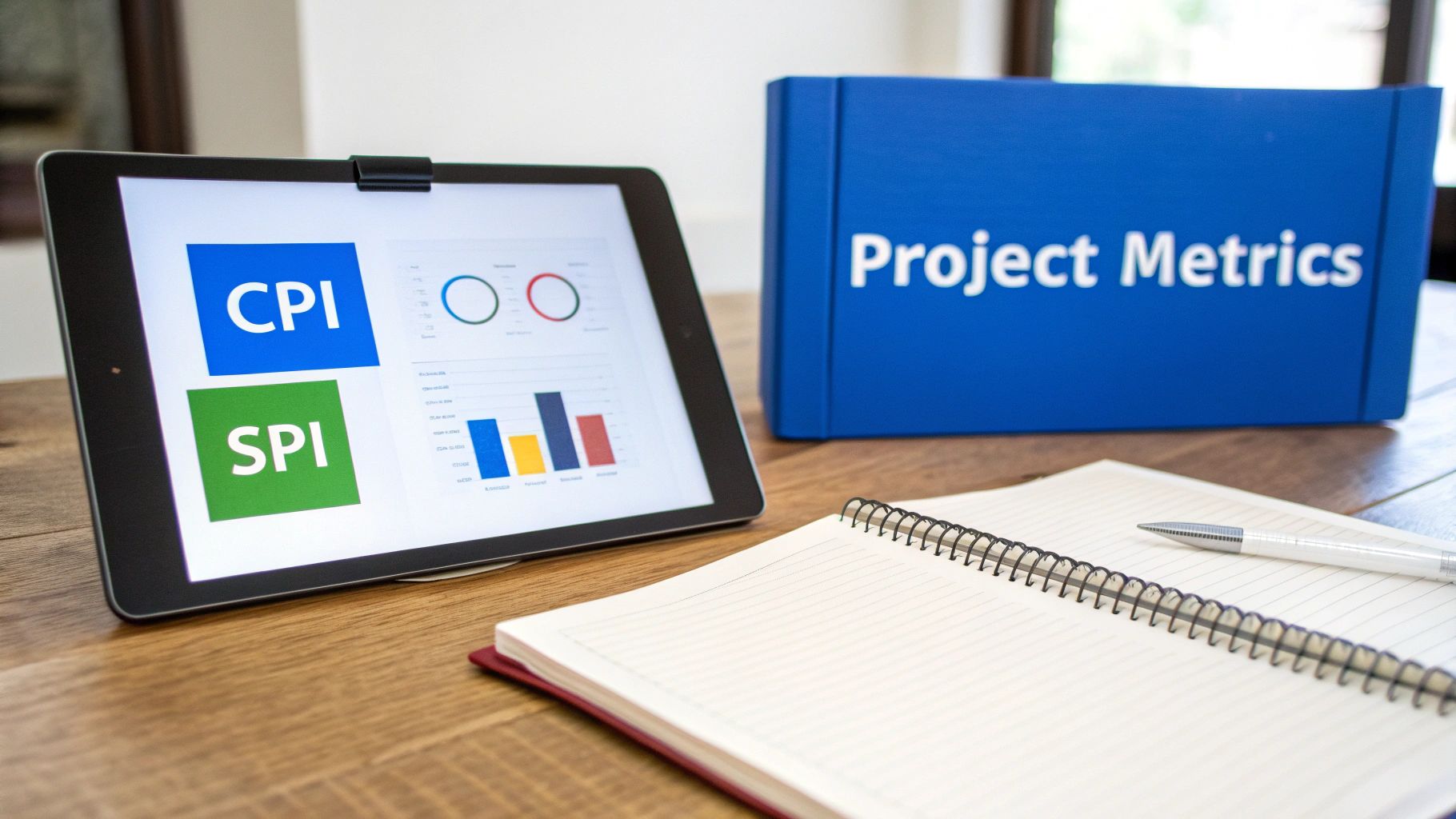
Managing project costs effectively comes down to keeping a friendly eye on the right data. Flying blind is the quickest way to watch a budget spiral. Think of these key metrics as the dashboard in your car. They give you the real-time feedback you need to get where you’re going, on time and without running out of gas.
Two of the most helpful numbers come from a technique called Earned Value Management (EVM). Don’t let the formal name intimidate you; the concepts are surprisingly simple and incredibly insightful.
Essential project health metrics. Let’s look at the two most important dials on your project dashboard. These aren’t just for show; they tell a clear, simple story about your efficiency and whether you’re really on track.
- Cost Performance Index (CPI): This is your financial efficiency score. It answers one simple question: “Are we getting the value we paid for?” A CPI over 1.0 is great news (you’re under budget!), while a CPI under 1.0 is a friendly heads-up that you’re over budget.
- Schedule Performance Index (SPI): This tells you how you’re doing against the timeline. It asks, “Are we as far along as we planned to be?” An SPI over 1.0 means you’re ahead of schedule, while anything under 1.0 means you’re falling behind.
Let’s make this practical. Imagine you’re running a branding project. You’ve completed work valued at $20,000 (your Earned Value), but you check the books and see you’ve actually spent $25,000 (your Actual Cost).
Your CPI would be 0.8 ($20,000 / $25,000). This immediately and clearly tells you you’re over budget. For every dollar you’ve spent, you’ve only created 80 cents worth of value. It’s a clear signal to investigate.
These numbers are vital signs that let you step in before a small issue becomes a big problem. To get the full picture, you need to understand how to track the overall financial performance of your projects and connect it back to your firm’s bottom line.
Common pitfalls and how to sidestep them. Knowing your numbers is one thing, but avoiding the common traps that sink projects is another skill entirely. Spotting these potential issues early is what makes a great project manager. Only 35% of projects worldwide finish successfully, meeting all goals and timelines, which shows just how critical it is to get cost management right.
1. Overly Optimistic Estimates – It’s tempting to submit a lean estimate to win a job, but this friendly gesture often backfires, setting the project up for financial stress from day one. This usually happens by underestimating complexity or not checking if the right people are available.
- Warning Sign: Your team is constantly asking for more time or money right after the project kicks off.
- How to Sidestep: Ground your estimates in reality using historical data from similar projects. Have a senior team member give it a friendly “gut check” before it goes to the client. For example, check the timesheets from your last website build before promising a timeline on the next one.
2. The Slow Poison of Scope Creep – This is the silent budget killer. It often starts with a client’s innocent request: “While you’re in there, could you just…?” One small, undocumented change leads to another, and soon your team has put in dozens of unbilled hours, and your profit margin has evaporated.
- Warning Sign: The final deliverable is starting to look quite different from what was in the original scope of work.
- How to Sidestep: Implement a simple, formal change request process. Every new request gets documented, estimated, and approved by the client, ensuring everyone understands the impact on budget and timeline. It’s a friendly process that protects everyone.
Scope creep isn’t a sign of a difficult client; it’s often a sign of a weak process. A clear, communicated change control system protects both you and your client from any unwelcome surprises.
3. Ignoring Non-Billable Internal Work – Projects don’t run on client work alone. All those internal meetings, admin tasks, and team check-ins take up real time. If you don’t account for this “unseen” work in your budget, it quietly eats into your profit.
- Warning Sign: The project looks profitable on paper, but your firm’s overall profitability is lower than you expected.
- How to Sidestep: Build time and budget for internal project management right into your plan. Use a time tracking tool that lets your team log hours against both billable and non-billable project tasks. This gives you a true, honest picture of the total effort required.
Tailoring Cost Management for Your Industry
Effective project cost management isn’t a rigid, one-size-fits-all formula. The way an ad agency tracks its costs is very different from how an engineering firm does it, and for good reason!
The trick is to adapt the core principles (estimating, budgeting, and controlling) to the unique rhythm and risks of your field. When you focus on your industry’s specific challenges, your cost management strategy starts feeling less like a chore and more like a friendly advantage.
Let’s explore how different professional service firms can do just that.
Best practices for consulting firms. For consultants, your biggest asset (and your biggest cost) is your people. The financial game is won or lost based on how well you manage your team’s time. This means getting serious about utilization rates.
A consultant’s time is a perishable good; an unbilled hour is revenue lost forever. A major financial drain is “bench time,” when a consultant is between projects but still on payroll. Good cost management here means mastering resource forecasting to keep the bench as empty as possible. The SPI Research 2025 Professional Services Maturity Benchmark found that billable utilization has slipped to just 68.9%, well below the 75% optimal threshold, with the most mature firms dramatically outperforming those without structured resource and cost practices.
Here are a few practical strategies:
- Track Billable vs. Non-Billable Hours Diligently: This isn’t just for invoicing. It’s crucial data for understanding the true cost of winning new business (all that proposal writing!) and your general overhead.
- Forecast Utilization Proactively: Use your sales pipeline to predict future staffing needs. This helps you avoid both overstaffing (which is expensive) and understaffing (which leads to burnout).
- Analyze Profitability by Consultant and Project: A junior consultant might have a lower bill rate, but if they’re super efficient, they could be one of your most profitable team members. Understanding these details helps you build smarter project teams.
Best practices for architecture and engineering firms. Architecture and engineering (A&E) firms face a different set of challenges. Projects are often long and complex, involving a mix of labor, specialized materials, and outside contractors. One of the biggest financial risks is the change order.
When a client asks to move a structural wall, it isn’t just a design tweak; it impacts materials, timelines, and subcontractor schedules. Poorly managed change orders are a top cause of budget overruns in the A&E world.
In architecture and engineering, your budget is a living document. The goal isn’t to prevent changes; they’re inevitable. The goal is to have a rock-solid, friendly process for documenting, pricing, and getting approval for them so they don’t eat into your profit.
To protect your bottom line, try these approaches:
- Implement a Formal Change Order Process: No work begins on a change until a formal, client-approved order is in place. This document should clearly outline the impact on both cost and schedule. No exceptions.
- Use Phased Budgeting: Break huge projects into distinct phases (e.g., schematic design, design development, construction documents). This gives you more accurate, short-term cost control and natural checkpoints to review the budget with your client.
- Factor in Commodity Price Volatility: The cost of materials like steel or glass can fluctuate. Your initial estimates should include contingency funds for material price volatility, protecting you from market shifts beyond your control.
Best practices for creative and marketing agencies. Creative agencies operate where value can be subjective and scope is notoriously fluid. How do you budget for “a more dynamic logo”? This ambiguity makes tight project cost management an absolute must.
Your financial landscape is also complex. You’re managing your team’s billable hours, freelance costs, and a growing list of software subscriptions (like Adobe Creative Cloud or social media tools).
Here’s how to bring some financial clarity to the creative process:
- Budget by Deliverable, Not Just Hours: Instead of a vague hourly estimate, structure proposals around concrete deliverables (e.g., 3 logo concepts, 1 round of revisions). This sets clear expectations and makes it much easier to spot and discuss scope creep in a friendly way.
- Track Software Costs Per Project: Don’t let your software overhead be a mystery. Assign license costs to the projects that use them. This gives you a true picture of each project’s profitability. For example, if a video project requires a special effects plugin, that cost should be tied directly to that project’s budget.
- Create a Freelancer Cost Database: Keep a simple, updated record of your go-to freelancers, their rates, and specialties. This speeds up estimating and ensures you’re budgeting accurately for outside talent from the start.
How a PSA platform unifies your financial workflow.
Chasing financial data across scattered spreadsheets, time trackers, and email chains is exhausting and prone to errors. It’s a disconnected process that forces project managers to spend more time hunting for numbers than actually managing. This is where a modern Professional Services Automation (PSA) platform can make a real difference.
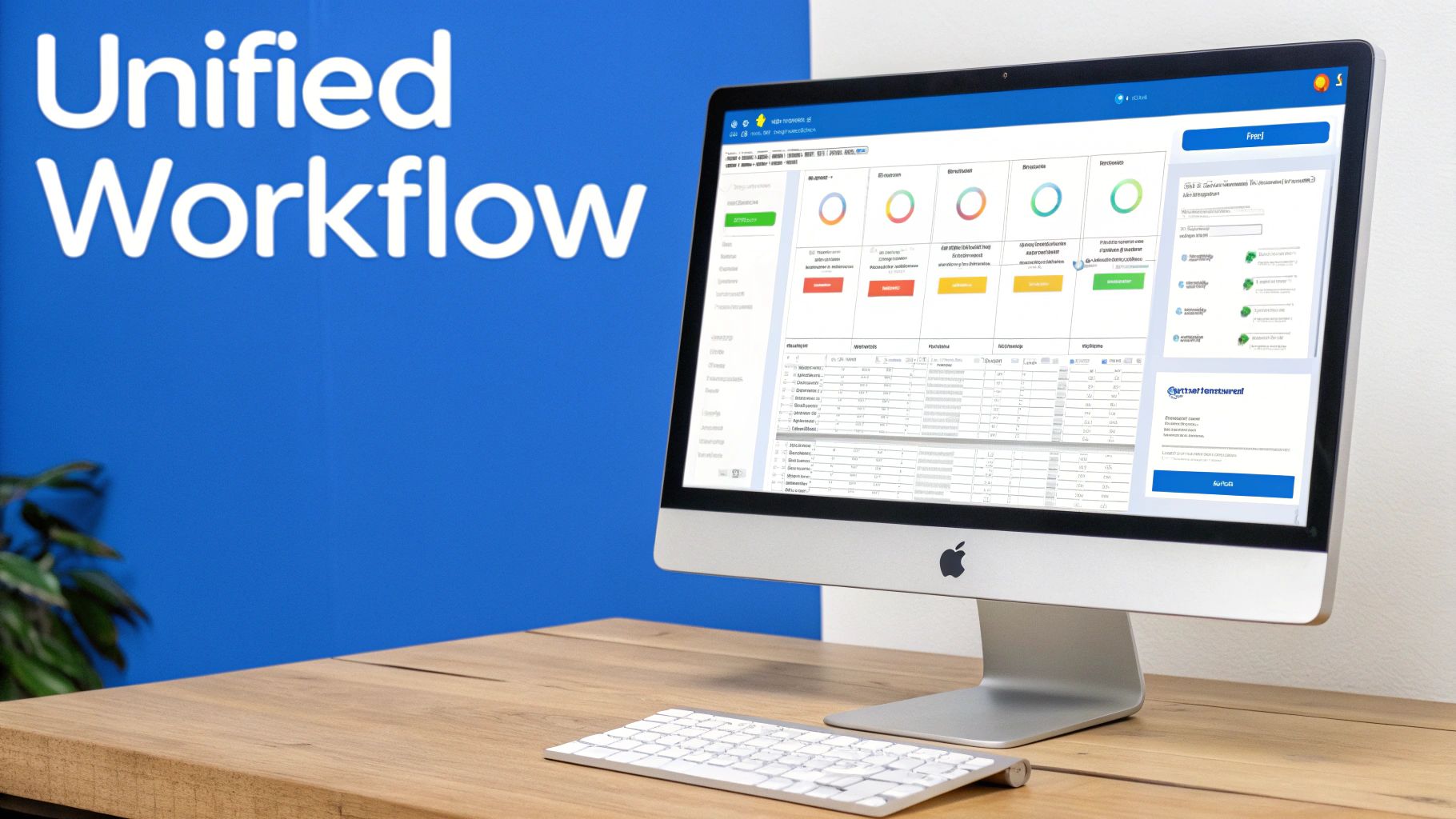
Think of a PSA as the friendly central hub for your firm’s financial workflow. Instead of juggling a half-dozen different tools, it brings every piece of the project cost management puzzle into one unified system. This creates a smooth flow of information from the first sales call all the way to the final paid invoice.
From proposal to paid invoice. A great PSA platform creates a direct, automated link between each stage of the project lifecycle. This connected workflow eliminates the tedious manual data entry that costs your team valuable time and always invites human error. It’s all about creating a single source of truth for your project finances.
Here’s what that connected workflow looks like in practice:
- Proposals to Projects: When a client signs off on your proposal, the PSA can automatically create the project, set the budget, and establish the cost baseline. No more copy-pasting numbers.
- Time and Expenses to Actuals: As your team logs hours and submits expenses in the platform, those costs instantly update the project’s actuals. This gives you a real-time view of your budget, not a report that’s two weeks old.
- Work to Invoicing: All billable hours and expenses are automatically pulled into accurate, professional invoices. This direct line from work to revenue dramatically speeds up your billing cycle and improves cash flow.
A PSA platform transforms project cost management from a series of clunky administrative tasks into a smooth, automated workflow. It’s the difference between manually piecing data together and having a friendly system that does it for you.
The practical payoff of a single system. Adopting a unified platform isn’t just about convenience; it delivers real business results. It reduces the administrative burden on your project managers, freeing them up to focus on strategy and client relationships. It also provides incredible visibility into project health, letting you spot budget issues before they become emergencies.
The demand for these tools is growing for a reason. The project management software market is projected to hit $12.02 billion by 2030, according to The Business Dive’s analysis of project management trends. Yet, a surprising 23% of organizations still don’t use dedicated project management software, meaning many are stuck with inefficient, manual methods. Meanwhile, organizations that implement smart time tracking reduce budget overruns by 43% and improve estimation accuracy by 67%, which underscores the tangible payoff of connecting your financial data in one place.
Ultimately, a PSA platform offers more than just a list of features; it provides a better, more connected way to run your business. By integrating every financial touchpoint, you gain the clarity needed for accurate project cost management and the efficiency required to boost profitability.
For a closer look at these powerful tools, check out our friendly guide on what PSA software is and how it works.
An Actionable Playbook for Getting Started and Common Questions
Ready to move from theory to action? Rolling out a formal project cost management framework doesn’t have to be a huge, intimidating effort. By breaking it down into clear, manageable steps, you can build a system that genuinely boosts profitability and helps your firm grow. This playbook is your friendly, hands-on guide to making it happen.
The journey starts not with a massive software purchase, but with a simple, honest look at your current process. Where are things getting stuck? What’s working well, and what’s causing the most headaches for your team?
Phase 1: Assess and Standardize. Before you can improve anything, you need a clear baseline. Start by auditing a few recently completed projects. Where did your estimates miss the mark? Were there any surprise costs? Getting this initial picture is the critical first step.
Next, focus on standardization. Create simple, consistent templates for your cost estimates and project budgets. This ensures everyone on your team is building their financial plans the same way, using the same friendly language and categories.
A standardized process is the foundation of reliable data. If every project manager estimates costs differently, you can never compare apples to apples or learn from past performance.
Phase 2: Tool Up and Train Up. With your core processes mapped out, it’s time to find the right tools to do the heavy lifting. Let’s be honest: manual tracking in spreadsheets is a recipe for errors and wasted hours. A unified platform is what you need.
Look for tools that connect the dots from proposal to final invoice. This means features for creating budgets, tracking time and expenses, and keeping a real-time, friendly eye on project financials. To get a clear idea of what to look for, see how modern time tracking and expense software can pull all this data into one helpful place.
Once you’ve chosen your tool, it’s all about team adoption. Don’t just send an email with a login link. Run friendly, hands-on training sessions that show your team exactly how this new system makes their lives easier: less admin, clearer goals, and better outcomes. Getting their buy-in is essential for success.
Phase 3: Implement and Improve. Now it’s time to go live. We recommend starting with a pilot project to iron out any kinks before rolling the new process out to the entire firm. This gives you a safe space to test your new templates and tools without high stakes.
Finally, establish a cycle of continuous improvement. The real goal of effective project cost management isn’t just to control the current project’s budget, but to make the next one even more accurate and profitable.
Hold a quick “lessons learned” session after each project wraps up. This simple step transforms cost management from a one-time setup into a living system that gets smarter with every project you deliver.
Ready to put this into practice? Here’s a simple checklist to guide you.
Cost Management Implementation Checklist
| Phase | Key Action | Success Indicator |
|---|---|---|
| Assess | Audit 3-5 past projects for budget variances. | You can clearly identify the top 2-3 reasons for cost overruns. |
| Standardize | Create and adopt firm-wide budget and estimate templates. | All new project proposals use the approved templates without exception. |
| Tool Up | Select and implement a unified PSA or project management tool. | Time and expenses are logged directly against project budgets in one system. |
| Train Up | Conduct role-specific training for all team members. | Team members can independently track their time and view project progress. |
| Improve | Hold post-project financial reviews to refine future estimates. | Your firm’s estimate accuracy improves by 5-10% within six months. |
By following these friendly steps, you build a powerful feedback loop that tightens up your estimates, protects your margins, and sets your firm up for long-term financial health.
Jumping into a more structured approach to project cost management usually brings up a few good questions. We’ve tackled some of the most common ones below to give you clear, straightforward answers as you start putting these principles to work.
What is the difference between cost management and accounting? It’s easy to get these two mixed up, but they have different jobs. Think of it this way: accounting is historical. It looks in the rearview mirror at what the company has already spent and earned. Its role is financial reporting, compliance, and painting a picture of overall business health.
On the other hand, project cost management is forward-looking. It focuses on a specific project’s budget. It’s about actively forecasting and steering future expenses to make sure that single engagement stays profitable. One looks back at the past; the other helps you steer the ship forward.
How should we handle unexpected costs? Let’s be real: unexpected costs are going to happen. The trick isn’t to avoid them, but to be ready for them. The best way is to include a contingency reserve in your initial budget. This is a specific amount, often 5-10% of the total budget, set aside for foreseeable risks, like a potential price hike on materials.
For the curveballs you truly couldn’t see coming, you can use a management reserve. When an unexpected cost pops up, the process is simple: document it, figure out the impact, and talk to your client. A transparent, no-surprises approach builds trust and keeps everyone on the same page. A practical example would be a sudden software subscription increase; you’d document it and discuss with the client how to best absorb that new cost.
The goal isn’t to dodge every unexpected cost; that’s impossible. The goal is to have a clear, friendly plan for dealing with them when they inevitably show up.
Can small firms really use these principles? Absolutely! In fact, small firms might benefit the most. You don’t need a complex system or a big finance team to do this well. For a solo consultant or a small agency, solid project cost management can be as simple as:
- Creating a proposal template you use every time.
- Using a simple spreadsheet or an affordable tool to track time and expenses against your project budget.
- Holding a quick “lessons learned” chat after each project to see how your estimate compared to reality.
The core ideas of estimating, budgeting, and controlling costs are completely scalable. The key is to start simple. Build a friendly process that gives you better financial visibility without bogging you down in administrative tasks.
Ready to stop juggling spreadsheets and get real-time control over your project finances?
Drum brings your proposals, project management, time tracking, and invoicing together on a single, intuitive platform built just for professional services. See how much more profitable your projects can be.
Start your free 14-day trial and discover a better way to run your studio.