
 Pipeline & Proposals
 Project Management
 Resource Planning
 Time & Costs
 WIP & Invoicing
 Commercial Reporting
 Consulting Engineers
 Architects
 Town Planners
 Building Designers
Project Management for Creative Agencies: How to Deliver Great Work Without Killing Margins

Ben Walker
Written for Drum
In This Article
- Project Management for Creative Agencies: A Practical Guide
- Why Traditional Project Management Breaks Creative Flow
- The Blueprint for Creative Project Success
- Choosing Your Agency’s Project Management Style
- Building Your Agency’s Project Management Tech Stack
- Mastering Resource Planning to Prevent Team Burnout
Project Management for Creative Agencies: A Practical Guide
Juggling projects in a creative agency is a delicate dance between structure and freedom. It’s all about crafting a workflow that guides projects across the finish line without snuffing out the spontaneous, sometimes messy process that sparks brilliant work. Let’s look at how you can make that happen.
Why Traditional Project Management Breaks Creative Flow
Welcome to the beautiful chaos of a creative agency! If you’ve ever tried to force a dynamic branding project into a rigid, corporate-style project plan, you know exactly what we’re talking about. It feels like trying to paint a masterpiece using a spreadsheet. The tool just wasn’t made for the job.
Traditional project management, born from predictable industries like manufacturing and construction, is built on a foundation of certainty. Tasks are linear, sequential, and defined down to the last nut and bolt from day one. But creative work is anything but straightforward. A logo idea might morph overnight, client feedback on a video script can send the team back to the drawing board, and inspiration rarely clocks in and out between 9 AM and 5 PM.
The friction between structure and spontaneity is where the breakdown begins. When you force a rigid structure onto a fluid process, you create instant friction. Old-school methods often demand that every single detail is planned upfront, leaving zero room for the exploration and happy accidents that are the lifeblood of innovation. This approach is a fast track to frustrated teams and underwhelmed clients.
The core issues usually boil down to a few familiar problems:
- Stifled Creativity: When your team is locked into a strict plan, they feel pressured to stick with the original concept, even when a much better one surfaces mid-project. Imagine a designer has a brilliant new idea for a website’s navigation, but the wireframes were approved weeks ago. A rigid process makes that inspiration a problem, not an opportunity.
- Unrealistic Expectations: Traditional plans just don’t account for the non-linear, unpredictable nature of creative problem-solving, which almost always leads to blown deadlines and stress. A copywriter might need an extra day to nail the perfect tagline. That’s part of the process, not a failure to execute a task.
- Communication Gaps: Rigid systems can shut down the open, collaborative dialogue that’s essential for refining ideas and adapting to new insights.
Forcing creatives to follow a rigid, step-by-step process is like asking a jazz musician to only play the notes on the page. You’ll get a song, but you lose all the magic and improvisation that makes the performance special.
When good intentions lead to burnout. The goal of any project management system is to bring order to chaos. But when the system doesn’t fit the work, it just adds another layer of complexity. This mismatch is a huge driver of burnout in the creative industry. Constantly fighting a process that works against you is just plain exhausting.
For example, scope creep becomes a nightmare when the initial plan is too inflexible to handle natural project evolution. A client’s small suggestion for a website’s color palette can feel like a major crisis in a rigid Waterfall plan. A more agile approach, on the other hand, treats it as a normal part of the iterative design process. If this sounds familiar, our guide on project management for design firms dives deeper into these challenges.
Ultimately, successful project management for creative agencies doesn’t try to tame the chaos. It embraces it, providing a supportive framework instead of a restrictive cage.
The Blueprint for Creative Project Success
Building a project management framework for a creative agency often feels like walking a tightrope. Go too rigid, and you kill the creative spark. Go too loose, and projects dissolve into pure chaos. The magic lies in finding that sweet spot: a system with just enough structure to guide the process, not cage it.
Think of it like producing a film. It’s a massive undertaking with countless moving parts, clear phases, and a definite end goal. Every role matters, and the final cut is a marriage of artistic vision and painstaking planning. Let’s use that film production analogy to build your agency’s blueprint for success, one scene at a time.
The script: strategic scoping and client briefs. Every great film starts with a great script. It defines the story, characters, and the world they live in. In the agency world, your script is the strategic scope and creative brief. This is, without a doubt, the single most important document you will create, acting as the foundation for everything that follows.
A vague brief is like a script with missing pages. It’s a one-way ticket to confusion, endless rewrites, and a final product nobody is happy with. A solid brief, on the other hand, sets crystal-clear expectations from the very first day.
Your “script” must nail down:
- The Core Plot: What are the client’s actual business goals? For instance, is it to “increase online sales by 15%” or “generate 500 new leads for the sales team”? Be specific.
- The Characters: Who is the target audience? What makes them tick, what do they care about? Think beyond demographics and get into psychographics. Are they busy parents who value convenience or tech-savvy millennials who crave authenticity?
- The Setting & Tone: What are the brand guidelines? This includes everything from voice and tone to the specific visual style. Are we “playful and witty” or “authoritative and professional”?
- The Climax: What does a “win” look like? Define the key deliverables (e.g., five blog posts, a 30-second video) and the metrics we’ll use to measure success.
Whatever you do, don’t rush this stage. A thorough kickoff call where you dig deep into the client’s world is non-negotiable. This isn’t just about ticking boxes; it’s about forging a shared understanding of the project’s true purpose.
Casting and crew: resource and capacity planning. With a killer script locked down, a film director starts casting. They need the right actors and the best crew to bring the story to life. For you, the next step is resource and capacity planning. It’s all about getting the right people with the right skills on the right tasks.
This is exactly where so many agencies trip up. Overloading your star designer or lead copywriter is a fast track to burnout and sloppy work. Smart resource planning isn’t just about seeing who’s free; it’s about knowing who has the mental bandwidth and specific expertise to knock it out of the park. For a complex web animation project, you need your senior motion designer, not just any available graphic artist.
A well-managed workload is the bedrock of a healthy creative culture. When team members have the breathing room to focus and innovate, they produce their best work. Overbooking your “A-list” talent for every single project leads to creative fatigue and costly mistakes.
This means looking at all current and upcoming projects to get a real sense of your team’s workload. Having a clear view of your capacity helps you make smarter assignments, push back on impossible timelines, and justify bringing in more help when you actually need it.
The shooting schedule: agile workflows and task management. Once the cast and crew are set, production kicks off with a detailed shooting schedule. This breaks the enormous job of filming a movie into manageable scenes and daily to-do lists. For your agency, this is your agile workflow and task management system.
This is where the real work gets done. Instead of a stiff, top-down plan, creative projects thrive on agile, iterative cycles. You “shoot” a scene (complete a design sprint for a homepage mock-up), review the “dailies” (get internal feedback from the team), and make tweaks before moving on.
A visual workflow, like a Kanban board, is your best friend here. It lets everyone on the team see what’s being worked on, what’s in review, and what’s up next. That kind of transparency keeps the team in sync and helps project managers spot bottlenecks (like a designer waiting on copy) before they derail the whole production.
The director’s cut: client feedback and iteration loops. After filming wraps, the director hits the editing room to assemble the “director’s cut.” This cut is then shown to producers for feedback. This critical stage in filmmaking is a perfect mirror for your client feedback and iteration loop.
Managing feedback is an art form. It demands a structured process that prevents the project from spiraling into endless revisions and scope creep.
Here’s how to keep it under control:
- Centralize Feedback: Get all notes in one place. No more hunting through scattered emails, chat threads, and random documents. Use a tool that allows clients to comment directly on the design proof.
- Define Rounds: Be upfront about how many rounds of revisions are included in the scope. For example, your contract might state, “This project includes two rounds of consolidated client feedback.”
- Translate Feedback: The project manager’s job is to translate client comments like “make it pop” into clear, actionable tasks for the creative team, such as “increase the color saturation by 15% on the main CTA button.”
This structured approach turns feedback from a source of conflict into a collaborative part of the process. It ensures the final cut is something both your team and your client can be proud of. When these systems fail, the financial hit can be massive. In fact, poor project management causes agencies to waste an average of 11.4% of their resources on every project, according to PMI’s Pulse of the Profession research. It’s a key reason so many projects fail to hit their goals.
Choosing Your Agency’s Project Management Style
Just like you wouldn’t use the same creative approach for a billboard and a mobile app, you shouldn’t force a one-size-fits-all project management style on your team. The real secret to successful project management for creative agencies is picking a methodology that actually fits the work you do. It’s like having the right tool for the job. A hammer is great, but not when you need a screwdriver.
Let’s break down the most common approaches and figure out where they belong in the beautifully unpredictable world of a creative agency. We’ll focus on two main philosophies: the traditional Waterfall model and the more flexible Agile approach.
The Waterfall method: a linear path to completion. Imagine you’re designing a straightforward print ad for a magazine. The steps are crystal clear and have to happen in order: get the brief, write the copy, approve the copy, design the layout, get the final client sign-off, and send it to the printer. You can’t start designing before the copy is approved, and you definitely can’t print before the client gives the final nod.
This linear, step-by-step process is the heart of the Waterfall methodology. Each phase must be totally finished before the next one can kick off, with progress flowing downwards like, well, a waterfall.
Waterfall is your best friend for projects where:
- The scope is locked in from day one.
- The client knows exactly what they want.
- There’s very little room for surprises or changes.
For a simple brochure or a defined social media graphic package, this method can be super efficient. But its rigidity becomes a major liability for more complex, evolving creative projects where the magic happens along the way.
The Agile approach: embracing creative evolution. Now, let’s picture a full website redesign. The project is a beast, with tons of unknowns at the start. You might have a general idea of the structure, but the user experience, design elements, and interactive features are going to evolve as you build, test, and get feedback. Trying to plan every single detail upfront would be a fool’s errand and would probably result in a clunky, outdated final product.
This is where Agile really shines. Instead of one massive, linear plan, Agile chops the project into smaller, manageable cycles called “sprints.” The team tackles a small piece of the project, gets feedback, makes adjustments, and then moves on to the next piece. It’s an iterative process built for change and constant collaboration.
Agile methodologies recognize that the best ideas often emerge during the creative process, not before it begins. It provides a framework that allows for discovery and adaptation, making it a natural fit for the dynamic nature of creative work.
Within the Agile family, two popular methods for agencies are Scrum and Kanban.
-
Scrum: This is a more structured flavor of Agile, using fixed-length sprints (usually two weeks) to complete a set amount of work. It’s perfect for projects with clear milestones, like developing a new app feature or building out a specific section of a website. A team might commit to designing and coding the ‘About Us’ page in a single two-week sprint.
-
Kanban: This is a more visual and fluid approach. Tasks move across a board (think columns like “To Do,” “In Progress,” and “Done”). Kanban is a lifesaver for managing a continuous flow of smaller tasks, like ongoing social media content or blog post production, where priorities can shift daily. It allows a project manager to add an urgent request to the top of the “To Do” list without disrupting the entire workflow.
Making the right choice for your project. So, how do you choose? The best project managers are flexible, matching the methodology to the project’s specific needs. A hybrid model often works best for creative agencies that handle a massive variety of work. You might use Waterfall for the initial discovery and scoping phase of a project, then switch to an Agile approach for the creative development and execution.
To make it clearer, let’s put these styles head-to-head in a typical agency context.
Creative agency PM methodologies compared. This table breaks down how Agile and Waterfall stack up against each other on the key attributes that matter most in a creative environment.
| Attribute | Agile (Scrum/Kanban) | Waterfall | Best For |
|---|---|---|---|
| Flexibility | Highly adaptable; changes are welcomed and integrated. | Rigid; changes are difficult and costly to implement. | Projects with evolving requirements like branding or web design. |
| Client Input | Continuous collaboration and feedback throughout. | Limited to the beginning and end of phases. | Projects with a locked-in scope, like a print campaign. |
| Planning | High-level planning upfront, detailed planning per sprint. | All planning is done at the very beginning of the project. | Straightforward projects with predictable, sequential steps. |
| Pacing | Fast-paced, iterative cycles with quick deliverables. | Slower, sequential phases with one final deliverable. | Time-sensitive but simple tasks like event collateral design. |
Ultimately, great project management isn’t about blindly following one set of rules. It’s about having a toolkit of different approaches and knowing exactly when to use each one. This empowers your team to stay organized and efficient while giving them the creative freedom they need to produce exceptional work.
Building Your Agency’s Project Management Tech Stack
Picking the right software for your agency can feel like you’re lost in an endless aisle of options. Every tool promises to be the one magic bullet. But here’s the secret: the goal isn’t to find one single tool that does everything. It’s to build a smart, connected ecosystem, your agency’s tech stack, that takes your workflow from chaotic to crystal clear.
The foundation of any great tech stack is a central source of truth. Think of this as your project’s digital headquarters. It’s the one spot where every brief, task, deadline, and conversation lives. No more digging through scattered email chains, endless Slack threads, or outdated spreadsheets.

The core components of your creative tech stack. A solid tech stack usually pulls from three essential categories. While some platforms blur the lines between them, understanding their main job helps you build a system where they actually work together, not against each other.
-
Project Management Hubs: This is your command center. Tools like Asana, Monday.com, or Teamwork.com are built to visualize workflows, assign out tasks, track deadlines, and keep an eye on progress. They give you that high-level view you need to see who’s working on what and spot bottlenecks before they derail a project. Our own Drum,features for project management show just how powerful a unified platform can be in bringing all these pieces together.
-
Communication Channels: This is where the quick, collaborative magic happens. A tool like Slack is perfect for instant feedback, fast questions, and just general team camaraderie. The trick is to set clear ground rules for how it’s used. For example, create specific channels for each project (
#project-clientx) to keep conversations organized and ensure important decisions don’t get lost in the noise. -
Client Collaboration Portals: This is your dedicated, client-facing space. Instead of drowning in endless “RE: RE: Final_v3_Approved” emails, these portals give clients a single place to review work, leave consolidated feedback, and check on project status updates. That kind of transparency builds trust and cuts down on the administrative back-and-forth like you wouldn’t believe.
Creating an integrated ecosystem. The real power of a tech stack isn’t in the individual tools. It’s in the integration. Your tools shouldn’t just sit next to each other; they need to talk to each other.
Imagine this: a new task created in your project management hub automatically pings your team’s Slack channel. Or when a client leaves feedback in their portal, it automatically creates a revision task for the designer. Nobody has to lift a finger.
This creates a smooth flow of information that cuts down on manual data entry, minimizes the risk of human error, and gives everyone a real-time view of where things stand.
Your tech stack should be an enabler of creativity, not a barrier. The right tools automate the administrative grunt work, freeing up your team’s mental energy to focus on what they do best: producing amazing creative work.
Despite the obvious benefits, a ton of agencies are still lagging behind. The global project management software market hit USD 7.24 billion and is on track to reach USD 12.02 billion by 2030. Yet, a shocking 77% of teams still lean on outdated methods like spreadsheets and emails. This leaves a massive opportunity for agencies to get a serious competitive edge.
You can discover more insights on these project management trends to see how technology is reshaping the industry. By thoughtfully picking and connecting your tools, you build a powerful operational backbone. This is what allows your agency to scale efficiently, boost profitability, and deliver consistently killer results without all the chaos.
Mastering Resource Planning to Prevent Team Burnout
In a creative agency, your most precious resource isn’t your client list or your fancy espresso machine. It’s your team’s creative energy. Once that well runs dry, your ability to deliver brilliant work goes right along with it. This is why smart, humane resource management isn’t just a nice-to-have; it’s a non-negotiable part of project management. The goal is to stop burnout before it even gets a chance to start.
Proper resource planning is about more than just seeing who has a free slot on their calendar. It’s about truly understanding your team’s capacity, matching work to their unique skills, and spotting the very first signs of overload. A sustainable agency is a place where creatives can thrive, not just survive from one brutal deadline to the next.
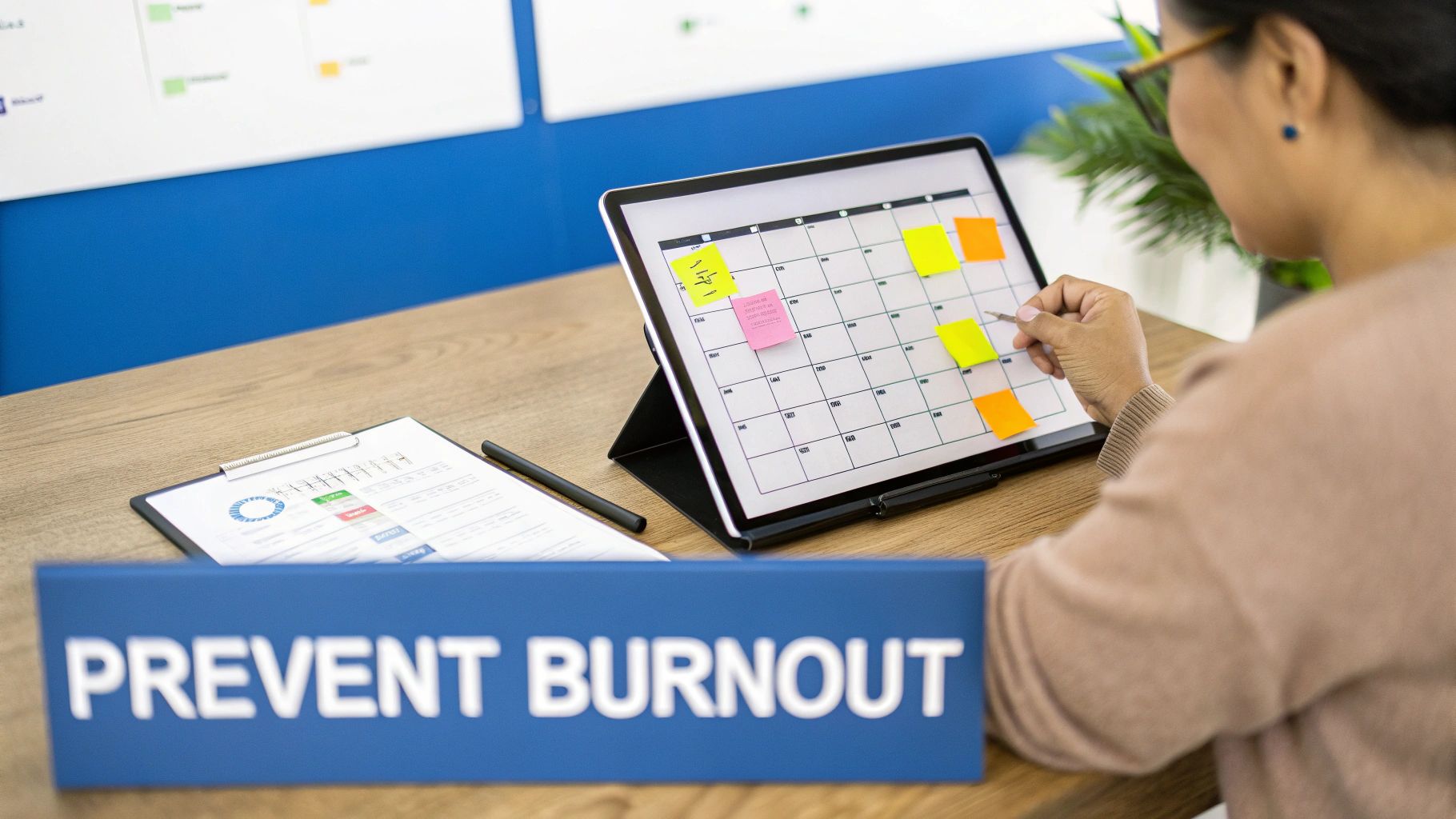
From guesswork to smart forecasting. Far too often, resource allocation is a frantic, reactive scramble. A new project lands, and the work gets thrown at the first available designer or writer, with little regard for their current workload. It’s a recipe for disaster that leads directly to missed deadlines, rushed jobs, and a team running on fumes.
The first step out of this chaos is to get a clear, data-driven view of your team’s actual capacity. This isn’t just about their scheduled hours; it’s about understanding how much time it really takes to complete different creative tasks.
Your team’s time is a finite resource. Treating it with the same respect you give your budget is the first step toward building a healthier, more productive, and more innovative agency culture.
Effective workload management begins with knowing exactly where the hours are going. For example, solid agency time tracking features can uncover patterns you’d otherwise miss, like how much time gets eaten by endless revision cycles or inefficient internal meetings. This data becomes your best defense against unrealistic client demands.
Practical strategies for balanced workloads. Once you have a real handle on capacity, you can start putting strategies in place that protect your team and lead to better project outcomes. This isn’t just about managing time; it’s about managing energy and focus.
Here are a few actionable tips to get started:
- Rotate High-Demand Projects: Don’t burn out your superstars by handing them every high-pressure project. Rotate the tough assignments to give others a chance to step up and your top performers a much-needed break. If Sarah just finished a stressful, high-stakes client launch, assign the next big project to David to give her a chance to work on some smaller, internal tasks.
- Build in Buffer Time: Every single project timeline needs a buffer for the unexpected—revisions, creative blocks, you name it. A simple 20% buffer can be the difference between a stressed-out team and a smooth delivery. If you estimate a design phase will take 10 days, schedule it for 12.
- Visualize the Workload: Use a workload management tool to see everyone’s assignments at a glance. This makes it painfully obvious who’s overloaded so you can reassign tasks before it becomes a full-blown crisis.
Using data to protect your team. Pushing back on impossible timelines is tough, but it’s a whole lot easier when you have data on your side. When a client asks for the moon, you can respond with a clear breakdown of the hours required, showing them exactly how it would overload the team and put the final quality at risk. You can say, “To hit that deadline, we’d need to pull our lead designer off another key project, which would put its timeline at risk. Could we instead deliver the initial concepts by your date and the final files three days later?”
This isn’t just an internal problem; it’s a massive challenge across the entire industry. The 2025 Creative Industry Report from FunctionFox found that workload imbalance is the number one workplace culture issue for creative agencies. It revealed that 32% of agencies describe their teams as somewhat overworked, with another 13% saying their teams are frequently overworked. That means nearly half of all creative teams are dealing with stress that directly kills morale, innovation, and retention. Meanwhile, ManyRequests’ research on creative agency best practices found that only 28% of creative professionals spend more than half their day on actual creative work, with the rest consumed by admin, feedback loops, and coordination overhead.
By getting a grip on resource planning, you build a resilient agency where creativity can actually flourish.
Even with a solid game plan, dialing in your project management for creative agencies is going to bring up some questions. It just comes with the territory. Let’s dig into a few of the most common ones that agency leaders wrestle with as they try to build a more structured—but still flexible—creative environment.
How can a small agency start without overwhelming the team?
For a small creative shop, the words “formal process” can sound like a creativity killer. The trick is to start small and zero in on your single biggest pain point first. Don’t even think about trying to roll out some complex, all-in-one system overnight. That’s a recipe for disaster.
Instead, try introducing a simple Kanban board to visualize the workflow for just one project. This one change gives everyone instant clarity on who’s doing what and, more importantly, where things are getting stuck. Next, standardize how you kick things off with a simple creative brief template. It’s a small step that ensures you’re capturing all the critical info right from the jump.
Finally, just pick one person to be the project’s point person. This doesn’t need to be a full-time, dedicated project manager. It’s just someone whose job it is to keep an eye on progress. The whole idea is to introduce changes bit by bit, get the team on board at each stage, and celebrate the small wins (like a project that actually finishes on time) to build up some real momentum.
What are the most critical KPIs to track? To really get a feel for how your projects are performing, you have to look beyond just “on time” and “on budget.” Those are table stakes. Creative agencies need to track a healthy mix of financial, operational, and client-focused KPIs to get the full picture.
Here are a few metrics that are absolutely essential to monitor:
- Project Profitability: This is it. The ultimate measure of your agency’s financial health. Pit your total project revenue against every single associated cost, from billable hours to outside expenses. If a $20,000 project cost you $15,000 in time and resources, your profit margin is 25%. Is that sustainable?
- Resource Utilization: This one’s all about efficiency. Track the percentage of your team’s available time that’s actually being spent on billable client work. A healthy target is usually around 75-85%, which leaves enough breathing room for internal projects and professional development.
- Scope Creep: Get a handle on the number of change requests or “can-we-just-add” tasks that pop up after the initial scope has been locked in. This KPI helps you spot recurring issues with certain clients or glaring gaps in your own scoping process.
- Client Satisfaction (CSAT): Once a project is wrapped, send a quick survey asking the client to rate their satisfaction on a scale of 1-5. This gives you direct, unfiltered feedback on your process and is a huge indicator of whether they’ll be coming back for more.
Tracking the right KPIs turns project management from a simple to-do list into a powerful strategic tool. It gives you the hard data you need to make smarter calls on pricing, staffing, and which clients are truly worth the effort.
How do you manage client feedback and revisions effectively? This is where so many creative projects go off the rails. Managing client feedback is an art, but the solution lies in a structured, centralized process that brings order to the chaos of subjective opinions.
First, you have to set clear rules of engagement right there in the project kickoff meeting. Be completely upfront about how many rounds of revisions are baked into the scope and what the exact process for submitting feedback looks like. No surprises. You might say, “Our process includes two rounds of revisions. We’ll ask you to consolidate all feedback from your team and submit it through our client portal by the dates outlined in the project timeline.”
Second, force all feedback into one single place. You have to kill the chaos of notes coming in from scattered emails, random Slack DMs, and hallway conversations. Use a dedicated tool where every stakeholder can leave consolidated, contextual comments right on the creative itself.
Finally, assign a single point of contact on both the agency and client sides to act as a funnel for all communication. When feedback comes in, the project manager should be the one to review it, ask clarifying questions, and then translate it all into crystal-clear, actionable tasks for the creative team, complete with deadlines, right inside your project management system.
Ready to unify your proposals, projects, time tracking, and invoicing into a single source of truth? Drum provides a simple, intuitive operating system designed to help creative agencies run more profitably. Discover how Drum can simplify your agency’s operations today.
Ready to unify your proposals, projects, time tracking, and invoicing into a single source of truth?
Drum provides a simple, intuitive operating system designed to help creative agencies run more profitably.
Start your free 14-day trial and see how it works.