
 Pipeline & Proposals
 Project Management
 Resource Planning
 Time & Costs
 WIP & Invoicing
 Commercial Reporting
 Consulting Engineers
 Architects
 Town Planners
 Building Designers
Best Project Management Software for Architects and Engineers in Australia (2026)

Ben Walker
Written for Drum
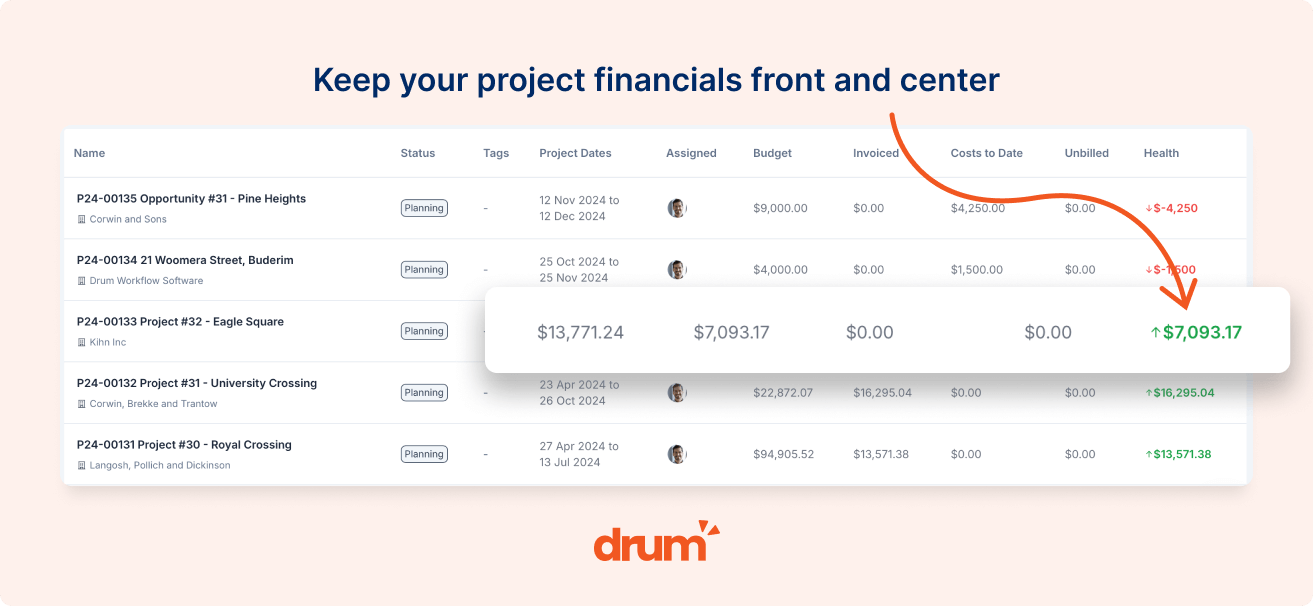
The best project management software for architects and engineers in Australia runs your fee proposals, project stages, timesheets, WIP and invoicing in one place, then syncs to Xero or MYOB. Six tools come up on most Australian shortlists: Drum, Total Synergy, Projectworks, Abtrac, WorkflowMax and Kynection.
They are not interchangeable. Two were built for architecture and engineering practices, two were built for professional services in general, and two were built for job-based businesses such as trades, transport and field services. Picking from the wrong group is how a 20-person practice ends up running its WIP in Excel next to a tool it pays for every month.
This guide gives you the shortlist, published prices where they exist, and an honest note on who each tool suits. Full disclosure: we build Drum. Several tools on this list are cheaper than Drum, and we’ll say where.
| Built for | Pricing (AUD, monthly) | Project stages with fees | WIP | Accounting | Based in | |
|---|---|---|---|---|---|---|
| Drum | Architecture, engineering and other built-environment consultancies | $225 for 5 seats, then $45/seat | Yes | Yes | Xero, MYOB, QuickBooks | Australia |
| Total Synergy | Architecture and engineering firms | Price on request | Yes | Yes | Xero, MYOB, QuickBooks Online | Australia |
| Projectworks | Professional services firms | $39 to $55/user, 10-user minimum | Yes | Yes | Xero and others | New Zealand |
| Abtrac | Professional service firms | From $47 for 1 user, tiered per user | Phases | Via reports | Xero via a $20/month link | Australia |
| WorkflowMax | Any job-based business | $12.22 to $37.78/user | Job phases from Pro | Advanced plan only | Xero, QuickBooks Online | Australia (BlueRock) |
| Kynection | Transport, construction, manufacturing and field services | Price on request | Job and task based | Not a focus | Xero, MYOB and others | Australia |
Prices checked October and November 2026 on each vendor’s own site. Drum excludes GST and onboarding, which is custom-priced.
Why Generic Project Management Tools Fall Short for Architects and Engineers
Ever tried running a fee proposal through Asana? You can build the tasks, but the tool has no idea that concept design is a $40,000 lump sum, that site inspections bill hourly, or that the client just approved a variation. Task boards manage work. Architects and engineers also need to manage money against that work.
That’s the gap between project management software and what many firms call practice management software. A practice needs four things joined up:
- Fee proposals that become the project budget, stage by stage.
- Timesheets logged against those stages at the right rates.
- WIP, so you know what you’ve earned but not yet billed.
- Invoicing that pushes clean progress claims into Xero, MYOB or QuickBooks.
When those live in separate tools, money leaks through the seams. SPI Research has tracked revenue leakage of 5% to 15% in professional services firms from unbilled time, write-offs and scope creep. For a 25-person practice billing $4 million a year, even the low end is $200,000.
So the useful question isn’t “which tool has the most features?” It’s “which tool understands a staged fee?”
The Shortlist: Six Tools Australian Practices Compare
1. Drum: best for Australian practices that want proposals to invoices in one system. Drum is an Australian-built platform for architects, consulting engineers, town planners, surveyors and building designers. Fee proposals become staged project budgets, time burns against each stage, and lump-sum, hourly and variation fees can sit on one project and go out on one invoice. WIP, resource planning and two-way Xero, MYOB and QuickBooks sync are part of Drum Complete, which is $225 a month for your first five seats and $45 per extra seat, excluding onboarding. The trade-off is price: Abtrac and WorkflowMax cost less per month, and Drum’s value shows up in the admin you stop doing rather than on the invoice.
2. Total Synergy: the long-standing AEC specialist. Total Synergy is a long-standing Australian specialist for architecture and engineering firms, and its plans page describes its Business plan as “perfect for small to mid-sized A&E firms”. It covers phases, budgets, profitability, document transmittals and forecasting, with CRM, HR and analytics sold as add-ons. Pricing is on request only. It suits larger firms that want deep functionality and are comfortable with a heavier rollout. Our Total Synergy pricing guide lists what to ask for in a quote.
3. Projectworks: strong on utilisation and forecasting. Projectworks is a New Zealand platform for professional services firms, with clear published pricing of $39, $47 and $55 AUD per user per month across Build, Scale and Unleash. There’s a 10-user minimum, extra users are billed in bands of five, and onboarding starts at $1,000. Its reporting on utilisation, margin and forecasting is genuinely good. It’s a broader professional services tool than an AEC one, and CRM and Proposals were still listed as beta features on Unleash when we checked.
4. Abtrac: the budget pick with a long track record. Abtrac has sold practice management software to Australian and New Zealand firms for more than 25 years, and it’s the cheapest specialist option here. Abtrac’s pricing starts at $47 a month for one user, with tiered rates that bring a 25-person firm to about $445 a month including the accounts link. The catch is the experience. Some Capterra reviews call it dated or slow, and it has no separate pipeline for fee proposals. Practices that have moved from Abtrac to Drum tell us their staff put off time entries and WIP drifted back into spreadsheets.
5. WorkflowMax by BlueRock: flexible, affordable and general. WorkflowMax was part of Xero until 2024 and is now owned by BlueRock. It costs $12.22 to $37.78 AUD per user per month, with capacity planning and WIP only on the top plan (full pricing). It’s a horizontal tool, built for any job-based business from plumbers to marketing agencies. One established WorkflowMax customer told us they’d outgrown its standard features: hybrid projects with lump-sum and hourly work had to be split across several jobs, and adjusting a fee for a variation partway through was cumbersome.
6. Kynection: built for the field, not the studio. Kynection is a family-owned Victorian business whose KIM platform covers job management, scheduling, time and attendance, safety, assets and fleet. Its industry list is transport and logistics, construction, manufacturing, field services and specialised services, and it doesn’t publish prices. It’s a good fit for a construction or field services business with crews and equipment on site. For a design consultancy, much of the platform goes unused while fee stages and consulting WIP are missing.
What Each Option Costs a 10, 25 and 50 Person Practice
Here’s the monthly licence cost at three practice sizes, using each vendor’s published rates. Two vendors quote on request, so they can’t be compared until you have a quote in hand.
| Monthly cost (AUD) | 10 people | 25 people | 50 people |
|---|---|---|---|
| Drum Complete | $450 | $1,125 | $2,250 |
| Total Synergy | On request | On request | On request |
| Projectworks (Build to Unleash) | $390 to $550 | $975 to $1,375 | $1,950 to $2,750 |
| Abtrac (incl. accounts link) | $265 | $445 | $645 |
| WorkflowMax (Pro to Advanced) | $220 to $378 | $550 to $945 | $1,100 to $1,889 |
| Kynection | On request | On request | On request |
Monthly billing, excluding GST where the vendor charges it. Drum does not charge GST. Onboarding, setup and migration fees are extra for most vendors and vary by firm.
Abtrac and WorkflowMax are clearly cheaper than Drum on licence. Projectworks Unleash costs more than Drum Complete at every size, and its 10-user minimum means a seven-person studio still pays for ten. So what does the extra money buy?
Mostly, it buys back admin time. Picture a 25-person engineering practice where three project managers each spend half a day at month-end rebuilding WIP in a spreadsheet. That’s 12 hours a month, or roughly $1,800 at a $150 internal cost rate, which is more than the gap between any two subscriptions above. (This is an illustration, not a measured result.) The cheapest licence is only the cheapest tool if your team doesn’t have to work around it.
How to Choose Project Management Software for Your Practice
Start with how your firm wins and bills work, not with a feature list. Lay out one real, messy project: a staged fee, a variation, some hourly site work and a sub-consultant. Then run it through each shortlisted tool in a demo and watch for three things:
- Does the fee proposal become the budget without re-keying? If someone types the fee table in twice, it’ll drift.
- Can lump-sum and hourly stages sit on one project and one invoice? This is where general job tools struggle most.
- Does WIP come out of the system, or out of Excel? Ask to see a month-end WIP report on the demo project.
Your answer usually lands in one of three places. If you want an Australian specialist that covers proposals through to invoices and gets your team using it within weeks, shortlist Drum. If you need document transmittals and deep configuration and have the budget for it, talk to Total Synergy. If cost is the deciding factor and your team already knows it, Abtrac still does the basics.
As Lauren Sutton, Accounts Manager at Projex Partners, put it after moving to Drum: “Drum’s philosophy of being a ‘single source of truth’ has allowed us to manage project data simply and accurately.” That single source of truth is what the right project management software for architects and engineers should give you. See how Drum fits architecture practices and consulting engineering firms, browse every head-to-head on our comparisons page, or book a demo and bring your messiest project.
Frequently Asked Questions
What is the best project management software for architects and engineers in Australia? For most Australian architecture and engineering practices with 10 to 80 staff, the strongest options are Drum, Total Synergy and Projectworks, because they handle staged fees, timesheets, WIP and invoicing. Drum is Australian-built with published pricing and syncs with Xero, MYOB and QuickBooks. Total Synergy suits larger firms that also want document transmittals. Abtrac is the low-cost option, while WorkflowMax and Kynection are general job tools.
How much does project management software for architects cost? Drum Complete is $225 AUD a month for five seats plus $45 per extra seat, excluding onboarding. Projectworks costs $39 to $55 AUD per user with a 10-user minimum. Abtrac starts at $47 a month for one user with tiered per-user rates. WorkflowMax costs $12.22 to $37.78 AUD per user. Total Synergy and Kynection price on request.
What’s the difference between project management and practice management software? Project management software organises tasks, deadlines and who’s doing what. Practice management software adds the commercial side architects and engineers need: fee proposals, timesheets against project stages, WIP, invoicing and accounting integration. Most firms with more than ten staff need both, which is why specialist tools combine them.