
 Pipeline & Proposals
 Project Management
 Resource Planning
 Time & Costs
 WIP & Invoicing
 Commercial Reporting
 Consulting Engineers
 Architects
 Town Planners
 Building Designers
Plan your team's workload before capacity becomes a problem
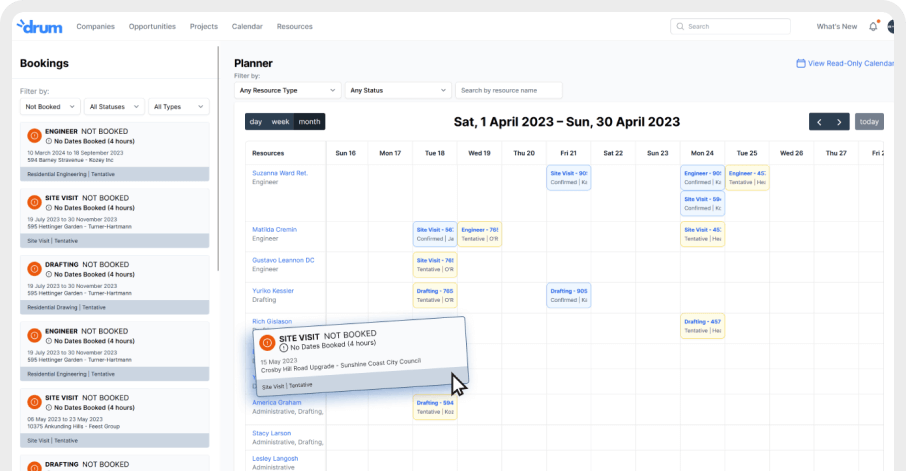
Drum helps engineering firms plan staff capacity across active projects and upcoming work, so directors and project managers can see who is overloaded, who has capacity, and whether the firm has enough billable work planned.
With drag-and-drop resource planning, billable utilisation visibility and weekly task lists for staff, Drum connects the resource plan to the work your team actually needs to deliver.
- See who is overloaded, underutilised or available at a glance.
- Plan against billable utilisation, not theoretical hours.
- Push planned work into each staff member's weekly task list.
- Connect resourcing to timesheets, utilisation and project reporting.
Resource planning breaks when the plan is disconnected from the work
Most engineering firms are trying to balance project deadlines, staff availability, utilisation targets and changing client priorities at the same time.
The problem is that resourcing is often managed in spreadsheets, meetings, project manager judgement or disconnected planning tools. That makes it difficult to see whether the team is genuinely over capacity, whether key people are being pulled in too many directions, or whether planned work is actually making it onto people's weekly task lists.
- Resource plans live in spreadsheets, meetings or individual PM judgement.
- Directors cannot easily see capacity across the whole firm.
- Senior staff become overloaded before anyone sees the pattern.
- Some people are underutilised while others carry too much work.
- Project plans change, but the resource plan is not always updated.
- Weekly priorities are unclear for the people doing the work.
- Project and firm-level resourcing live in one connected view.
- Directors can see overload, availability and future capacity pressure.
- Project managers can adjust allocations as priorities change.
- Staff see their planned work in their weekly task list.
- Timesheets are guided by the work already allocated.
- Leadership can compare planned work with actual delivery.
One connected workflow for planning people, projects and capacity
Resource planning in Drum sits between project delivery, weekly work, timesheets and reporting.
That means the plan does not sit in a spreadsheet beside the business. It becomes part of the same workflow your team uses to manage projects, record time and understand utilisation.
- Project demand
- Staff allocations
- Weekly task lists
- Timesheets
- Utilisation reporting
- Project performance
See firm-wide capacity before it becomes a delivery problem
Drum gives directors and project managers a live view of capacity across people, projects and weeks.
Instead of relying on spreadsheet updates or resourcing meetings to understand who is available, leaders can see where the team is overloaded, where capacity is open, and where upcoming workload needs to be adjusted.
- View workload across projects and weeks.
- Spot over-allocation before it affects delivery.
- Identify underutilised staff with available capacity.
- Plan around leave, part-time schedules and billable targets.
- Understand whether the firm has enough work planned.
- Make better decisions before committing to new deadlines.
Plan project work without building another spreadsheet
Project managers can allocate work directly against project tasks, deliverables or phases, then adjust the plan as deadlines move, scopes change or staff availability shifts.
Every project-level change rolls up into the wider capacity view, so directors can see the impact across the firm.
Allocate by task or deliverable
Assign staff to the project work they are expected to deliver.
Drag and drop as priorities change
Move allocations between people, projects or weeks without rebuilding the plan.
Adjust hours and timing
Update planned effort as scope, timing or delivery priorities change.
Keep firm capacity in sync
Project-level decisions remain visible in the wider resource plan.
Plans change. Drum makes that manageable.
Move work, reassign people and adjust planned effort as deadlines shift, scope changes or availability changes, without rebuilding the plan from scratch.
Plan against real billable capacity, not theoretical hours
A staff member may work 38 hours a week, but that does not mean they have 38 hours of billable project capacity.
Drum uses billable utilisation expectations to help firms plan more realistically. A director, senior engineer, graduate engineer and admin team member may all have different billable capacity targets, and the resource plan should reflect that.
- Plan using realistic billable capacity.
- Compare allocations against utilisation expectations.
- Support different roles, seniority levels and working patterns.
- Avoid assuming every person has the same available capacity.
- Improve confidence in workload and utilisation reporting.
Turn the resource plan into each person's weekly work list
Resource planning only works if the plan reaches the people doing the work.
Drum turns planned allocations into each staff member's weekly task list, giving the team a clear view of what they are expected to focus on without maintaining a separate task list or spreadsheet.
- Automatically show planned tasks for the current week.
- Help staff understand weekly priorities.
- Reduce manual follow-up from project managers.
- Keep delivery aligned with the resource plan.
- Give managers more confidence that planned work is visible to the team.
Plan capacity against upcoming work, not just active projects
Resource planning becomes more useful when it includes the work that has not landed yet.
Drum connects pipeline and project demand so directors can see whether upcoming opportunities may create future workload pressure before the work is officially won.
Future capacity pressure
Understand capacity pressure from likely future work, not just the projects already in delivery.
Use expected start dates
Plan ahead using likely project start dates from the pipeline, so resourcing reflects what is coming, not just what is here.
Absorb upcoming projects
See whether the team can absorb upcoming work or whether some commitments will create real delivery pressure.
Hiring and scheduling decisions
Make earlier, better-informed decisions about hiring, scheduling and project commitments.
Avoid avoidable stress
Stop winning work that creates avoidable delivery stress by seeing the capacity picture before saying yes.
One view of demand
Active projects and pipeline opportunities sit in the same capacity picture, so leadership sees demand from both sides.
Connect resourcing to utilisation, delivery and commercial performance
Because resource planning in Drum is connected to projects, timesheets, budgets and reporting, directors get more than a visual workload planner.
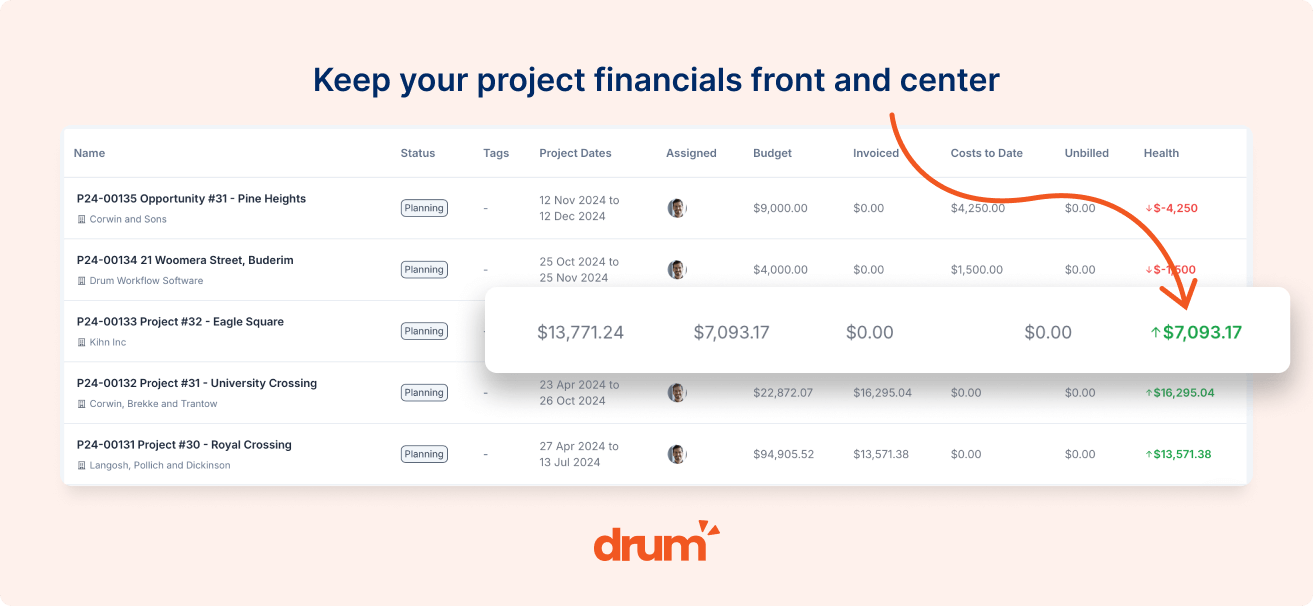
They can see whether planned work is turning into actual time, whether utilisation is on track, and where capacity issues may affect delivery, WIP, invoicing or revenue.
Planned utilisation
See planned utilisation against billable targets.
Available capacity
Identify where capacity is open across the coming weeks.
Planned vs actual time
Compare allocated hours with recorded time.
Future capacity pressure
Spot upcoming pinch points before they affect delivery.
Commercial impact
Understand how resourcing decisions affect project performance, WIP and revenue.
Better resourcing visibility without the planning overhead
Engineering firms need resource planning that is structured enough to create visibility, but simple enough that project managers will actually use it.
Drum helps firms move away from disconnected spreadsheets, informal resourcing meetings and manual workload checks by connecting resource planning directly to project delivery, weekly work, timesheets and reporting.
- Less reliance on spreadsheet-based capacity planning.
- Fewer surprises around overloaded staff.
- Clearer weekly priorities for the team.
- Better alignment between directors and PMs.
- More realistic utilisation planning.
- Stronger connection between plans and actual delivery.
Drum helps engineering and built-environment firms create a clearer operating rhythm across project planning, delivery, time, WIP, invoicing and reporting.
We have found the team from Drum to be both responsive to our needs and open to changes and improvements. Implementing Drum has allowed us to significantly improve the visibility of our projects' performance to the team and is resulting in more timely and accurate management of our projects.
Daniel Berry
Managing Director, Projex Partners
Resource planning connects to the rest of the firm
Drum keeps project delivery, time, costs, resourcing, WIP, invoicing and reporting working from the same underlying data.
Project Management
Connect resource plans to project budgets, tasks, deliverables and commercial outcomes.
Time & Costs
Feed planned work into timesheets so staff record time against the right project task with less friction.
WIP & Invoicing
Turn planned work and recorded time into accurate WIP and invoices, then sync to Xero, MYOB or QuickBooks.
Pipeline & Proposals
Use pipeline data to plan capacity for upcoming work, not just the projects already underway.
Commercial Reporting
Give directors a live view of utilisation, capacity, revenue, margin and project performance.
Xero Integration
Keep finance connected to resourcing decisions with two-way sync of contacts, invoices and payments between Drum and Xero.
Frequently asked questions
Common questions about resource planning, capacity visibility, weekly task lists, billable utilisation and how resourcing connects to timesheets and reporting in Drum.
How does Drum help with resource planning?
Drum helps engineering firms allocate staff to project work across weeks, see available capacity, identify overloaded staff and connect planned work to weekly task lists, timesheets and reporting.
Can Drum show who is over capacity?
Yes. Drum gives directors and project managers a firm-wide view of staff allocations, so they can see who is overloaded, who has capacity and which weeks need attention.
Can we plan using billable utilisation targets?
Yes. Drum allows firms to plan against realistic billable capacity, rather than assuming every person has the same number of available hours each week. A director, senior engineer, graduate engineer and admin team member can each have their own billable capacity target.
Does resource planning connect to timesheets?
Yes. Planned allocations flow into staff weekly task lists and suggest relevant tasks when staff enter time, helping improve timesheet accuracy and project reporting.
Can project managers adjust the plan when priorities change?
Yes. Project managers can move, reassign and adjust planned work as deadlines, scope, availability or client priorities change, without rebuilding the plan from scratch.
Can directors see future capacity pressure?
Yes. Drum helps leadership see upcoming workload pressure across projects and teams, with visibility into utilisation, available capacity and planned work, including the pressure created by likely future work in the pipeline.
How does resource planning connect to project performance?
Because resource planning connects to projects, timesheets and reporting, firms can compare planned work against actual time and understand how capacity decisions affect utilisation, WIP, invoicing and margin.
Is this suitable for firms already using spreadsheets for resourcing?
Yes. Drum is designed to reduce reliance on spreadsheet-based resource planning by connecting capacity planning directly to projects, weekly work, timesheets and reporting.
Ready to plan capacity from one live source of truth?
Book a personalised walkthrough and see how Drum helps engineering firms plan staff capacity, allocate work, manage weekly priorities and connect resourcing with timesheets, utilisation, WIP, invoicing and reporting.