
 Pipeline & Proposals
 Project Management
 Resource Planning
 Time & Costs
 WIP & Invoicing
 Commercial Reporting
 Consulting Engineers
 Architects
 Town Planners
 Building Designers
Project Manager's Checklist: 10 Phases From Kickoff to Close-Out

Ben Walker
Written for Drum
In This Article
- Project managers checklist: 10 Phases for Success
- Foundation and Setup: Getting Your Project Off the Ground
- Planning and Controls: Schedule, Budget, and Risk
- Execution and Delivery: Quality, Communication, and People
- Closure and Continuous Improvement
- Putting Your Checklist into Action for Flawless Delivery
Project managers checklist: 10 Phases for Success
Welcome, project leaders! Juggling scope, budgets, timelines, and client expectations in professional services can feel like conducting an orchestra during a hurricane. From architectural practices managing multi-phase builds to marketing agencies chasing profitability insights, the common thread is the need for control amidst complexity. We get it. Success isn’t about luck; it’s about having a repeatable structure that guides you and your team.
This is where a definitive project managers checklist becomes your most valuable asset. Think of it as your conductor’s baton, bringing harmony to the disparate elements of any engagement. We’re moving beyond generic advice to provide a phased, actionable framework designed specifically for the high-stakes environment of professional services.
This comprehensive guide breaks down the entire project lifecycle into 10 distinct, manageable checklists. You’ll find specific checks for every stage, from initial client conversations to final project handoff. We’ve packed each section with practical examples and helpful tips to help you implement these strategies immediately. This project managers checklist will help you transform frantic scrambles into a scalable, successful process.
Foundation and Setup: Getting Your Project Off the Ground
Every successful project shares one thing in common: a strong start. The first three phases of your project managers checklist focus on validating the project’s viability, aligning stakeholders, and locking down what the project will and won’t include. Skip these steps, and you’re building on sand.
1. Pre-Project Planning is your foundational blueprint, a critical first step completed before a project officially kicks off. It’s a structured validation process to ensure a project is viable, aligned with business goals, and has the necessary groundwork in place for success. Think of it as answering the fundamental question: “Should we even do this project?” This methodical approach is championed by standards like the Project Management Institute (PMI) and PRINCE2. For example, a marketing agency might use this phase to confirm a potential client’s social media campaign goals are realistic and that the agency has the right team available before drafting a full proposal.
Start by creating a stakeholder map. For a new software build, this would include the client’s executive sponsor, the end-users, your development lead, and the finance department. Note their influence and what they need from the project. Then draft a clear business case: “This website redesign will increase lead generation by 25% within six months.” Define success with SMART (Specific, Measurable, Achievable, Relevant, Time-bound) goals. Develop a high-level scope statement. A practical example: “We will build a five-page website with a contact form. E-commerce functionality is out of scope for phase one.” Conduct a quick feasibility study: do we have the right designers available and the budget to succeed? Finally, brainstorm potential risks. Think about market changes, resource availability, or technical hurdles. For example, “A key designer has a planned vacation in the middle of the project timeline, which could cause a delay.” This initial pass helps inform the go/no-go decision.
Key Insight: The goal of pre-project planning isn’t to create a perfect plan. It’s to build a strong enough foundation to secure approval and justify the investment in a full-scale planning phase. Document all your assumptions clearly; they will be invaluable later.
2. Project Kickoff is the official launchpad, transforming an approved concept into an active initiative. This critical meeting happens right after project approval and before the real work begins. It’s a structured session designed to align the entire team and key stakeholders on the project’s goals, scope, roles, and how you’ll all communicate. A successful kickoff ensures everyone starts on the same page, preventing misunderstandings that can derail progress later.

Before the meeting, circulate a concise, one-page summary covering the project’s mission, key objectives, a high-level timeline, major deliverables, and the core team roster. Use the meeting to explicitly define who is doing what with a RACI (Responsible, Accountable, Consulted, Informed) chart. For example: “Sarah is Responsible for creating the wireframes; Mark is Accountable for the final design approval.” Agree on the primary tools for communication (e.g., Slack for daily chats, email for formal client updates) and the frequency of check-ins (e.g., a 15-minute daily stand-up, a weekly progress report every Friday). Walk through the project scope, explicitly highlighting what is in and what is out. Outline the immediate next steps and assign the first set of tasks to get things moving.
Key Insight: The project kickoff is your single best opportunity to build team cohesion and set the project’s culture. Don’t just present information; facilitate a conversation. Encourage questions and make it a collaborative session to secure genuine buy-in from every team member.
3. Scope Management is your definitive guide to defining, documenting, and controlling what is and is not included in a project. Its primary function is to prevent “scope creep,” that all-too-common situation where small requests gradually expand project requirements, derailing your timeline and budget. This checklist ensures every deliverable is explicitly defined and that any changes go through a formal evaluation and approval process. For firms that need end-to-end project and billing control, mastering scope is essential.
Create a detailed scope statement outlining the project’s deliverables, boundaries, assumptions, and constraints. Be explicit about what is out of scope. For a new logo design, this might state: “Includes three logo concepts and two rounds of revisions. Website and business card design are out of scope.” Then deconstruct the major deliverables into smaller components using a Work Breakdown Structure (WBS). Establish a formal change control process: define the exact steps for how a change request is submitted, reviewed, approved, and implemented. Finally, hold a formal review session with all key stakeholders to validate and sign off on the scope.
Key Insight: Create a “parking lot” document for ideas and requests that are valuable but fall outside the current scope. This acknowledges your client’s great ideas without derailing the project. These items can be perfect candidates for a Phase 2 or a future project!
Planning and Controls: Schedule, Budget, and Risk
With the foundation set, the next layer of your project managers checklist shifts to the “how” of delivery. These three phases transform your scope into a detailed timeline, wrap financial guardrails around it, and prepare you for the inevitable curveballs.
4. Schedule and Timeline transforms the “what” and “why” from the project charter into a detailed “when” and “how.” It’s a dynamic tool for sequencing activities, assigning durations, and identifying dependencies to create a realistic project timeline. This disciplined approach has roots in methodologies developed by figures like Henry Gantt. An event planning agency, for instance, uses a detailed timeline to manage everything from booking the venue to sending invitations and confirming catering, knowing that each step depends on the one before it.
Start with your Work Breakdown Structure (WBS) and break down large deliverables into smaller, manageable tasks. Then determine the logical order of tasks and involve your team in estimating the time required for each activity. Use project management software to map out dependencies and find the critical path, the longest sequence of tasks that determines the project’s end date. Build in a contingency buffer (e.g., 10-15%) to account for unforeseen delays, and once a draft schedule is ready, review it with key stakeholders and the project team. Remember: a schedule is not a “set it and forget it” document. Update it regularly, ideally weekly, to reflect actual progress and re-forecast completion dates.
Key Insight: The primary purpose of a project schedule is not just to set a deadline, but to create a shared understanding of how the team will get there. It’s a communication tool first and a tracking mechanism second. Highlighting critical path activities ensures everyone knows where the team’s focus must be.
5. Budget and Cost Control is the financial guardian of your project. It’s a dynamic framework for estimating costs, allocating funds, and diligently monitoring expenses from kickoff to closeout. This process ensures the project remains financially viable and operates within its approved constraints, preventing budget overruns that can jeopardize profitability. This rigorous financial oversight is a cornerstone of methodologies like Earned Value Management (EVM). Think of how a construction firm tracks the cost of lumber, labor, and permits against the planned budget for each phase: they spot overspending early rather than discovering it at the end.
Align your budget directly with your Work Breakdown Structure (WBS) by creating a Cost Breakdown Structure (CBS). Implement regular tracking, typically weekly or bi-weekly, using timesheets, expense reports, and vendor invoices to log actual costs against your plan. Set predefined variance thresholds (e.g., 10% over budget) that trigger an alert for review and corrective action. Use metrics like burn rate to forecast the final project cost, and hold monthly budget review meetings with finance and key stakeholders. Proper project management and accounting tools can automate much of this reporting for you.
Key Insight: Always include a contingency fund, typically 10-20% of the total budget, to cover unforeseen risks or scope changes. This buffer is critical for maintaining financial control when unexpected challenges arise, preventing you from having to go back to the client for more money under pressure.
6. Risk Management is your systematic process for identifying, analyzing, and responding to potential problems and opportunities throughout the project. It’s not about eliminating all risk, that’s impossible, but about proactively managing uncertainty. This structured approach is a cornerstone of methodologies like the PMBOK Guide.
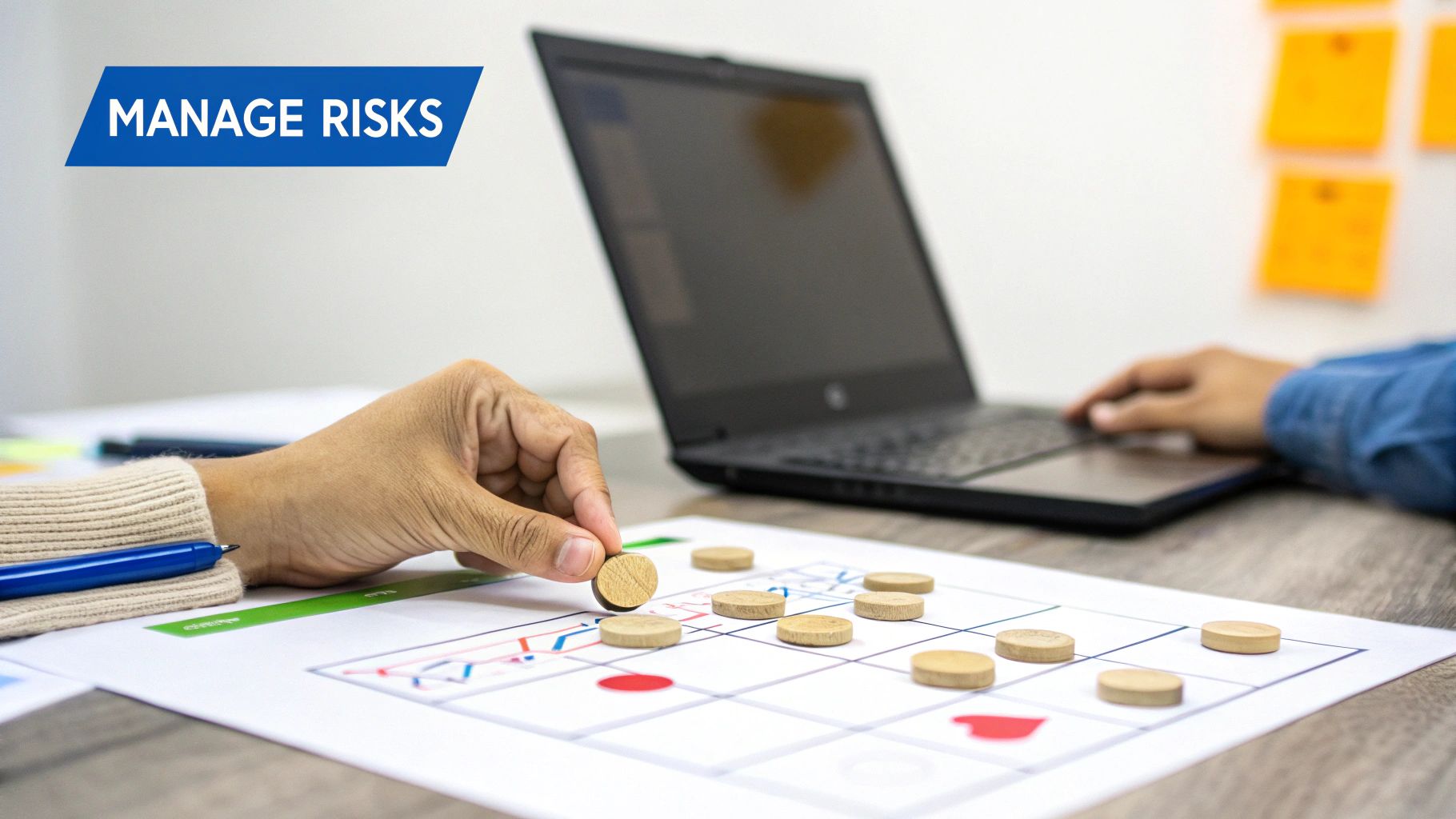
Early in the project, hold a brainstorming session and ask, “What could go wrong?” For a website launch, risks might include “the server could crash” or “a key team member could get sick.” Document everything in a risk register. For each risk, assess its potential impact (high, medium, low) and its likelihood. A server crash might be low probability but high impact, while a team member getting sick could be medium probability and medium impact. Develop a clear response strategy for high-priority risks: for the server crash risk, you could mitigate it by having a backup server; for the sick team member risk, you could accept it for a junior role but mitigate it for a lead developer by having another team member cross-trained. Review the risk register in your weekly team meetings to keep it alive and useful.
Key Insight: A common mistake is confusing risks with issues. A risk is a potential future event that might happen (e.g., our main graphic designer could resign). An issue is a problem that is happening now (e.g., our main graphic designer just resigned). Your checklist should focus on proactively managing risks to prevent them from becoming issues.
Execution and Delivery: Quality, Communication, and People
Planning only goes so far. These three phases of the project managers checklist deal with the realities of doing the work: keeping deliverables at a high standard, making sure stakeholders stay informed, and looking after the team that makes it all happen.
7. Quality Assurance and Control is your framework for ensuring everything your team produces meets or exceeds the standards you’ve set. It’s a proactive process that weaves quality into every project phase, rather than just inspecting things at the end. This systematic focus on quality was pioneered by figures like W. Edwards Deming.
Before work begins, agree with your client on what “good” looks like. For a website, this could be technical standards like “pages must load in under 2 seconds” or “it must be mobile-responsive on all major devices.” Outline the proactive steps the team will take to prevent defects, such as using a standardized template for client presentations or holding a “design walkthrough” to get feedback before finalizing a concept. Define inspection-based activities too: a dedicated tester running through a checklist of functions on a new app, or a User Acceptance Testing (UAT) session where the client clicks through the website. Keep a simple log of issues found to spot trends. If the same type of mistake keeps happening, you can address the root cause with more training or a better process.
Key Insight: Quality is not an event at the end of a project; it’s a continuous process. Investing a little time in prevention (like a peer review) is always cheaper and less stressful than dealing with the cost of poor quality (like having to redo work or losing a client’s trust).
8. Stakeholder Communication is your strategic plan for managing the flow of information to everyone invested in your project’s success. It ensures that the right people get the right information at the right time, which helps prevent misunderstandings, manage expectations, and build strong, collaborative relationships. Think of a public relations firm managing a product launch: they need a plan to keep the client’s CEO updated with high-level summaries, the marketing team informed of detailed campaign metrics, and the media supplied with carefully crafted press releases, all different messages for different stakeholders.
Create a simple stakeholder map. List everyone involved and note their influence and interest. For example, your executive sponsor needs a brief weekly email summary, while your lead engineer needs daily check-ins. Build a chart outlining who gets what information, when, how, and who is responsible for sending it. Make it easy for stakeholders to ask questions and give feedback, whether that’s a dedicated Slack channel or weekly “office hours.” And stick to your plan. If you promised a Friday update, send a Friday update, even if there’s not much new to report.
Key Insight: Don’t just report the good news. Addressing issues and bad news transparently and promptly, along with a proposed solution, builds trust far more effectively than hiding problems. Proactive and honest communication is your best tool for navigating challenges.
9. Resource and Team Management is your guide to building and nurturing a happy, high-performing project team. It’s about more than just assigning tasks; it’s about assembling the right skills, fostering a collaborative and supportive environment, and ensuring every team member is engaged and productive. This people-centric approach is validated by extensive research, like Google’s Project Aristotle, which found that psychological safety was the most important factor in a team’s success.
Use a RACI matrix to eliminate confusion. For a new marketing campaign, this clarifies that “The copywriter is Responsible for writing the ad copy, and the Marketing Director is Accountable for approving it.” Develop a resource plan at the project’s start: “We need the senior designer for 20 hours a week for the first two weeks, then 5 hours a week for the remainder of the project.” Use precise data from time tracking software to ensure workloads are balanced and realistic. Invest in your team. If a junior developer needs to learn a new skill, arrange for online training or pair them with a senior mentor. Hold regular one-on-one meetings to discuss their work, address any roadblocks, and talk about their career goals. And address performance issues promptly and supportively, while also remembering to recognize and celebrate successes.
Key Insight: Effective resource management is a continuous process, not a one-time task. Regularly check in with your team, monitor their workloads, and be prepared to adjust your plan as the project evolves. The most successful projects are powered by teams that feel supported, valued, and empowered.
Closure and Continuous Improvement
The final phase of any well-run project is often the most overlooked, and it’s arguably the most valuable. This is where you turn experience into organizational wisdom.
10. Project Closure and Lessons Learned is the step that transforms a completed project into a lasting organizational asset. It’s a formal process for winding down all activities, ensuring every deliverable has been accepted, and capturing the valuable knowledge the team gained. This isn’t just about filing paperwork; it’s a strategic review that asks, “What went right, what went wrong, and how can we do even better next time?” This practice is a cornerstone of Agile’s retrospective principles.
Get the final, formal sign-off and acceptance from the client for all deliverables, send the final invoice, close out any vendor contracts, and officially release your team members to other projects. Schedule a post-mortem or retrospective meeting within a week or two of project completion, while memories are still fresh. Structure it by asking everyone to contribute ideas for three categories: “What should we start doing?”, “What should we stop doing?”, and “What should we continue doing?” Create a final project report that includes a summary of performance against the original goals, the final budget vs. actuals, and the documented lessons learned. Store all key project documents in a centralized place where they can be easily found for future reference. And don’t forget to acknowledge the team’s hard work with a thank you, a team lunch, or a shout-out in a company-wide email.
Key Insight: Don’t treat project closure as an administrative chore. It is your single greatest opportunity for organizational learning. Documenting both successes (“The new design software saved us 20 hours!”) and failures (“We didn’t budget enough time for client feedback.”) provides a powerful playbook for future project teams.
Putting Your Checklist into Action for Flawless Delivery
Managing the complexities of a professional services project without a structured framework is like setting sail without a map and compass. You might eventually reach a destination, but the journey will be fraught with uncertainty, detours, and unnecessary risk. The comprehensive project managers checklist we’ve detailed throughout this guide provides that essential map, breaking down the entire project lifecycle into manageable, actionable phases.
| Checklist | 🔄 Implementation complexity | ⚡ Resource requirements | 📊 Expected outcomes | 💡 Ideal use cases | ⭐ Key advantages |
|---|---|---|---|---|---|
| Pre-Project Planning Checklist | Medium–High — structured analysis and approvals | Medium — stakeholder time, executive input | Validated viability; fewer late-stage failures | New initiatives, high-cost investments, strategic projects | ⭐ Early risk ID; clear scope; informed go/no-go |
| Project Kickoff Checklist | Medium — one-time facilitation and alignment | Low–Medium — meeting prep, materials | Team alignment, clarified roles and expectations | Project start, team onboarding, cross-functional launches | ⭐ Unified team understanding; improved morale |
| Scope Management Checklist | High — detailed documentation and change control | High — time for WBS, approvals, tracking | Controlled scope; reduced scope creep; stable baselines | Fixed-price contracts, construction, regulated projects | ⭐ Prevents scope creep; enables accurate forecasting |
| Schedule and Timeline Checklist | Medium–High — sequencing and critical-path analysis | Medium — planning tools and team input | Realistic schedule; early identification of delays | Time-critical deliveries, engineering, program planning | ⭐ Visibility into progress; focus on critical activities |
| Budget and Cost Control Checklist | High — financial setup and ongoing tracking | High — finance expertise, tracking systems | Cost containment; clear ROI; timely corrective actions | Tight-budget projects, government contracts, capital projects | ⭐ Prevents overruns; supports go/no-go decisions |
| Risk Management Checklist | Medium–High — iterative identification and mitigation | Medium — workshops, risk register maintenance | Fewer surprises; earlier, cheaper mitigations | High-uncertainty or regulated projects, R&D | ⭐ Reduces uncertainty; assigns clear ownership |
| Quality Assurance and Control Checklist | High — standards, testing and continuous checks | High — testing resources, QA tools, time | Fewer defects; higher customer satisfaction; compliance | Manufacturing, software releases, regulated outputs | ⭐ Reduces rework; ensures compliance and reliability |
| Stakeholder Communication Checklist | Medium — planning and tailored messaging | Low–Medium — communication channels and cadence | Sustained support; fewer misunderstandings | Cross-functional programs, executive reporting, change initiatives | ⭐ Builds trust; enables early issue resolution |
| Resource and Team Management Checklist | Medium–High — allocation, development and conflict handling | Medium–High — recruitment, training, tooling | Right skills at right time; higher productivity | Matrix organizations, long-duration projects, scaling teams | ⭐ Improves retention; prevents burnout; boosts productivity |
| Project Closure and Lessons Learned Checklist | Low–Medium — finalization and documentation | Low — meetings, reports, archive effort | Formal closure; captured lessons for future projects | Project completion, handovers, organizational learning | ⭐ Captures knowledge; frees and reassigns resources |
From the foundational steps in the Pre-Project Planning phase to the critical reflections in the Project Closure phase, each section serves a distinct purpose. It’s not about adding bureaucratic layers; it’s about building a system that transforms reactive problem-solving into proactive, strategic execution. The true power of these checklists is unlocked when they become an integral part of your operational rhythm, not just a document you consult when trouble arises.
The journey to flawless project delivery begins with small, consistent steps. Trying to implement all ten checklists at once can be overwhelming. Instead, focus on building momentum by integrating them incrementally. Start with your biggest pain point: is scope creep constantly derailing your projects? Begin by rigorously applying the Scope Management phase on your next engagement. If you’re new to this structured approach, concentrate on mastering the beginning and the end. Implement the Project Kickoff phase to ensure alignment from the start and the Project Closure phase to guarantee a professional handover and capture invaluable lessons learned. These two phases have an outsized impact on client perception and future project success.
Adopting a systematic project managers checklist is more than an organizational exercise; it’s a strategic advantage that yields tangible business results. For a consulting engineering firm, the Risk Management phase can mean the difference between identifying a potential structural issue early and facing costly rework and reputational damage later. For a digital marketing agency, the Budget and Cost Control phase provides the real-time data needed to ensure campaign profitability, preventing over-servicing that erodes margins.
The ultimate goal of a project management checklist is to create a predictable, repeatable process for delivering excellence. It frees up your mental energy from worrying about what might be missed, allowing you to focus on strategic client relationships, creative problem-solving, and leading your team effectively.
This structured approach fosters a culture of accountability and transparency. When every stakeholder understands the plan, the budget, and the communication protocols, trust is built, and collaboration flourishes. Your clients feel more confident, your team feels more empowered, and your firm builds a reputation for reliability and flawless delivery, one well-managed project at a time. This is how you move from simply completing projects to mastering them.
Ready to turn your checklists into an automated, unified system?
Drum consolidates every phase of your project, from proposal and planning to time tracking and invoicing, into a single source of truth, ensuring nothing ever falls through the cracks.
Discover how you can operationalize your project management process and gain real-time visibility into project health. Start your free 14-day trial today.