
 Pipeline & Proposals
 Project Management
 Resource Planning
 Time & Costs
 WIP & Invoicing
 Commercial Reporting
 Consulting Engineers
 Architects
 Town Planners
 Building Designers
Finance and Project Management: Why Disconnected Teams Kill Your Margins

Ben Walker
Written for Drum

In This Article
- finance and project management: Align Teams for Profit
- Why Your Business Needs Both a Captain and a Quartermaster
- Shared Metrics That Unite Finance and Project Teams
- Building Workflows for Smooth Project Delivery
- Choosing the Right Tools for Unified Operations
- Your Action Plan for a More Profitable Future
finance and project management: Align Teams for Profit
For any professional services firm, finance and project management are two sides of the same coin, working together to ensure success. This critical link is the engine that drives your profitability, making sure every project you deliver is not just a creative success, but a financial one, too.
Why Your Business Needs Both a Captain and a Quartermaster
Think of your project manager as a skilled ship captain. They’re the ones expertly managing client needs, timelines, and team resources to get everyone to the destination. Now, picture your finance team as the resourceful quartermaster, meticulously tracking supplies, managing the voyage’s budget, and ensuring the whole trip is profitable.
If the captain and quartermaster are working from different maps or don’t talk about resources, that journey is headed for trouble. It’s the exact same situation in your business.
When project and finance teams operate in separate silos, profitability quietly slips through the cracks. Project managers are laser-focused on delivery and deadlines, while finance is buried in budgets and billing. This gap creates some common, costly problems:
- Delayed Invoicing: Manually transferring data from project reports into your accounting system creates huge lags. For example, if it takes a week to compile timesheets and another week to issue an invoice, your cash flow is already a month behind schedule.
- Inaccurate Forecasting: Without real-time project data, financial forecasts become unreliable guesswork. You might be planning next quarter’s budget on revenue that, in reality, is at risk due to project delays.
- Hidden Scope Creep: Those “quick five-minute changes” slowly add up, eroding a project’s profitability. Often, no one even notices until it’s far too late.
- Poor Resource Planning: Misalignment leads to over-servicing clients or underusing valuable team members. Both scenarios hit your bottom line hard.
A unified approach to project management and accounting turns these challenges into genuine opportunities. It creates a single source of truth where the operational reality of a project is directly tied to its financial outcome.
The growing demand for integrated systems.
The market numbers back this up. The global project management software market was valued at nearly $11.96 billion in 2021 and is projected to hit around $15.08 billion by 2030, according to analysis from Mosaic’s roundup of PM software statistics. This growth isn’t just about managing tasks better. It shows the rising importance of tight financial oversight and resource allocation, with 82% of companies confirming that these tools drive major organizational efficiencies.
By connecting the operational realities of a project with its financial performance from day one, you move from reactive problem-solving to proactive profit management. It’s about making smarter, data-driven decisions at every stage of the project lifecycle.
Ultimately, integrating finance and project management is a strategic necessity, not a small operational tweak. It builds a solid foundation for scalable growth, stronger client relationships, and a healthier, more predictable business.
So what does this misalignment actually look like on the ground? Let’s move past the theory and talk about the everyday frustrations that are secretly eating away at your bottom line. For most professional services firms, the gap between project delivery and financial oversight isn’t just a small annoyance; it’s a constant, slow leak draining your profitability. This problem almost always comes from using separate, siloed systems for different parts of the business.
Workday’s analysis of the make-or-break priorities for professional service firms highlights that nearly 80% of high-performing organizations now leverage a PSA solution, with over half integrating it directly with their core financials. Yet many firms are still stuck in the old way. Here’s a scene that probably feels familiar: a project manager diligently approves weekly timesheets in one piece of software. A few weeks later, someone on your finance team is manually punching that exact same data into another system just to create invoices. This isn’t just double-handling. It’s a process that feels designed to create delays, human error, and cash flow nightmares. When your data can’t move freely, your business is the one that pays the price.
The hidden costs of manual workarounds.
The real cost of these disconnected systems goes way beyond the obvious busywork. It triggers a ripple effect of financial risks that can quietly undermine even your most successful projects. Your team ends up burning valuable time just patching information together instead of focusing on the high-value work clients are paying them for.
This manual patchwork quilt of data leads directly to a few core problems that hit your ability to run a profitable business right where it hurts:
- Delayed Billing Cycles: When invoicing relies on someone manually gathering data, delays are a given. A one-week lag in getting an invoice out the door can easily stretch your payment cycle by a month or more, creating some serious cash flow crunches.
- Inaccurate Revenue Forecasts: How can you possibly predict future revenue with any confidence if your financial data is always weeks behind what’s actually happening on your projects? Disconnected systems turn forecasting into little more than a guessing game, making real strategic planning almost impossible.
- Unchecked Scope Creep: Those little client requests and extra tasks are notorious for falling through the cracks when they aren’t captured in a single, unified system. All those unbilled hours silently chip away at your margins, project by project.
The heart of the issue is a complete lack of real-time visibility. When your project management data and your financial data live in two different worlds, you simply can’t see the true profitability of your work until it’s far too late to do anything about it.
When guesswork is in charge of your margins.
The consequences of this data gap are serious. Without a single source of truth connecting project progress to financial outcomes, your most important business decisions are based on gut feelings, not facts. You might think a project is a huge moneymaker based on the initial quote, only to get a nasty surprise at the end of the quarter when you realize that a mountain of non-billable hours completely wiped out your margin.
Think about an engineering firm managing a big, multi-phase construction project. The project team is tracking their progress and who’s working on what in one tool, while the finance team is managing the budget and expenses in another. A project manager might approve a change order that needs more engineering hours.
Without an integrated view, the finance team might not see the budget impact of those extra hours for weeks. By the time they realize the project is about to go over budget, the work is already done and dusted. This lag between an action and its financial consequence is exactly where profit gets lost. A unified approach to finance and project management means every operational decision has immediate financial context.
This lack of clarity doesn’t just hurt individual projects; it holds your entire firm back. You can’t confidently decide which types of projects are actually the most profitable, where you should invest in new talent, or how to price your services to stay competitive. You’re essentially flying blind, constantly reacting to financial problems long after they’ve happened instead of proactively steering your business toward growth. Breaking down these operational walls is essential for survival.
Shared Metrics That Unite Finance and Project Teams
After seeing how disconnected systems can silently eat into your profits, it’s pretty clear a new game plan is needed. To really connect the dots between project delivery and financial oversight, your teams need to start speaking the same language. That shared language isn’t built on buzzwords or endless meetings; it’s built on clear, reliable data.
When both your project and finance teams are looking at the same key performance indicators (KPIs), you create a single source of truth that gets everyone pulling in the same direction. It’s about zeroing in on a handful of powerful metrics that tell the whole story, giving a project manager the operational intel they need while handing the finance team a live view of profitability.
This shared data empowers everyone to make smarter, more proactive decisions that actually protect your bottom line.
Project margin: the true north of profitability.
The most critical metric tying finance and project management together is Project Margin. It might sound like a term for the finance folks, but it’s born from how well a project is actually run. It’s the ultimate health check, answering that one vital question: “Are we making money on this work?”
Project margin is simple: take your project revenue and subtract all the direct costs of getting it done, which is mostly your team’s labor.
A healthy project margin is the clearest sign that your project is on track, both in the trenches and on the balance sheet. It tells you your initial quote was solid, your team is working efficiently, and scope creep hasn’t run wild.
Let’s say a marketing agency prices a project at $50,000. Over its course, they track $30,000 in billable hours. That leaves them with a project margin of $20,000, or 40%. This one number gives both the PM and the CFO an instant, shared understanding of whether the project was a win.
Resource utilization: fueling both forecasts and schedules.
Next up is Resource Utilization. This metric shows how much of your team’s available time is spent on billable client work versus getting caught up in internal tasks or just sitting on the bench. For a project manager, utilization data is pure gold. It shows them who’s overloaded, who has room for more, and helps them build schedules that don’t break.
But for the finance team, that exact same data is the foundation of solid financial forecasting. When they know the utilization rates for different people and their cost, they can predict future labor costs and forecast revenue with startling accuracy.
Picture an engineering firm where a senior engineer has a target utilization of 85%.
- The Project Manager Sees: The engineer is running hot at 95% utilization. That’s an immediate red flag. They’re at risk of burnout, and any new task will probably push deadlines back.
- The Finance Team Sees: That high utilization rate means they can confidently forecast higher-than-expected revenue for the quarter. They can also use this data to model the financial impact of bringing on another engineer to share the load.
It’s one metric, pulled from the same data, providing mission-critical insights for two different departments.
Budget vs. actuals: keeping everyone honest.
Finally, there’s the Budget vs. Actuals report. This is the ultimate reality check for any project. It’s a running tally comparing the hours and costs you planned to spend against what you’ve actually spent. This isn’t some dusty report you run after the fact to see how you did; it’s a living, breathing guide for making decisions during the project.
When this report is shared and up-to-date, a project manager can spot if a particular phase is taking longer than planned and pivot accordingly. At the same time, the finance team gets an early heads-up if a project is drifting over budget. This lets them start strategic conversations with the client or PM long before things go critical.
A unified platform like Drum makes this data instantly available, turning what used to be a reactive, historical report into a proactive tool that keeps everyone aligned and accountable.
Building Workflows for Smooth Project Delivery
Knowing which metrics to track is the first step, but the real magic happens when you build intelligent workflows around them. A truly aligned approach to finance and project management isn’t just about looking at the same reports; it’s about designing your processes so data flows automatically from one stage to the next.
This creates a connected flow from the first client conversation all the way to the final paid invoice.
Think of your project lifecycle as a relay race. A successful race hinges on clean, flawless handoffs between runners. When one runner fumbles the baton, the whole team loses momentum. The same is true for your projects. A clumsy handoff between sales, project delivery, and finance creates delays, errors, and lost revenue.
From initial quote to project kickoff.
The journey starts the moment a potential project lands on your radar. That quoting stage is the first critical handoff. Instead of building a proposal in a separate document and just hoping the numbers are right, an integrated system connects this directly to your project management and financial tools.
When your sales team creates a quote, the data they input (estimated hours, roles, and rates) should automatically generate a project shell with a preliminary budget. Once the client gives the green light, the project manager doesn’t have to start from scratch. They can immediately see the proposed budget and scope, ready for them to refine and plan resources against.
This initial handoff makes sure the financial promises made during sales become the financial foundation for project delivery, eliminating guesswork from day one.
Milestone completion and automated invoicing.
One of the most powerful workflows you can build is linking project progress directly to your billing cycle. This is where so many professional services firms stumble, leaning on manual reminders and spreadsheets to figure out what they can invoice and when.
A much smarter workflow automates this entirely.
- Trigger-Based Billing: When a project manager marks a key milestone as complete in the system, it can automatically trigger the creation of a draft invoice.
- Time and Materials Invoicing: For ongoing projects, an automated workflow can pull all approved timesheets and expenses at the end of the month and compile them into an invoice, with no manual data entry required.
For example, when an architectural firm completes the “Schematic Design” phase, the system can instantly tell the finance team that a 25% milestone payment is ready to be billed. This simple automation closes the gap between doing the work and getting paid, dramatically improving cash flow.
This infographic shows how shared metrics like margin, utilization, and budget are interconnected throughout the project delivery workflow.
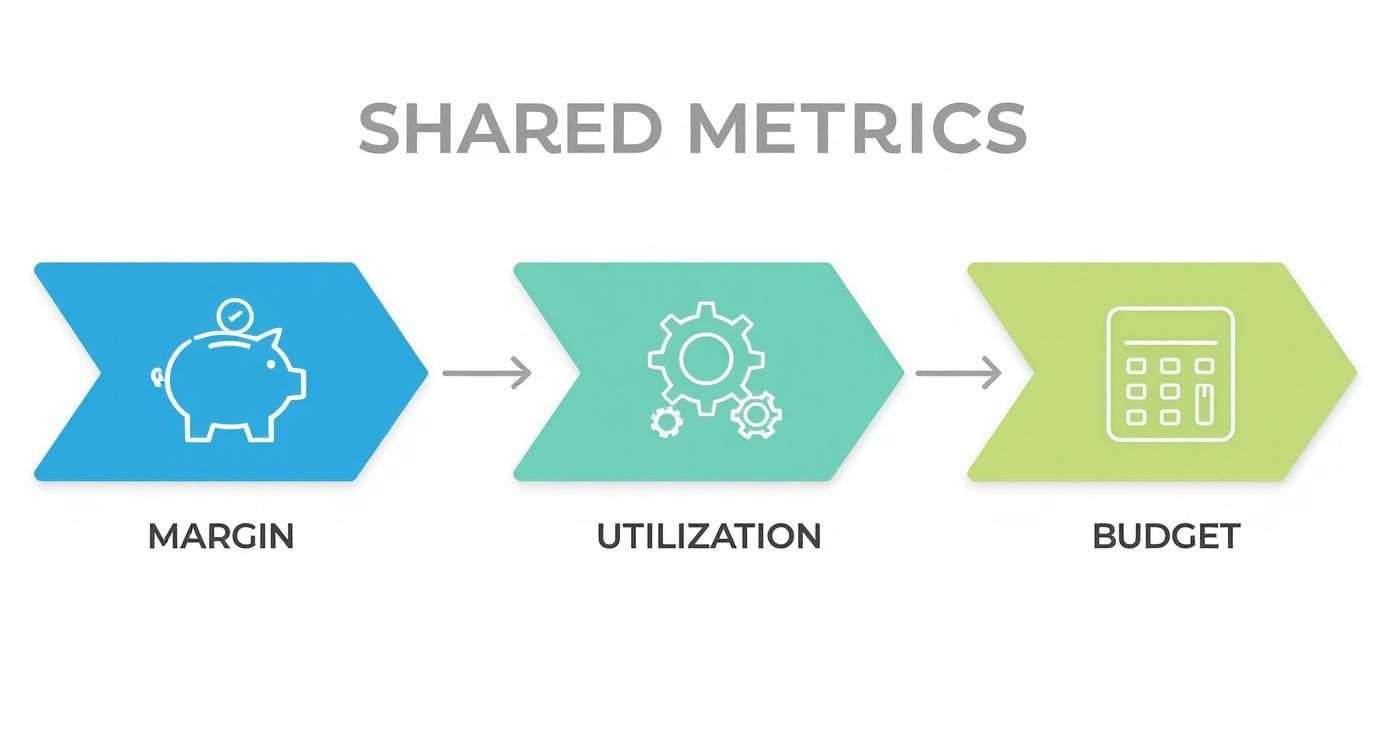
The visualization really highlights that a clear process connecting financial goals with operational execution is essential for keeping your business profitable.
Resource planning and revenue forecasting.
Finally, a truly connected workflow ties how you manage your team’s time with how you predict your company’s financial future. A project manager’s resource plan isn’t just a schedule; it’s a direct input for the finance team’s revenue forecast.
By designing workflows that ensure data flows effortlessly from one team to another, you’re building a more resilient, predictable, and profitable business model where everyone is working from a single, reliable source of truth.
This connection is crucial for strategic growth. Strong communication and financial acumen are no longer just nice-to-have “power skills.” In fact, PMI’s 2025 Pulse of the Profession report shows that when organizations emphasize these skills in their project teams, 72% of projects meet their business goals, a big jump from the 65% achieved by organizations that don’t.
Platforms with integrated time tracking and expense software make this possible by tying every logged hour back to a project and its budget. This allows finance to see forecasted revenue based on scheduled work, providing a clear and accurate picture of what’s coming down the pipeline.
Choosing the Right Tools for Unified Operations
All the smart workflows and shared metrics in the world won’t get you far without the right technology to power them. Relying on a messy patchwork of spreadsheets, single-purpose apps, and manual data entry is like trying to build a modern skyscraper with hand tools.
It’s just too slow, full of errors, and simply won’t scale.
The right software platform acts as the central nervous system for your business, making sure information flows instantly between your project teams and your finance department. This is where a truly unified approach to finance and project management really comes to life.
Moving beyond basic task management.
When you’re looking for a solution, it’s easy to get distracted by generic project management tools. They’re great at tracking tasks but completely ignore the financial side of the equation.
That’s a big miss for professional services firms. You need a platform built to manage the entire project lifecycle, from the initial proposal straight through to the final invoice.
Instead of just looking for features like Gantt charts and to-do lists, you should be focused on capabilities that directly connect operational activities to financial outcomes. This shift in perspective is key to choosing a tool that will actually improve your bottom line.
The goal is to find an elegant, all-in-one platform that replaces operational chaos with a single source of truth, empowering you to make informed decisions that drive growth.
Core features for profitable operations.
To make the right choice, you need to focus on the specific features that deliver the most value for firms like yours. These are the non-negotiables that form the foundation of a truly integrated system.
Look for a platform that nails these four key areas:
- Combined Project Planning and Budgeting: The tool must allow you to build a project plan and a budget in the same place. For instance, when you assign an engineer to a 10-hour task, the system should automatically calculate the labor cost against the budget, giving you real-time financial visibility from day one.
- Real-Time Financial Dashboards: Forget waiting for month-end reports. A unified platform needs to provide live dashboards showing key metrics like Project Margin, Budget vs. Actuals, and Resource Utilization. This lets PMs and finance leaders spot trouble long before it spirals out of control.
- Integrated Time and Expense Tracking: Your team should be able to track hours and submit expenses directly against specific projects and tasks. This kills the manual data entry for the finance team and ensures every single billable moment is captured accurately.
- Intelligent, Automated Invoicing: The system should automatically generate invoices based on completed milestones or approved timesheets. For example, once a PM approves the team’s weekly hours, a draft invoice should be ready for the finance team to review and send with just a few clicks.
Essential features of an integrated platform.
When you’re evaluating different tools, it helps to have a clear checklist of what matters most. Think of this as your guide to finding a platform that truly connects your project delivery with your financial performance.
| Feature Category | Key Functionality | Why It Matters for Profitability |
|---|---|---|
| Project Financials | Real-time budget vs. actuals tracking, margin calculation, cost management. | Instantly see if projects are on track financially, preventing costly overruns and protecting your margins. |
| Resource Management | Billable utilization tracking, capacity planning, skills-based scheduling. | Ensures your most valuable asset, your people, are deployed effectively on billable work, maximizing revenue. |
| Time & Expenses | Integrated timesheets, expense claims against projects, approval workflows. | Captures all billable activity accurately and speeds up the billing cycle, improving cash flow. |
| Billing & Invoicing | Automated invoice generation from timesheets, flexible billing models. | Drastically reduces administrative overhead and ensures invoices are accurate and sent out on time. |
| Reporting & Analytics | Customizable dashboards, profitability reports, client-level financial insights. | Provides the data-driven insights needed to make strategic decisions about clients, services, and growth. |
Having these features baked into a single platform isn’t just a “nice-to-have.” It’s the core of what allows a professional services firm to operate efficiently and scale profitably. The 2025 SPI Professional Services Maturity Benchmark found that Level 5 firms, those with the most integrated systems, outperform their Level 2 peers by +433% in revenue growth and +265% in EBITDA.
A powerful platform designed as a comprehensive consulting project management software will have these capabilities at its core. Platforms like Drum are specifically designed to bring these functions together, giving firms a clear, live view of project health and profitability without needing to jump between multiple, disconnected systems. Choosing the right tool isn’t just an IT decision; it’s a strategic business decision that underpins your ability to operate profitably and scale effectively.
Your Action Plan for a More Profitable Future
We’ve seen how disconnected systems quietly bleed profit from your business and touched on how shared metrics and smarter workflows can build a much more resilient firm. Now, it’s time to put it all together.
Getting your finance and project management teams on the same page isn’t just an efficiency play. It’s a strategic move that directly fuels sustainable growth and a healthier bottom line. The good news? This operational harmony is well within your grasp. It all starts with a clear, deliberate plan to move away from siloed data and toward a single source of truth.
Your step-by-step implementation roadmap.
Transforming how you operate won’t happen overnight, but you can start making real, tangible progress today. Here’s a simple, four-step roadmap to guide you toward a more connected and profitable future.
- Audit Your Current Pain Points: Get brutally honest about where the friction lies. Are invoices constantly late? Do your project managers fly blind when it comes to real-time budgets? Map out the specific manual workarounds, spreadsheets, and data gaps that are costing you time and money right now.
- Engage Key Stakeholders: Bring your project and finance leaders into the conversation early. Show them, don’t just tell them, how a unified system makes everyone’s life easier by killing off tedious tasks and serving up better data. Their buy-in is absolutely essential for a smooth transition and long-term success.
- Define Your Core Requirements: Based on your audit, build a no-nonsense checklist of what you actually need from a new tool. Focus on the essentials that solve your biggest headaches, like integrated budgeting, live dashboards, and automated invoicing.
- Evaluate the Right Tools: With your requirements in hand, start looking at platforms built specifically for professional services. A tool like Drum is designed from the ground up to unify the entire project lifecycle, from the first proposal to the final invoice. A purpose-built tool will always run circles around a patchwork of generic apps.
Adopting this integrated approach is more than just an operational upgrade. It’s a commitment to building a more predictable, transparent, and profitable business. It gives your teams the clarity they need to make smarter decisions, day in and day out.
You now have the blueprint to stop those slow profit leaks and start building a stronger foundation for growth. By taking these deliberate steps, you can create the operational harmony that turns good projects into great, profitable business.
Bringing finance and project management closer together always sparks a few questions. Let’s tackle some of the most common ones with real-world, practical answers.
How can we get teams to care about new metrics?
Let’s be honest, nobody gets excited about another dashboard. If you want your team to care about KPIs like project margin or utilization, you have to make it personal. The trick is to translate the numbers into something that directly impacts their work and success.
Instead of just dropping a margin percentage in a meeting, frame it in a way that matters to them. Try something like, “If we hit our target margin on this project, we’ll have the budget for that new software we’ve been wanting, plus we can invest in more training for everyone.” Suddenly, it’s not just a number; it’s a shared goal with tangible benefits.
What is the first step in aligning finance and project management?
Before you even think about new software or processes, do this one simple thing: get your finance and project leads in the same room. Seriously. Just start a conversation. Your only goal is to map out a single project’s journey, from the first quote all the way to the final payment.
As you walk through the process, you’ll naturally start to see where things fall apart. Where does information get dropped? Where is someone re-entering data that already exists somewhere else? You’ll quickly uncover the biggest headaches, whether it’s clunky invoicing or project managers flying blind on budget spend. This exercise isn’t about pointing fingers; it’s about building a shared understanding of the problem and getting everyone on board to fix it.
The goal isn’t to blame departments for existing friction. Instead, it’s to build a unified map that clearly shows where a smoother handoff or a shared piece of data could make everyone’s job easier and the business more profitable.
Do we need to replace all our tools?
Not always, but you absolutely need a single source of truth for your project and financial data. So many firms get bogged down trying to duct-tape together separate tools for accounting, time tracking, and project management. Even with integrations, it often creates a fragile system that’s just waiting to break.
This is exactly the problem a professional services automation (PSA) platform is built to solve. It centralizes all these functions, so when a timesheet gets approved, the project budget, the client’s next invoice, and your company forecast all update in real-time. It’s less about ripping and replacing everything and more about establishing a reliable operational hub that eliminates the mess of disconnected apps.
Ready to create that single source of truth for your firm?
Drum unifies your proposals, projects, time tracking, and invoicing into one simple platform, giving you the real-time visibility you need to drive profitability.
Start your free 14-day trial and see how it works.