
 Pipeline & Proposals
 Project Management
 Resource Planning
 Time & Costs
 WIP & Invoicing
 Commercial Reporting
 Consulting Engineers
 Architects
 Town Planners
 Building Designers
How to Improve Cash Flow for Your Agency: 8 Strategies That Actually Work

Ben Walker
Written for Drum

In This Article
How to Improve Cash Flow for Your Agency
Improving cash flow isn’t just about making more sales; it’s about speeding up the cash coming in and thoughtfully managing what’s going out. From my experience, the best strategies come down to two key things: accelerating your accounts receivable and completely rethinking your billing practices. It’s a constant balancing act between getting paid faster and spending smarter, and we’re here to help you nail it.
Why Healthy Cash Flow Is Your Agency’s Lifeline
If you run a professional services firm, you know this frustrating reality all too well: a signed contract doesn’t mean cash in the bank. That gap between delivering the work and actually getting paid is where so many agencies, from engineering and architecture to consulting and creative studios, hit their biggest financial roadblocks.
Think of cash flow as the oxygen your business needs to breathe. When it’s positive, you can cover payroll without breaking a sweat, invest in new talent, pay for software, and jump on growth opportunities. But when it’s negative, it’s a constant source of stress. You’re forced to delay payments, lean on credit, and make decisions out of survival instead of strategy.
This isn’t a rare problem. A staggering 82% of business failures are chalked up to poor cash flow management, and PYMNTS research found that 22% of US small businesses currently struggle to pay their bills due to cash flow issues alone.
This guide is your straightforward, friendly playbook. We’re skipping the MBA-level jargon and getting straight to the practical steps you can take today to build a more predictable, profitable firm.
This simple visual breaks down the process of spotting a cash flow blocker, understanding its real impact, and finding the right solution.
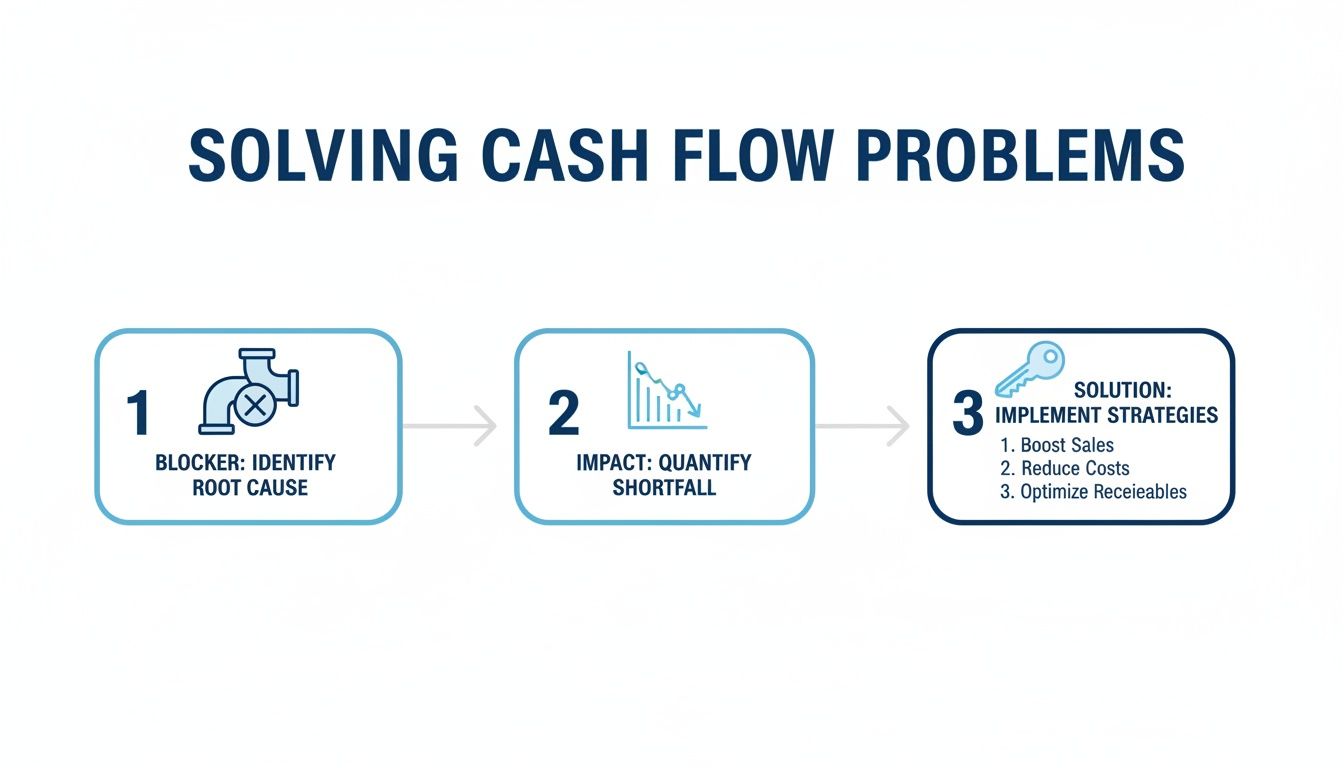
The key thing to remember is that every financial headache has a root cause and a corresponding fix you can apply.
You can’t fix what you can’t see. The first step toward healthier cash flow is getting a crystal-clear view of where your money is going and, more importantly, where it’s getting stuck.
Common cash flow blockers and their solutions. Here’s a quick overview of the most common issues professional services firms face with cash flow and the practical strategies we’ll cover to solve them.
| Cash Flow Blocker | Impact on Your Agency | Practical Solution We’ll Cover |
|---|---|---|
| Slow-paying clients | Forces you to use credit for payroll and operating costs, strains client relationships. | Implementing clear payment terms, offering early payment discounts, and automating reminders. |
| Inefficient invoicing | Delayed or inaccurate invoices mean you wait longer for payments and create client confusion. | Setting up recurring invoices, milestone billing, and using time-tracking to generate invoices instantly. |
| Unpredictable project scope | Scope creep leads to unbilled work, eating into your profit margins and delaying project completion. | Using detailed SOWs, retainers for ongoing work, and a clear change order process. |
| Poor resource planning | Over-staffed projects drain cash, while under-staffed projects lead to delays and unhappy clients. | Adopting resource forecasting tools to match team capacity with your project pipeline. |
| Delayed expense tracking | Unrecorded expenses give you a false sense of profitability and lead to surprise costs later on. | Implementing real-time expense capture tools and setting clear policies for reimbursement. |
Seeing these common threads helps you realize you’re not alone in these challenges. The good news is, they’re all solvable with the right systems in place.
Diagnosing Your Cash Flow Gaps for Quick Wins
Before you can fix the leaks, you have to find them. Improving your cash flow starts with playing detective in your own finances, pinpointing exactly where money gets stuck and, more importantly, why. Too many firms just feel the pain of a cash crunch without ever digging into the specific invoices, clients, or internal processes causing the gridlock.
This isn’t about firing up complex financial models. It’s about using the data you already have to find some quick, high-impact wins. A little focused investigation can reveal the bottlenecks so you can take action right away.
Uncover delays with your Cash Conversion Cycle. Your Cash Conversion Cycle (CCC) is a powerful number. It tells you, in days, how long it takes your firm to turn its work into actual cash in the bank. Think of it as the time from the moment your team starts a project to the day that client payment hits your account. A long CCC means your money is tied up for extended periods, creating a constant drag on your resources.
Calculating it is simpler than it sounds, and it gives you a clear benchmark. For service businesses, the most critical piece is your Days Sales Outstanding (DSO), which is just the average number of days it takes you to collect payment after sending an invoice.
A high DSO is an immediate red flag. For instance, if your standard payment terms are Net 30 but your DSO is hovering around 55, it means you’re effectively giving your clients an extra 25 days of interest-free credit. That’s a huge gap you can start closing immediately.
Pinpoint problem areas with an aging report. The single most practical tool for this financial detective work is your Accounts Receivable (A/R) Aging Report. This report is your treasure map. It shows you exactly who owes you money, how much they owe, and just how long each invoice has been sitting there unpaid.
But don’t just glance at the total. The real insights come from breaking it down into buckets:
- Current: Invoices within their payment terms (0-30 days).
- Slightly Overdue: Invoices that are 31-60 days past due.
- Moderately Overdue: Invoices that are 61-90 days past due.
- Seriously Overdue: Invoices that are 90+ days past due.
This simple breakdown instantly shines a light on your biggest problems. For example, you might discover that one large, otherwise wonderful client consistently pays 45 days late, strangling your cash flow. Or maybe a handful of small, old invoices are tying up thousands of dollars you’d mentally written off. The data doesn’t lie: the probability of collecting an overdue invoice plummets the longer it goes unpaid.
An A/R aging report isn’t just a list of late payments; it’s a diagnostic tool that tells you where your collections process is breaking down. It helps you shift from a reactive “where’s our money?” mindset to a proactive, strategic one.
Take immediate action with smarter reminders. Once you’ve identified the late payers, you need a plan. Firing off aggressive demands can wreck client relationships, but staying silent definitely won’t get you paid. The key is a friendly, professional, and systematic approach.
Start with a gentle reminder just before or on the due date. Once an invoice creeps into that 31-60 day bucket, it’s time for a more direct but still courteous follow-up.
Here’s a simple, effective email script you can adapt:
Subject: Quick Question About Invoice #1234
Hi [Client Name],
Hope you’re having a great week.
Just following up on Invoice #1234 for [Project Name], which was due on [Due Date]. I’ve attached another copy for your convenience.
Could you please let me know when we might expect payment? If you’ve already sent it, please just ignore this message.
Thanks so much, [Your Name]
This script is non-confrontational and simply opens the door for a conversation. You’d be surprised how often an invoice was just lost, overlooked, or sent to the wrong person.
Make getting paid effortless. Honestly, one of the biggest quick wins is just making it incredibly easy for clients to pay you. If your process requires them to dust off a checkbook, find an envelope, and locate a stamp, you’re creating friction that breeds delays.
Implementing an online payment portal is one of the most effective changes you can make. By embedding a simple “Pay Now” link directly on your digital invoices, you let clients pay with a credit card or ACH transfer in a few clicks. For example, a design agency we know started getting paid 10 days faster on average just by adding a payment link to their invoices. This simple tech shift removes a huge barrier and can accelerate your cash conversion cycle almost overnight.
Building Contracts and Billing for Faster Payments
Your contracts and billing processes are the front lines of your cash flow defense. We often get fixated on chasing late payments, but the real win is preventing those delays in the first place. This means getting proactive and structuring your agreements and invoices so that cash comes in consistently as you deliver value, not just at the very end of a long project.
Let’s be honest, the traditional “Net 30” invoice sent after all the work is done is an outdated model. It essentially forces you to act as a bank for your clients, financing their projects for a month or more. It’s time to build a system that supports your financial health from day one.

Tie payments to progress with milestones. For any project-based firm, milestone billing is a significant shift for your finances. Instead of waiting until a six-month engagement is totally wrapped up, you break the project into clear phases and send an invoice as each one is completed. Simple, right? But it completely changes your cash flow by aligning revenue directly with your team’s effort.
This approach doesn’t just inject cash into your business at regular intervals; it also fosters better client communication. It requires both sides to agree on what “done” looks like for each stage, which drastically cuts down on scope creep and those painful end-of-project disputes.
Here’s what this looks like in the real world for an engineering firm designing a commercial building:
- Milestone 1 (25%): Completion and sign-off on the initial site analysis and conceptual designs.
- Milestone 2 (30%): Delivery of detailed schematic designs and structural plans.
- Milestone 3 (30%): Finalization of all construction documents and permit applications.
- Milestone 4 (15%): Project completion and final handover.
By structuring payments this way, the firm covers its costs as it goes. It’s a powerful way to shorten your cash conversion cycle.
Create predictable revenue with retainers. For ongoing client work, nothing beats the stability of a retainer agreement. A retainer is simply a fee paid upfront for work you’ll perform over a set period. This creates a predictable, recurring revenue stream you can actually count on every single month. That predictability is the bedrock of strong cash flow management.
The trick is in how you position it. A retainer isn’t just about pre-paying for hours; it’s about the client securing dedicated access to your team’s expertise and ensuring their work gets priority.
Think of a marketing agency. They might have a monthly retainer that covers a defined scope, like managing social media, running ad campaigns, and delivering performance reports. This model shifts the entire conversation from hourly billing to the ongoing value and results you provide, which fosters a much stronger partnership.
Retainers transform your financial planning from a reactive guessing game into a proactive strategy. When you know exactly how much revenue is coming in each month, you can make confident decisions about hiring, investments, and growth.
Secure your position with upfront payments. I know asking for money before you start work can feel a bit uncomfortable, but it’s a standard and essential business practice. Requiring a deposit or upfront payment ensures you have cash on hand to cover initial project costs like software licenses, subcontractor fees, or just dedicating resources. It also gets the client financially committed, which seriously reduces the risk of them backing out after you’ve already invested time and effort.
A common and easily justified approach is asking for 30-50% upfront to officially kick off the project. You can frame it professionally right in your proposal:
“A 40% deposit is required upon signing to schedule the project kickoff and allocate dedicated team resources. The remaining balance will be billed upon project completion.”
This one clause protects you from shouldering all the initial financial risk and immediately improves your cash position before a single hour is logged. You can learn more about effective invoicing in our guide on invoicing in QuickBooks Online.
Accelerate payments by redefining “Net 30”. Finally, take a hard look at your standard payment terms. “Net 30” has become the default for so many firms, but there’s no law saying it has to be yours. Shortening your payment window is a direct lever you can pull to get cash in the door faster.
Shifting to Net 15 or even payment-on-receipt can make a huge difference to your Days Sales Outstanding (DSO). Some firms I know even offer a small incentive, like a 2% discount, for clients who pay within 10 days. For instance, on a $10,000 invoice, offering a $200 discount to get paid 20 days sooner is often a brilliant trade-off for your cash flow.
This change is all about clear communication. When you bring on a new client, state your payment terms clearly in the contract and on every single invoice. For existing clients, just give them a friendly heads-up about the policy change. You’ll be surprised how many clients are perfectly fine with shorter terms when it’s positioned as your standard from the very beginning.
Tightening Operations to Stop Revenue Leaks
Hidden cracks in your daily operations can quietly drain your cash reserves, one unbilled hour and one unreimbursed expense at a time. While your contracts and billing tactics set the stage for healthy finances, it’s the day-to-day processes that actually capture the value you create.
Tightening up these operational workflows is how you stop the slow, silent leaks that erode profitability and delay cash flow. A casual approach to time tracking or a clunky expense process might seem like minor issues, but they add up to a significant amount of lost revenue over the year. Let’s look at how to plug these gaps for good.

Capture every billable minute. In a professional services firm, your team’s time is your inventory. If you don’t track it accurately, you’re essentially giving it away for free. I’ve seen it time and again: inconsistent time tracking is one of the biggest and most common sources of revenue leakage.
When your team waits until Friday afternoon to fill out timesheets, they’re just guessing. They forget a quick 30-minute client call or underestimate the time spent on a design revision. A few of these small omissions from each person, every week, can easily add up to tens of thousands of dollars in unbilled work by year’s end.
The key is making time tracking a simple, real-time habit, not an end-of-week chore.
- Make it easy: Choose an intuitive tool that integrates with apps like Slack or your calendar. If logging hours takes more than a few clicks, they just won’t do it consistently.
- Set clear expectations: Establish a firm policy that timesheets are due daily. Crucially, explain why it matters for the firm’s financial health. It’s not about micromanagement, it’s about everyone getting paid for the great work they do.
- Connect it to projects: Every minute must be logged against a specific project or task. This doesn’t just ensure accurate billing; it gives you invaluable data on project profitability.
When your invoicing is powered directly by accurate timesheets, you close the gap between work performed and revenue collected. Our article on time tracking and expense software offers more ideas on getting this right.
Nail down your expense management. Just like unbilled time, unreimbursed project expenses are another common leak. Whether it’s specialized software licenses, travel costs, or third-party contractor fees, these costs should be passed on to the client promptly and accurately.
A messy expense process (think shoeboxes full of receipts and confusing spreadsheets) creates delays and errors. An expense gets forgotten, coded to the wrong project, or submitted too late to make it onto the correct invoice. When that happens, the firm often just eats the cost to avoid the hassle of re-invoicing a client.
Your goal should be to treat project expenses with the same urgency as billable hours. They are a direct component of your project cost and need to be captured and invoiced in real time to protect your margins and cash flow.
A modern expense management system is a straightforward fix. Team members can snap photos of receipts with their phones and submit them for approval instantly. This ensures all project-related costs are captured, tied to the right project, and ready for the next invoice cycle without any tedious manual entry.
Maximize your team with smart resource planning. Beyond tracking what’s already happened, improving cash flow means looking ahead. Resource planning is all about forecasting your team’s capacity and strategically assigning people to the right projects at the right time. Getting this right is crucial for maximizing billable hours and avoiding the financial drains of downtime or burnout.
When you don’t have a clear view of your team’s availability, you run into two very expensive problems:
- Under-utilization: Highly skilled (and expensive) team members sit on the bench between projects. That’s a direct hit to your bottom line.
- Over-utilization: Your star players are stretched thin across too many projects, leading to burnout, missed deadlines, and poor-quality work that requires costly rework.
Effective resource planning lets you see your project pipeline and team capacity in one clear view. You can spot who will be free in three weeks to start a new project or identify potential bottlenecks before they derail a delivery timeline. This proactive approach helps you maintain a high billable utilization rate, a core driver of revenue and cash flow for any service firm.
This is where a unified system makes a real difference. Implementing Professional Services Automation (PSA) software can dramatically improve cash flow by connecting these operational dots. Research shows firms adopting PSA solutions saw billable utilization rates climb by 8.2%, turning more hours into billable revenue faster. By automating time tracking, resource allocation, and real-time invoicing, these platforms eliminate the manual errors that cause revenue leaks. To dig deeper, you can explore the full research on PSA software benefits.
Forecasting Your Financial Future with Confidence
Improving your cash flow isn’t just about plugging leaks as they appear; it’s about looking ahead and preparing for what’s coming. Honestly, the real shift from a firm that just gets by to one that truly scales is moving from a reactive to a forward-looking mindset. And the best tool for that job is a simple, powerful cash flow forecast.
This doesn’t mean you need a finance degree or some complex modeling software. It’s about getting a clear, week-by-week picture of the money you expect to come in versus the money you know has to go out. Think of it as your early warning system. It’ll help you spot a potential cash crunch months down the road, giving you plenty of time to actually do something about it.
Building your 13-week cash flow forecast. So, why 13 weeks? It’s a magic number because it covers one business quarter. This gives you the perfect balance: it’s short-term enough for tactical decisions but long-term enough for a bit of strategic vision. It’s also a rolling forecast. Each week, you just add a new week to the end, keeping your financial horizon crystal clear.
Getting started is as simple as mapping out your inflows and outflows.
Expected Cash Inflows:
- Accounts Receivable: List every single outstanding invoice and make a realistic guess on when you’ll actually see the cash.
- New Business: Look at your sales pipeline. Which deals are likely to close? What are the initial payment terms on those contracts?
- Retainer Payments: This is the easy one. Plug in all the recurring revenue you know is hitting your bank account each month.
Expected Cash Outflows:
- Payroll & Contractor Fees: Usually your biggest and most predictable expense.
- Rent & Utilities: Those fixed costs that are easy to account for.
- Software Subscriptions: Don’t forget all those SaaS tools you’re paying for monthly or annually.
- Taxes & Loan Payments: These are non-negotiable, so get them in there.
When you lay this all out in a spreadsheet, you’ll immediately see which weeks look a little thin. If you spot a potential deficit in week nine, you now have two full months to handle it. Maybe you push to accelerate a few collections, or perhaps you just need to adjust a payment schedule with a vendor. No more surprises.
A 13-week forecast takes financial management from a guessing game to a data-driven strategy. It’s your roadmap for making confident calls on hiring, investments, and getting through slow periods without the stress of flying blind.
Key reports to keep on your radar. Beyond the forecast, there are a few key reports that feed you the data you need to make these smart, proactive moves. Reviewing them regularly helps you understand the health of your projects and the efficiency of your team, which are the real drivers of your cash flow.
It’s not just about when money comes in, but how efficiently you manage the money going out. Automating your accounts payable (AP) can be a massive win for service firms. The best-in-class teams that use AP automation process invoices for just $2.78 each, compared to $12.88 for everyone else. They also get it done in 3.1 days instead of 17.4 days, which means cash stays in your business longer. You can explore more on this in a 2025 analysis from Phoenix Strategy Group.
Monitoring project profitability and utilization. For any professional services firm, two of the most critical metrics are project profitability and billable utilization. These numbers tell you if your projects are actually making money and if your team is being used effectively.
-
Project Profitability Report: This report is your truth-teller. It breaks down the revenue, costs, and profit margin for every single project. You can quickly see which types of projects are your cash cows and which ones are barely breaking even (or worse). Armed with that info, you can start refining your pricing and focusing sales efforts on higher-margin work.
-
Billable Utilization Report: This one is all about efficiency. It shows what percentage of your team’s available time is spent on billable client work. A low utilization rate is a huge red flag. It could mean you have too much non-billable overhead, or your project pipeline can’t keep everyone busy.
These reports aren’t just for looking back at what happened. They feed directly into your forecast. If you see project margins starting to shrink, you can adjust your bids for future work. If utilization is dipping, you know it’s time to ramp up sales and fill the pipeline.
For a deeper look, check out our guide on tools for monitoring your firm’s financial performance. By making these reports a regular part of your financial review, you create a direct line between your day-to-day operations and your bottom line.
Even with the best game plan, specific questions always pop up when you’re in the trenches trying to get your firm’s finances on solid ground. Improving cash flow isn’t a one-and-done project; it’s an ongoing discipline. Let’s tackle the most common questions we hear, offering up some quick, clear advice for handling those familiar challenges.
What’s the first thing I should do if I anticipate a cash crunch? If your forecast is flashing a warning sign about a potential shortfall in the next few weeks, your first move is to pull up your Accounts Receivable (A/R) Aging Report. This isn’t the time for a big strategic meeting; it’s about taking immediate, decisive action.
Pinpoint your largest and oldest outstanding invoices and get on the phone. A friendly, professional call is worlds more effective than yet another automated email that’s easy to ignore.
At the same time, scan your upcoming expenses. Are there any big, non-critical payments you can push back without causing issues? Sometimes, a quick chat with a vendor to shift a payment date by a week or two is all it takes to bridge the gap. The secret is moving before the crunch hits, not after.
When you see trouble coming, your only priority is to speed up incoming cash and slow down outgoing cash. It’s a simple formula, but it demands quick, focused execution.
How do I handle a good client who consistently pays late? Ah, the classic agency dilemma. You love the client and the work, but their payment habits are a constant headache for your finances. The key here is to set professional boundaries without damaging the relationship.
First, have a direct but friendly conversation. It’s entirely possible their finance team is just on a different payment cycle and they have no idea it’s causing a problem for you. You could try something like this:
“We absolutely love working with you. Just wanted to mention that our standard payment terms are Net 15, which helps us manage project resources effectively. Is there anything we can do on our end to help get these invoices processed a bit quicker to align with your system?”
If a polite chat doesn’t move the needle, it’s time to build smarter terms into your next contract or SOW. A few options to consider:
- Require a retainer: This gives you a cash buffer to work with from day one.
- Move to milestone billing: This breaks payments into smaller, more frequent chunks tied to progress.
- Offer a small discount for prompt payment: A 2% discount for paying within 10 days can be a surprisingly powerful incentive.
By tackling the issue proactively and contractually, you can keep a great client and protect your cash flow.
Is it better to have more cash or higher profits? This question really gets to the core of financial management. While profit is the end goal, cash is the immediate lifeblood. It’s entirely possible to be a highly profitable company on paper and still go out of business because you don’t have enough cash on hand to make payroll. This is the critical difference between being profitable and being liquid.
Profit is a long-term measure of your business’s health and whether your pricing strategy is working. Cash flow, on the other hand, is the operational fuel you need to get through the day-to-day.
Here’s another way to think about it: Profit is the nutritional value of a meal, but cash is the oxygen you need to breathe. Both are vital, but you’ll feel the lack of oxygen a lot faster. The ultimate goal is to build a business that is both profitable and consistently cash-flow positive.
How often should I review my cash flow statement? For most professional services firms, a weekly review is the sweet spot. This rhythm lets you stay on top of receivables, keep an eye on upcoming bills, and make small course corrections before they turn into big problems.
A monthly review is almost always too late; a lot can happen in 30 days. By checking in weekly, you can see how your actual cash position stacks up against your forecast. This regular check-in turns cash flow management from a stressful, reactive chore into a confident, proactive habit that supports every strategic decision you make.
Ready to take control of your agency's finances and move from reactive problem-solving to proactive growth?
Drum is the all-in-one platform built for professional services firms to manage everything from proposal to payment. By unifying your projects, time tracking, and invoicing, Drum gives you the real-time visibility you need to improve cash flow and build a more predictable, profitable business.
See how it works by visiting and start your free trial today.