
 Pipeline & Proposals
 Project Management
 Resource Planning
 Time & Costs
 WIP & Invoicing
 Commercial Reporting
 Consulting Engineers
 Architects
 Town Planners
 Building Designers
Scope Management Plan: How to Define, Control, and Defend Your Project Boundaries

Ben Walker
Written for Drum
In This Article
A Practical Guide to Scope Management Plans
It’s easy to think projects fail because of some big, dramatic event, but the reality is often much quieter. The most common culprit is scope creep, that slow, insidious addition of features and tasks that weren’t part of the original plan. It silently eats away at your profitability and your team’s morale.
Why Scope Creep Is Silently Sinking Your Projects
Let’s be honest: many professional services projects go off the rails not because of a lack of skill, but from a total lack of clear boundaries. A simple “could you just…” from a client can seem harmless enough. But those small requests have a nasty habit of snowballing. Before you know it, you’re staring down blown budgets, a burned-out team, and clients who are somehow still disappointed.
This isn’t just an occasional headache; it’s a massive, industry-wide issue with serious financial consequences. The data paints a pretty grim picture. According to recent reports, a staggering 70% of projects are plagued by failure, with scope creep consistently named as a top reason. It gets worse. Poor scope definition leads to 52% of projects exceeding their budgets by at least 50%. You can read more about these project scope findings to see the full, eye-watering impact.
The real-world fallout of unchecked scope goes way beyond the numbers on a spreadsheet. It hits every single part of your firm’s operations and, eventually, its reputation.
Here’s what that actually looks like in practice:
- Eroding Profitability: Every unbilled hour spent on an out-of-scope task is a direct hit to your profit margin. For example, a consulting firm agreeing to “one more small revision” on a final report might not seem like a big deal, but across a six-month project, those “small” tweaks can add up to weeks of unpaid work.
- Team Burnout and Frustration: Suddenly your team is forced to work longer hours to meet deadlines that never accounted for all the extra work. This constant pressure leads straight to exhaustion, tanking morale, and ultimately, higher employee turnover.
- Strained Client Relationships: Ironically, trying to please a client with every small request often leads to bigger disappointments down the line. When timelines slip and the final invoice is much higher than expected, trust is broken.
The most effective way to build client trust isn’t by saying ‘yes’ to everything. It’s by establishing clear expectations and delivering exactly what you promised, on time and on budget.
This is precisely why a scope management plan is so critical. It isn’t just more paperwork; it’s your most vital tool for protecting your bottom line and ensuring your projects actually succeed. By proactively defining what’s in and, just as importantly, out of scope, you transform a potentially chaotic process into a predictable, profitable engagement. Learn more about managing scope creep in project management in our detailed guide.
Building Your Scope Management Plan From Scratch
Moving from the abstract fear of scope creep to taking concrete action is where the real work begins. Creating a scope management plan isn’t about adding layers of bureaucracy; it’s about building a rock-solid, shared understanding with your client from day one.
This is the foundational process that turns lofty project goals into an actual, actionable plan. For professional services firms in architecture, engineering, and creative fields, getting this right is non-negotiable.

This process is way more than a checklist. It’s about genuine alignment with your stakeholders to nail down requirements, draft a scope statement that leaves no room for doubt, and develop a Work Breakdown Structure (WBS) that makes even the most daunting project feel manageable.
Gathering and documenting project requirements is arguably the first and most critical part of this process. This is where you dig deep to understand what your client really needs, not just what they initially ask for. Vague requirements are the number one cause of scope disputes down the line, so the time you invest here will pay off tenfold.
Your goal is to translate your client’s vision into detailed, documented requirements. This isn’t just a kickoff meeting; it’s a structured discovery process.
- Stakeholder Interviews: Talk to everyone who has a vested interest in the project’s outcome. An architect might interview not just the developer but also the future property manager to understand long-term operational needs that could impact the design.
- Workshops and Brainstorming: Run collaborative sessions to uncover needs that weren’t obvious at first. A creative agency could facilitate a brand workshop to define the “vibe” and messaging goals for a new website, going far beyond a simple list of features.
- Surveys and Questionnaires: For bigger projects with lots of end-users, structured feedback can provide invaluable data. Think of an engineering firm surveying a community to understand traffic flow concerns before designing a new intersection.
The key is to document everything. A great idea shared in a conversation is just an idea; what’s written down and signed off on becomes a requirement.
Crafting a crystal-clear project scope statement is your next move. Once you have your requirements, it’s time to distill them into a formal Project Scope Statement. This document becomes the north star for your project. It needs to be so clear that anyone, from a new team member to the client’s CEO, can read it and know exactly what the project will deliver, and just as importantly, what it won’t.
Think of the scope statement as the constitution for your project. It’s the single source of truth that defines the boundaries of your work and the criteria for success, protecting both you and your client from misunderstandings.
Historically, project management has seen a lot of change. While agile methods shifted focus from rigid documents to flexible backlogs, waterfall approaches still dominate around 60% of professional services projects with fixed deliverables, like engineering bids. A major shift happened with the PMBOK 6th edition in 2017, which started emphasizing hybrid approaches. The data is compelling: scope verification through formal client sign-offs can slash project disputes by a remarkable 40%. You can learn more about how these frameworks have evolved by reading these insights on consulting project scoping.
This history lesson just reinforces how crucial clarity is in your scope statement. To get there, you need to include a few key components.
Essential components of your scope management plan. Your scope management plan is more than just a single document; it’s a collection of critical information that sets expectations. Here’s a breakdown of what every solid plan should include to keep your projects on the straight and narrow.
| Component | Purpose | Practical Example |
|---|---|---|
| Project Objectives | Defines the “why” behind the project. What business problem are you solving? | Instead of “Improve website,” use a measurable goal like “Increase online leads by 15% within six months of launch.” |
| Project Deliverables | Lists the tangible outputs the client will receive. | Be incredibly specific. “Architectural drawings” should become “A complete set of permit-ready architectural and structural drawings in PDF and DWG format.” |
| In-Scope Items | Clearly details everything included in the project. | For a new logo design, this might include “3 initial logo concepts, 2 rounds of revisions, and final files in AI, EPS, and PNG formats.” |
| Out-of-Scope Items | Explicitly states what is not included. This is your best defense against scope creep. | Be direct. For that same logo project, this could be “Brand guidelines, business card design, and website favicon are explicitly out of scope.” |
| Constraints & Assumptions | Documents any limitations (like budget or timeline) and things you’re assuming to be true. | An assumption could be, “Client will provide all final content and imagery within two weeks of request.” A constraint might be, “The project must be completed by November 30th.” |
| Acceptance Criteria | Defines how and when a deliverable will be considered complete and accepted by the client. | Tie criteria to deliverables. “The final logo is accepted upon written email approval from the project sponsor.” |
Putting this table together forces you to think through every angle, leaving less to chance and more to clear, mutual understanding.
Developing the Work Breakdown Structure is the logical next step. With your scope statement approved, the next move is to break the project down into smaller, more manageable pieces. This is your Work Breakdown Structure (WBS). A WBS is a hierarchical map of the total scope of work your team needs to deliver.
It’s not a task list or a schedule. Think of it as a map of all the work required to produce the project’s deliverables.
For an engineering firm designing a bridge, the WBS might look something like this:
- Bridge Design Project 1.1. Project Management 1.2. Feasibility Study 1.2.1. Site Analysis 1.2.2. Environmental Impact Assessment 1.3. Preliminary Design 1.3.1. Conceptual Sketches 1.3.2. Material Selection 1.4. Final Engineering 1.4.1. Structural Calculations 1.4.2. Geotechnical Analysis 1.5. Permit Application
Each level of the WBS adds more detail, giving you a solid foundation for assigning tasks, tracking time and expenses, and allocating your budget effectively. It’s how you transform your high-level scope into a concrete, actionable plan that your team can execute with confidence.
Defining Clear Deliverables and Gaining Client Buy-In
A plan is a great start, but its real value is in creating crystal-clear clarity for everyone involved. This is where we get out of the weeds of high-level objectives and into the art of defining tangible, measurable project deliverables.
It’s the difference between a vague promise and a concrete outcome. And it’s the absolute bedrock of a trusting client partnership.
The goal here is to shift from abstract requests to specific results. When a client asks for “a new website,” that’s just a starting point, not the destination. A well-defined deliverable sounds more like “a five-page responsive WordPress website with e-commerce integration for up to 50 products.”
One is wide open to interpretation and endless revisions; the other sets a clear, achievable target.
From vague ideas to tangible outcomes. Specificity is your best friend in scope management. Seriously. Vague deliverables are the number one cause of scope creep because they’re a breeding ground for assumptions. When you and your client have different mental pictures of the final product, disappointment is almost guaranteed.
To sidestep this, every major deliverable in your scope management plan should be described with enough detail to pass the “stranger test.” Could someone completely unfamiliar with the project read the description and know exactly what will be produced?
Here are a few before-and-after examples we see all the time in professional services:
- Vague: “Provide marketing materials.”
-
Specific: “Deliver a suite of marketing materials including a trifold brochure (print-ready PDF), a one-page sales slick (digital PDF), and three social media banner templates (Canva format).”
- Vague: “Consulting report on operational efficiency.”
- Specific: “A 25-page operational efficiency report in PDF format, including process maps for three core workflows and a prioritized list of five actionable recommendations with ROI estimates.”
This level of detail doesn’t just protect you; it gives the client immense confidence that you truly understand their needs and have a concrete plan to meet them. If you want to see how this kind of specificity translates into winning new business, check out our guide on how to write a compelling consulting proposal.
The power of formal acceptance criteria. Once you’ve nailed down what you’re delivering, the next critical step is defining how everyone will agree it’s done. This is where acceptance criteria come into play.
These are the specific, pre-agreed conditions that a deliverable must meet to be formally accepted by the client. Think of them as the quality control checklist for your project. They turn the dreaded “I’ll know it when I see it” into a simple, objective confirmation.
For that “five-page responsive WordPress website” deliverable, the acceptance criteria might look something like this:
- The website passes Google’s Mobile-Friendly Test on both a smartphone and a tablet.
- All five core pages (Home, About, Services, Blog, Contact) are populated with client-provided final content.
- The e-commerce functionality can successfully process a test transaction using the provided payment gateway.
- The client provides written sign-off via email after a final review.
Establishing acceptance criteria upfront transforms project sign-off from a potentially emotional, subjective discussion into a straightforward business process. It’s not about being rigid; it’s about creating a shared understanding and celebrating milestones together.
This structured process of validation and control is fundamental to project success. For marketing agencies and design studios, profitability insights show that a staggering 75% of underperforming projects stem from untracked scope variances. However, firms that use real-time dashboards to monitor scope can boost their project margins by as much as 17%.
These formal processes, which align with PMBOK standards, also prevent about 35% of quality failures. The results are clear: a 2022 survey found that teams with formal plans hit 92% on-time delivery, compared to just 65% for those winging it. You can discover more insights about project scope management to see the full impact.
Securing client buy-in at key milestones. Getting client buy-in isn’t a one-and-done event at the kickoff meeting. It’s an ongoing conversation, a process of communication and validation that should happen at every key project milestone.
Getting formal client sign-offs when you complete major phases isn’t a bureaucratic hurdle. It’s an essential alignment check.
This simple practice ensures you and your client are on the same page before you pour time and resources into the next phase. It prevents that gut-wrenching moment where a client sees the final product and says, “This isn’t what I imagined at all,” forcing you into costly, unbilled rework.
A simple sign-off process could look like this:
- Phase Completion: You deliver the “Final Wireframes” for the website project.
- Review Period: The client has an agreed-upon window (say, three business days) to review and provide consolidated feedback.
- Approval: Once any revisions are handled, the client sends a simple email: “We approve the final wireframes and are ready to move to the visual design phase.”
This written approval becomes part of the project record. It confirms the deliverable met the acceptance criteria and the project is on track. It’s a simple but powerful way to build trust, maintain momentum, and ensure the final outcome is a win for everyone.
How to Handle Changes Without the Chaos
Let’s be honest: no project plan survives first contact with reality. No matter how perfectly you map everything out, change is going to happen.
A client’s priorities might shift, the market could zig when you expected it to zag, or a new opportunity pops up mid-project. The real difference between a successful project and a chaotic one isn’t trying to avoid change; it’s having a clear, professional process to manage it.
This is where a change control process becomes your best friend. It’s not about building bureaucratic walls to stop new ideas. It’s about creating a simple, predictable path to evaluate and implement changes without blowing up your timeline or budget.
When you explain this process at the start of a project, everyone knows exactly what to do when something unexpected comes up. It turns a potential point of conflict into a calm, structured conversation.
Establishing a clear change request workflow. The heart of good change management is a straightforward workflow. When a client or even a team member has an idea that’s outside the agreed-upon scope, they need a formal way to bring it to the table. This is how you stop those “hallway requests” from quietly bloating the project.
A simple change request workflow gives you structure and makes sure every new idea gets properly evaluated. This doesn’t need to be complicated to be effective.
Here’s a practical, four-part workflow you can adapt:
- Submission: The person with the idea (usually the client) fills out a simple Change Request Form. This form should capture what the change is, why it’s needed, and what business value they expect it to deliver.
- Initial Review: The project manager takes a quick look at the form to make sure it’s complete. They’ll make an initial call: is this a minor tweak or a major deviation from what we agreed to?
- Impact Analysis: This is the most critical step. The project manager assesses how the request will affect the project’s key constraints: scope, timeline, budget, and resources.
- Approval or Decline: Armed with the impact analysis, the request is presented to the key decision-makers (like the project sponsor or client lead) for a final thumbs-up or thumbs-down, which is then formally documented and communicated.
A formal change control process isn’t about saying “no.” It’s about creating a structured way to say “yes” without jeopardizing the project’s success. It protects your team, manages client expectations, and keeps everyone focused on the original goals.
This infographic gives a high-level view of the client buy-in process, which is the foundation you need before you can even start managing changes effectively.
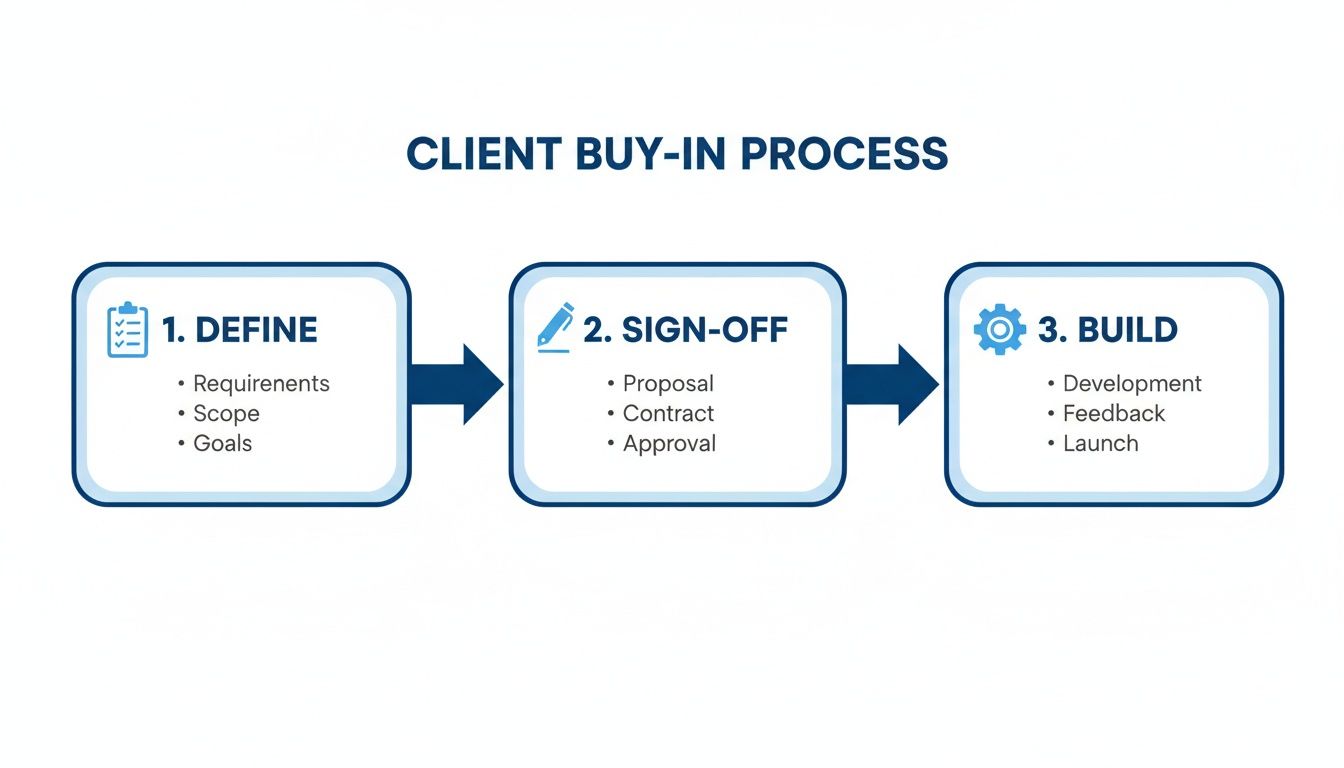
This visual really drives home the point that clear definitions and formal sign-offs are the prerequisites for controlled project execution and, by extension, controlled change management.
Distinguishing valid changes from scope creep. A key skill for any project manager is learning to tell the difference between a valid, value-adding change and classic scope creep. One helps the project succeed; the other slowly eats away at your profitability and focus. The difference usually comes down to intent and impact.
Imagine a marketing agency building a new website for a client.
- Valid Change Request: Halfway through the build, the client’s industry gets hit with a new data privacy regulation. The client submits a formal request to add a compliance banner and update the privacy policy page. This change is necessary, adds clear value, and its impact can be assessed in terms of extra hours and a revised launch date.
- Scope Creep: During a design review, the client casually says, “You know, it would be great if we could also add a blog section with five articles ready to go at launch.” This was never discussed, it’s not in the scope document, and it’s being presented as if it’s a minor addition. Without a formal change request, this is scope creep that could easily add weeks of unbilled work.
Your scope management plan gives you the framework to handle both of these situations like a pro.
For the valid change, you follow your process. For the scope creep example, you kindly guide the client back to that process. You might say, “That’s a great idea! Let’s get that submitted through our change process so we can properly evaluate the timeline and budget impact for you.” This approach protects your project’s boundaries while keeping the client relationship strong.
Putting Your Scope Management Plan into Action
A meticulously crafted scope management plan is a fantastic start, but its true power is unlocked when it moves from a static document into the living, breathing heart of your daily operations. A plan sitting in a shared drive is just theory; a plan integrated into your workflow is what drives profitability and success.
This is where we connect your scope management plan to the real world using a Professional Services Automation (PSA) platform. It’s about turning all that careful planning into tangible action and, more importantly, into a reliable system for tracking progress and protecting your margins.
From WBS to actionable project tasks. Your Work Breakdown Structure (WBS) is the perfect blueprint for your project. To make it truly work for you, though, you need to translate its components into actual tasks, assign them to your team, and track the time spent against them. Doing this creates a powerful, direct link between the planned scope and the real work being done.
Think about an architectural firm designing a new commercial building. Their WBS might have a major deliverable like “Schematic Design Package.” In a PSA, this isn’t just a line item; it becomes a parent task with sub-tasks:
- Task: Develop Floor Plans (Assigned to: Lead Architect, Budget: 40 hours)
- Task: Create 3D Massing Models (Assigned to: Junior Architect, Budget: 25 hours)
- Task: Select Preliminary Materials (Assigned to: Interior Designer, Budget: 15 hours)
Each team member logs their hours directly against these specific tasks. This simple action provides immediate, granular insight. You’re no longer just guessing if you’re on track; you have real-time data telling you exactly how much of your budgeted time has been consumed for each part of the scope.
Gaining real-time visibility into scope variances. One of the biggest headaches in scope management is the lag between when work is done and when you realize you’re over budget. With disconnected spreadsheets and manual time tracking, you might not spot a scope variance until you’re doing month-end reporting, far too late to do anything about it.
This is the operational gap that modern PSA tools are designed to close. They provide real-time dashboards that visualize project health at a glance.
The goal is to spot scope variances the moment they happen, not weeks later. Real-time data allows you to be proactive—to have a conversation with a client about a change request’s impact today, rather than explaining a budget overrun next month.
Here is an example of a project dashboard that provides this kind of instant visibility.

This kind of dashboard immediately shows how actual hours are tracking against the budget, highlighting potential issues before they escalate. It transforms project management from a reactive, backward-looking exercise into a proactive, forward-looking strategy. For a closer look at turning plans into results, explore our guide on creating a project execution plan.
Creating a connected scope-to-invoice workflow. Ultimately, the success of your scope management plan hinges on your ability to deliver and bill for precisely what you sold. Disconnects between your sales proposals, your project management, and your invoicing are where revenue and client trust go to die.
An integrated system ensures the scope you defined in your proposal automatically becomes the foundation of your project plan.
- Proposal to Project: When a client signs your proposal, the defined services and deliverables can be converted into a project structure with a single click. The budget you quoted becomes the project’s financial baseline.
- Time Tracking to Invoice: As your team tracks time against project tasks, those billable hours are automatically compiled. When it’s time to invoice, you can generate an accurate invoice based on the approved work, complete with detailed timesheets if needed.
This closed-loop process eliminates the costly gaps in communication and manual data entry that lead to billing errors and client disputes. It ensures that every hour of approved work is captured, billed, and contributes to your bottom line. By operationalizing your scope management plans this way, you create a reliable, scalable system that protects your team, delights your clients, and drives sustainable growth for your firm.
As you start putting these ideas into practice, some questions always come up. It’s totally normal to wonder how these concepts fit into your day-to-day reality. Let’s tackle a few of the most common ones we hear from firms just like yours.
Think of this as bridging the gap between the textbook theory and what actually happens on a Tuesday afternoon when a client calls with a “small change.”
How do you manage scope in an Agile project? This is a great question because, on the surface, Agile seems to throw traditional scope management out the window. And in a way, it does. Instead of a rigid, signed-in-blood plan upfront, scope in an Agile project is fluid and managed through a product backlog.
You still have an overall vision for the project, but the specific features get prioritized and built in short bursts called sprints. In this world, your scope management plan is really about how you manage that backlog.
- How do new ideas and user stories make it into the backlog?
- Who has the final say on prioritizing what’s next? (Hint: It should be the Product Owner).
- How are items estimated and vetted before the team commits to them in a sprint?
Change isn’t just accepted here; it’s a core part of the process. The trick is that while the details are flexible sprint-to-sprint, the overall project direction is still carefully controlled through release planning and constant feedback from stakeholders.
What is the difference between a project scope statement and a scope management plan? It’s easy to get these two confused, but they have very different jobs.
Think of it like this: the Project Scope Statement is the ‘what’. It’s a detailed description of the project’s destination—the deliverables, boundaries, and what success looks like.
The Scope Management Plan is the ‘how’. It’s the rulebook for the journey. It dictates how you’ll define, validate, and control the project’s scope from kickoff to closeout. The scope statement is just one of the critical documents you create by following the process laid out in the scope management plan.
One is the treasure map (the statement); the other tells you how to read the map and what to do when you run into pirates (the plan).
How can a small firm use a scope management plan without creating bureaucracy? For smaller firms, the aim is consistency, not complexity. You absolutely don’t need a 100-page manual to be effective. The goal is to create a lightweight process that focuses only on what matters.
Start with the basics. Create a simple, reusable template for your Scope Statement and a one-page change request form. Honestly, the process is far more important than the paperwork. Your real focus should be on:
- Defining ‘in’ vs. ‘out’ clearly in every single proposal you send.
- Mapping out a high-level Work Breakdown Structure (WBS) to guide how you create tasks for the project.
- Having a simple, agreed-upon rule for how any change gets handled—even if it’s just a formal email chain for approval.
This doesn’t have to feel like red tape. Using a lightweight PSA tool can automate a lot of this, turning what feels like bureaucracy into a smooth, professional workflow that protects your team and your bottom line.
A great scope management plan needs a great system to back it up.
gives you the tools to turn your plan into action, connecting your proposals, projects, time tracking, and invoicing in one place. Stop scope creep before it starts and see exactly how profitable your projects are in real-time.
Start your free 14-day trial today.