
 Pipeline & Proposals
 Project Management
 Resource Planning
 Time & Costs
 WIP & Invoicing
 Commercial Reporting
 Consulting Engineers
 Architects
 Town Planners
 Building Designers
5 Best Accelo Alternatives for Professional Services in 2026

Ben Walker
Written for Drum
In This Article
Looking for an Accelo alternative in 2026? You are in good company. Plenty of professional service firms are quietly shopping around, and two recent changes have sped up the search: Accelo has moved its pricing behind a custom quote, and it still has no native MYOB connection for Australian businesses.
This guide compares the five strongest Accelo alternatives for professional service firms, with current pricing, honest pros and cons, and a clear view of who each one actually suits. We will start with what to look for, because choosing your operations platform is a five-to-ten year decision, not a quick swap.
Why firms start looking for an Accelo alternative
Accelo is a capable platform. It chains your CRM, projects, time and billing together, and for the right firm that breadth is genuinely useful. So why do so many directors go hunting for a replacement?
The complaint that comes up most often is complexity. Across G2’s Accelo reviews and Capterra, the steep learning curve and lengthy setup are the most consistent themes, with implementations measured in months rather than weeks. If your team finds the system daunting, they quietly retreat to spreadsheets, and you lose the single source of truth you were paying for.
Pricing is the second sticking point, and it just got sharper. Accelo no longer publishes per-user prices at all. Its pricing page now reads “request a custom quote,” so you cannot compare costs without talking to sales, and historically the per-user, per-module model has climbed steeply as you add staff and features.
For Australian firms there is a third, very practical gap. Accelo integrates natively with Xero and QuickBooks Online, but not with MYOB, so MYOB AccountRight or Business users are pushed onto third-party connectors. If your accounts team lives in MYOB, that matters from day one. Add the commonly cited reporting limitations (finance leaders often end up “filling the gaps in spreadsheets,” as Scoro’s analysis of Accelo alternatives puts it) and the case for looking elsewhere writes itself.
What a real Accelo alternative needs to do
Before you compare logos, get clear on what good looks like. The biggest lever you can pull is finding one system that becomes your firm’s genuine single source of truth, so nothing falls through the gaps and every staff member knows exactly where to go. Here is what that demands.
A complete commercial lifecycle. The best Accelo alternative should carry you from enquiry to fee proposal to active project, time tracking and invoicing without you bolting on separate tools. When your proposal structure becomes your project structure automatically, you stop rekeying data and your budgets stay honest.
Deep Australian finance integration. Your platform should push invoices, purchase orders and supplier bills straight into Xero, MYOB or QuickBooks, sync contacts without creating duplicates, and update payment status both ways. This is exactly where Accelo’s missing MYOB connection hurts local firms.
An interface your team will actually use. Fast page loads, easy time entry, and a layout new hires can learn in a morning. If the software is slow or dense, adoption collapses and so does your data quality.
Tiered permissions and real-time insight. Directors and finance should see everything; project managers see their work; operational staff see only what they need. And the financial picture (future revenue, billable utilisation, project profitability) should update live as the team works, not after a painful end-of-month spreadsheet marathon.
A migration team that does the heavy lifting. Importing clients, projects, rates and templates is a real project. The right partner identifies the data you need, shares a training plan, and stays on a short communication loop while you settle in.
The 5 best Accelo alternatives in 2026
Here is how the five alternatives stack up at a glance, then a detailed look at each.
| Alternative | Best for | Native Xero / MYOB / QBO | Pricing model | Built-environment fit |
|---|---|---|---|---|
| Drum | Australian built-environment consultancies | Xero, MYOB and QuickBooks | Per user, transparent | Purpose-built |
| WorkflowMax by BlueRock | AU/NZ practices on Xero | Xero, QuickBooks (MYOB via connector) | Tiered, 10-user min on top plan | Broad job management |
| Synergy by Total Synergy | AEC design firms | Xero, MYOB, QuickBooks | Quote on request | Purpose-built (AEC) |
| Projectworks | Consultancies wanting open pricing | Xero, MYOB, QuickBooks | Published, 10-user min | Good |
| ClickUp | Generalist task management | None (Zapier only) | Per user, AI is an add-on | Weak |
Alternative #1: Drum.
The five pillars above are the foundations Drum is built on, which is why we believe it is the strongest Accelo alternative for Australian professional service firms in 2026. Drum is a real-time operations platform for consulting engineers and built-environment consultancies, and unlike most tools on this list it was built in Australia, for the way these firms actually work.
What you can do in Drum:
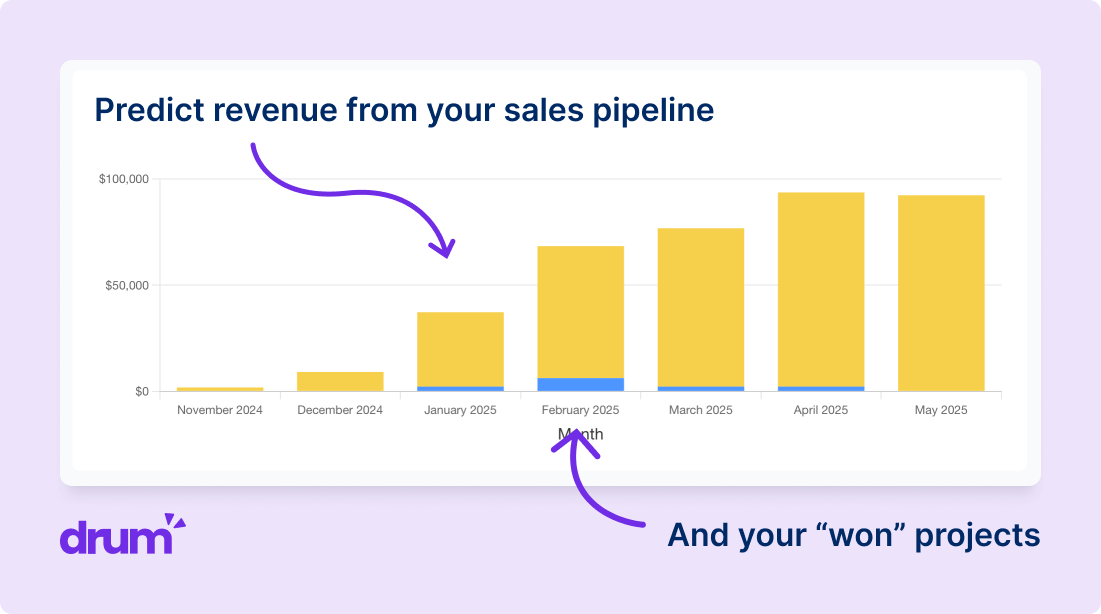
Run your whole pipeline and proposals in one place. Enter opportunities by hand or forward enquiry emails straight to your Drum sales inbox, where Drum Composer turns them into sales opportunities for you. From there you assign owners, deal values and key dates, and Drum projects your future revenue automatically. When you win, your fee proposal structure flows directly into the project, so you are never rebuilding the job from scratch.
Manage projects and budgets that update live. Build your project from the proposal or a template, allocate staff to phases and tasks, and watch the budget move in real time as time and costs land. Raising a purchase order for a subcontractor is as simple as changing a status field, with the right permissions.
Track time without nagging your team. Each person gets their own timesheet showing only the projects they are on, so time tracking is quick enough that people actually do it, and your project health stays accurate.
See your numbers and invoice in minutes. Invoice from the original amount, a percentage of budget, a fixed sum or unbilled time and costs, then push it into Xero, MYOB or QuickBooks by changing a status. Drum keeps a two-way connection, so you are never hopping between systems to check what has been paid.
Where Drum wins against Accelo specifically: transparent per-user pricing, native MYOB alongside Xero and QuickBooks, a genuinely intuitive interface, and consultative, pain-free migration with ten-minute live chat support from real humans.
Book a product demo with the Drum team and we will look at your current setup, what you are trying to achieve, and whether Drum is the right fit.
Alternative #2: WorkflowMax by BlueRock.
WorkflowMax has a twist worth knowing. The original product, owned by Xero, was retired on 26 June 2024, and the brand was acquired and rebuilt from the ground up by Australian firm BlueRock, which launched “WorkflowMax by BlueRock” on 21 February 2024. The new platform is a fresh codebase, not the old one, which is why some long-time users report missing features from the original.
It covers job and project management, quoting, timesheets and budgeting, with its flagship strength being deep, native Xero integration on every plan (plus QuickBooks Online). MYOB users generally rely on a connector rather than a native sync. Pricing starts from around AUD $36 per month on Standard and AUD $97 per month on Premium for a single user, with a per-user Advanced plan that requires a minimum of 10 users, per its pricing page.
The common gripes on Capterra are a dated interface and basic reporting with limited forecasting. WorkflowMax is a very broad product that tries to do a lot for a lot of different industries that have very different ideal flows.
If you want to dig into the local angle, we cover it in detail in our guide to Australian WorkflowMax alternatives.
Alternative #3: Synergy by Total Synergy.
Synergy is the most directly comparable tool to Drum on this list, because it is also Australian-built and purpose-made for the architecture, engineering and built-environment (AEC) sector. It handles project management, project accounting, timesheets and resourcing, and it has been refined for design firms since 1999.
Synergy integrates natively with Xero, MYOB Business and QuickBooks Online, which is a genuine plus for local firms. Total Synergy has recently moved its public pricing behind a demo request and it has multiple “modules” with add-on pricing, compared to Drum’s simpler pricing.
The most cited drawbacks are a steep learning curve and complex setup, plus documented reconciliation discrepancies when syncing with the legacy MYOB AccountRight, and resourcing that some users find clunky. If you are weighing the two directly, we go deeper in our Total Synergy alternative comparison.
Alternative #4: Projectworks.
Projectworks is a New Zealand-built professional services platform covering time tracking, resourcing, project budgeting, forecasting and invoicing. It is a serious player, having raised USD $12 million in mid-2025 to expand, and it earns strong reviews (4.7 on Capterra) particularly for its Xero billing, where approved timesheets pre-populate invoices.
Refreshingly, Projectworks publishes its pricing openly: roughly USD $17 to $41 per user per month billed annually, with native Xero, MYOB and QuickBooks on the entry plan. The catches are a 10-user minimum, seats sold in blocks of five, and onboarding fees from around USD $1,000.
Reviewers note that resourcing and forecasting are input-intensive and the timer UX takes a few too many clicks. Its sales pipeline and fee-proposal tooling are also lighter than Drum’s. For a side-by-side, see why firms choose Drum as a Projectworks alternative.
Alternative #5: ClickUp.
ClickUp is the wildcard. It is a powerful, highly customisable general work-management tool, and with enough setup you can shape it into something that runs parts of a service firm. It is also the cheapest on paper, at USD $7 per user per month for Unlimited and USD $12 for Business, per its pricing page.
The catch is that ClickUp is not a purpose-built PSA. There is no native client invoicing, no accounting ledger, and no native Xero, MYOB or QuickBooks connection (you stitch those together with Zapier or Make). Its AI, ClickUp Brain, is a paid add-on on top of your plan. Reviewers also flag feature bloat, a real learning curve, and slowdowns at scale. For a built-environment firm that needs project financials and tight accounting integration, that is a lot of assembly required.
Which Accelo alternative is right for you
Different firms should land in different places, so here is the honest version.
If you are an Australian built-environment consultancy (architects, consulting engineers, town planners, surveyors or building designers) that wants one fast platform for the full enquiry-to-invoice lifecycle with native MYOB and Xero, Drum is built specifically for you. If you are a broad AU/NZ practice already deep in Xero and happy with a more traditional job-management feel, WorkflowMax is worth a look. If you are an AEC design firm that wants another purpose-built option and can absorb a steeper learning curve, Synergy deserves a place on your shortlist. If transparent pricing and forecasting top your list and a 10-user minimum is fine, Projectworks is a strong pick. And if you are a generalist team that mainly needs flexible task management and will handle billing elsewhere, ClickUp can work.
To recap, the right Accelo alternative should consolidate your pipeline and projects, show clear real-time budgets to your management team, stay simple enough that your staff actually use it, integrate deeply with your Australian accounting system, and come with a support team that makes migration feel easy. We built Drum to cover every one of those bases for built-environment firms, and we would love to show you.
Book a demo with the Drum team and let’s see if Drum is the right fit for your firm.
Accelo alternatives: your questions answered
What is the best Accelo alternative for Australian firms? For Australian built-environment consultancies, Drum is purpose-built, integrates natively with Xero, MYOB and QuickBooks, and publishes transparent per-user pricing. Synergy and Projectworks are also strong, locally relevant options.
Why is Accelo’s pricing hard to compare? Accelo no longer publishes per-user prices. Its pricing page now asks you to request a custom quote, so you have to speak with sales to get a figure, unlike Projectworks and ClickUp which publish theirs openly.
Does Accelo integrate with MYOB? Not natively. Accelo connects directly to Xero and QuickBooks Online but relies on third-party connectors for MYOB, which is why MYOB-based firms often look for an Accelo alternative with native support.